2014 as we saw it…

The Earth and all her sciences were a big deal in 2014. Although this blog – the Mountain Mystery Blog – started in May 2014, it still caught some of the best stories of the year. In chronological order, here are links to some of this blogger’s favourites:

Posted in Culture, History | Tagged | Leave a comment

Has Cuba Got Oil?

Havana lawyer, Dr Fidel Castro, in Washington DC, 1959.

Havana lawyer, Dr Fidel Castro, visiting Washington DC in 1959.

Besides sunshine and sugar cane, what has Cuba got? It looks like the USA is serious about letting Americans party along Havana’s beaches and carry home a cigar or two. It has long bemused me that two of the continent’s closest neighbours have been isolated for two generations, with nary a neighbourly howdy between them. I can understand the American disdain when Castro turned to Russia for help and converted his island into a Communist dictatorship instead of a socialist democracy. But I can also see the point that others have made – sometimes an obstreperous foe’s behaviour changes more quickly by talking rather than isolating.

Let's concentrate on geology

Let’s concentrate on geology

This geology blog tends to steer clear of politics, so instead of pitching my three cents worth of non-expert opinion about embargoes vs free trade, I thought I’d write a few words about Cuba’s major oil fields. There really aren’t any elephants – not yet. Some readers may be surprised by the fact that the politics of oil exploration seems to play no role at all in the new American-Cuban detente.

Cuban village

Cuban village life south of Havana

Three geologists whom I know – Canadians working for three different companies – have spent time exploring Cuba’s subterranean oily treasures. They discovered very little oil, though one found a wife and settled into village life south of Havana. Nevertheless, there is oil within Cuba’s domain – the US Geological Survey estimates billions of (mostly offshore) barrels are awaiting discovery. Unfortunately, after drilling deeply in 2012 just off the north Cuban coast, hopes for the discovery of big oil fields were dashed. At least for now.

Things that make an oil field include source rock (usually oily shale), porosity (fractures and cracks that deliver hydrocarbons to the well), and traps (which can be ancient buried reefs, sand bars, pinched thrust sheets, or a bunch of other structures). There’s much more to an oil field than this, of course, but without a source, porosity, and trap, you’d better keep your derrick stashed in the shed at home. The things that make an oil field economical are the cost of production (depth of well, rock type, existing infrastructure), nearness to market, and the rule of law within the jurisdiction. How does Cuba stack up among these?

Well, all the elements that could create a profitable oil field actually exist in Cuba. The country itself has amazingly varied geology with plenty of source rock and plenty of traps buried in its highly structured geology, although the porosity element is sometimes problematic. Oil seeps were discovered centuries ago – strangely, though, the oil drips from igneous rocks, not the typical sedimentary limestones and sandstones that usually host hydrocarbons. An American Association of Petroleum Geologists’ 1932 paper, Occurrence of Oil in Igneous Rocks of Cuba, estimated that over 200 million barrels of “asphalt grade” oil was locked in rock along the north-central Cuban coast. In places, the heavy oil seeps from intrusive diorite dikes which have cut through 1,500 feet (500 metres) of oily Jurassic limestone and shale. All of this bode poorly for the explorers of the 1930s and it still does today. It means the hydrocarbon setting is complicated and unpredictable – and much of the oil itself is not much better than low-grade tar.

Regardless the US Geological Survey’s prediction of massive potential, Cuba has been energy-starved for a century. To fix this, Cuba famously entered into a deal with Venezuela, shipping well-regarded Havana-trained doctors south in exchange for South American oil. This worked well enough as long as Hugo Chavez was alive, but the flow may be stanched. Cuba needs to pump its own oil. Consumption has been around 155,000 barrels per day; production is one-third that. The shortfall has been purchased or bartered from Russia and Venezuela, but this creates a foreign expense of $5 million dollars a day – about $0.50/person in a country where daily income (GDP/pop) is a dismal $6. Both Russia and Venezuela are former big-bucks oil-ogarchies and were generous benefactors when oil prices were high. But things have changed. Those former sugar daddies have turned into sugar duds.

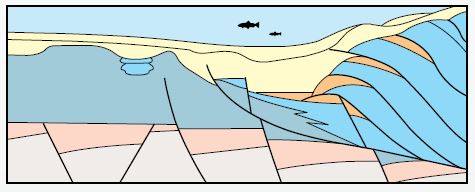
A Dog's Breakfast of geological puzzlement - USGS Cuba Structure Schematic

Dog’s Breakfast of Geology – USGS Cuba Structure Schematic

With the help of seasoned foreign geologists, Cuba has tried to produce its own oil. A very capable Canadian company – mining giant Sherritt International – explores and develops much of the country’s onshore oil. Sherritt is the largest independent oil producer in Cuba. But there is not an enormous amount of onshore oil. The real prize is waiting off the north coast – that’s where the USGS estimates 4.6 billion barrels of oil will eventually be produced. (The Cuban government claims the number is 20 billion barrels – but they are looking for investment partners.) Deep sea oil is not seeping to the surface – it is locked in rock deep below the ocean floor. Even though Cuba is near huge deep-water oil fields in the Gulf of Mexico, the geology under Cuba’s waters is remarkably different. The sticky prize is under 300 metres of seawater, then beneath 8,000 metres (25,000 feet) of twisted, faulted, thrusted rock. Geologists have a technical name for the jumbled thrust sheets that hold Cuba’s submarine oil – they call such formations a dog’s breakfast. It’s not pretty.

Not far from Cuba’s bit of the Caribbean are Gulf of Mexico oil platforms – some of which each produce 200,000 barrels a day. That’s more than the entire country uses. Large reserves are also under Cuba’s water, but so far none of it has been pumped to the surface. A recent casualty in the deep drilling effort was the Spanish oil company Repsol. After years of seismic exploration and testing under the tropical waters, Repsol gave up in 2012. Others have been poking holes in the Cuban exploration blocks – Brazil’s Petrobras (sometimes considered the world’s expert at deep marine exploration), Russian companies Rosneft and Zarubezhneft, as well as Norwegian, Indian, and Malaysian companies. All have given up on their offshore projects. Venezuela’s national oil company continues to be supportive, but can’t afford to drill the deep tricky wells off Cuba’s coast. Because of the 50-year embargo, American firms have not been involved at all – even though the huge Florida market for the offshore hydrocarbons is only a hundred kilometres to the north.

Greatly complicating things for Cuba, the drop in oil prices has further driven deep sea exploration projects from the stage. Low prices force drillers away from risky targets because the potential for a big financial return is too small. It must be frustrating for the Cuban people to own a non-recoverable resource that even the Americans assess at a $250 billion value. Because of the stubbornly unyielding deep sea reserves, Cuban leaders have refocused their efforts to the original fields – the proven onshore resources that already supply a chunk of the country’s oil. The Cubans have also begun focussing on solar, wind, and biomass energy (garnered from sugar mill waste) in earnest. Cuba’s vice president, Marino Murillo, recently told his parliament that Cuba plans to invest $3.6 billion over the next 15 years to develop alternative energy.

Oil well on Cuban beach

A safe oil well on a Cuban beach

This might be good news for Cuba’s growing tourist industry – oil production lies very near Havana and Varadero and is found on beaches popular with Canadian and European winter holidayers. The threat of leaks and spills worries Cuban residents as well as foreign resort developers. Cuba’s inadvertent switch away from deep sea oil exploration towards other energy schemes reduces their anxiety a bit.

The bottom line to this story is that Cuba and the States may become friendly neighbours but oil is not the reason. Someday the potential offshore Cuban oil reserves may be drilled, but with the current low price of oil and with the difficult geology of Cuba’s thrust and fold belt, development is decades into the future. By then the other elements that make an oil field – including lower cost of production and rule of law – will hopefully be ingrained features of the Cuban business environment.

Posted in Exploration, Geology | Tagged , | 1 Comment

Ghosts of Christmas Cold

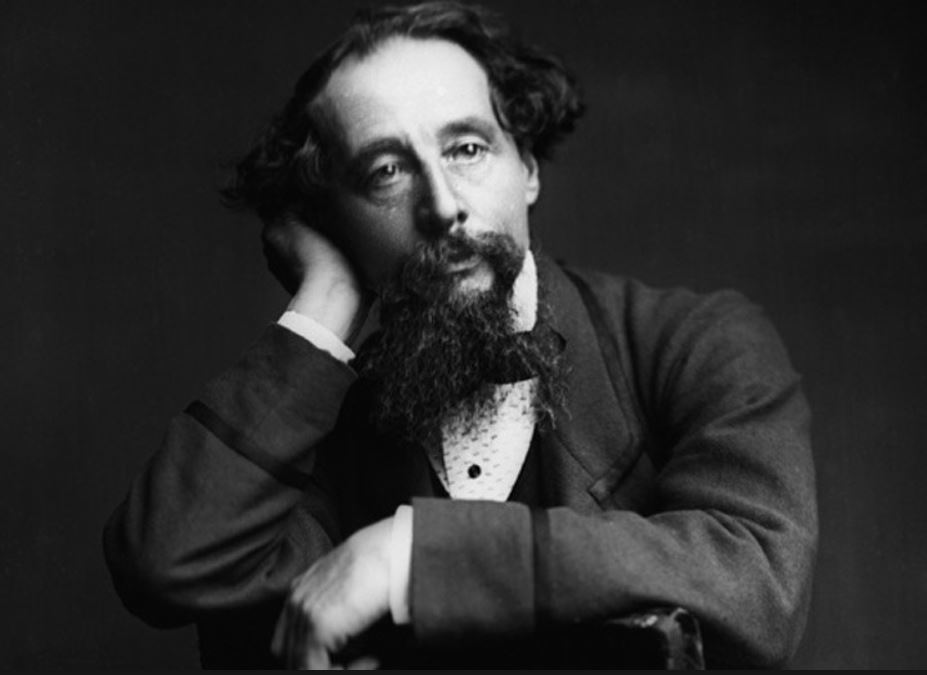
Dickens at age 49, photo by George Herbert Watkins

Charles Dickens at age 49, photographed by George Herbert Watkins in 1861

What would a modern Christmas be without Charles Dickens? For a lot of Canadians, Americans, and Brits, Dickens’ Christmas Carol is nearly the apex of Christmas culture: the story of a greedy bitter miserly capitalist whose nightmares awaken the spirit of Christmas within him. Dickens wrote his novella in 1843, a time when several of our modern holiday customs were emerging – Christmas cards, Christmas trees, and Christmas carols derived from boisterous bawdy pub songs rather than church hymns. Oh, and snow. Snow is a huge part of the Christmas image for many of us.

Geo-geeks over at the blog Letters from Gondwana inspired me to look at the Dickens-snow-Christmas connection. They analyzed The Little Ice Age and the 1815 Tambora volcano (which caused “the year without a summer”) and they explained how these events caused a period of cold weather that became part of our Christmas stories. Dickens described Scrooge with wintery symbolism: “No wind that blew was bitterer than he, no falling snow was more intent upon its purpose…” He likewise described London: “[on] the city streets on Christmas morning, where the weather was severe, the people made a rough, but brisk and not unpleasant kind of music in scraping the snow from the pavement in front of their dwellings, and from the tops of their houses, whence it was mad delight to the boys to see it come plumping down into the road below, and splitting into artificial little snow-storms.” Then the Ghost of Christmas Past took Scrooge upon the streets of his childhood: “The darkness and the mist had vanished with it, for it was a clear, cold, winter day, with snow upon the ground.” Dickens goes on and on, inconveniently dumping snow everywhere.

Dickens was only 31 when he wrote the Christmas Carol. The knee-deep snow of his childhood’s knees was still fresh in his memory. His story was an instant literary and commercial success. People loved the theme and identified with the snow drifts. They and their immediate ancestors had also witnessed the gripping cold of the receding Little Ice Age. Temperatures were cold for over 400 years (1400-1820), especially in northern Europe where entire communities became climate refugees.

Hunters in the Snow by Brueghel, 1565

Hunters in the Snow by Bruegel, 1565

Strange as it may seem, even today there are living tales of that cold time in Europe’s past. I have met two people who told me their family stories that include the Little Ice Age. One friend from Hungary, now living in Canada, has the unlikely surname Larsson. “Swedish,” he told me. “My great-great-grandfather left Sweden because the crops kept freezing. He settled along the Balaton in Hungary.” Another family friend, Helga Dorfi, was born a German-speaking Romanian. Her ancestors had left the Hamburg area “because the crops kept freezing” and had settled near the Black Sea. They kept their language and traditions for 300 years, she said. Then they emigrated to Pennsylvania.

The theory that a period of unusually cold weather before 1820 inspired our expectations of snow at Christmas seems probable. It also points to a full subversion of the Christmas story and its adaptation to a European audience. We ignore the probable spring-time birth of Christ, opting to fuse the Christian celebration with the Roman Empire’s wintertime Saturnalia Ceremony. We also ignore the palms and dusty desert manger, replacing the messy childbirth scene with clean white holiday snow. But I wonder if this will change?

In a typical winter, fewer than 10% of Americans are certain to have a white Christmas. Those folks live in northern Maine, Minnesota, Idaho, and the higher elevations of the Rockies. For everyone else, the probability diminishes quickly as one heads southward. I’ve included the US government’s NOAA Map of Snow-cover Probability, below. For over half of all Americans, there is little chance of sleigh rides and skating on open ponds. And if the climate continues its current trend, more and more of us will be dreaming of a white Christmas only after reading Dickens – in our shorts while lounging on the patio.

Probability of snow in the lower states - NOAA's National Climatic Data Center

Probability of snow in the lower states – NOAA’s National Climatic Data Center


Posted in Climate, Culture | Tagged , , , , | Leave a comment

Catastrophic Floods

Gustave Doré - The Deluge

Gustave Doré – The Deluge

An interesting blog posting, Catastrophic History, produced on the website The Not So Solid Earth, makes the point that much of future archeology will be marine archeology. During the last ice age, a lot of sea water was captured in ice sheets and was not topping up the oceans, so coasts were more exposed. Those mild, moist shorelines – now flooded – would have been ideal settings for villages older than eight or ten thousand years. In today’s blog, we’ll look at the conditions that followed those days and re-exam the status of Noah’s Flood – from a scientific perspective. Continue reading

Posted in Climate, Culture, History, Oceans, The Book | Tagged , , , , , , , , , | 2 Comments

Fat Cops; Skinny Scientists

Skinny cop

Cop.

What makes cops fat and scientists skinny? Before I go any further, let me say that I am quoting an American Journal of Preventive Medicine study and the statement reflects an average. There are outliers. I know a few overweight scientists and I know that there are skinny cops – including the one who will ask for my ID tomorrow morning while I am idling at a stop sign. He won’t be fat and I’ll tell him so, if I get a chance.

Yet it remains that the trend is there – 40.7% of police, firefighters and security guards are obese, according to the Wall Street Journal. Obesity is also over-represented among clergy, social workers, and counselors. Meanwhile the lightweights are economists, scientists, and psychologists – this group has just a 14.2% obesity rate. The contrast – 40.7% vs 14.2% – is significant. These figures are for the States – a place where over 60 billion dollars a year is spent trying to burn excess weight. The battle is not going well.

Fat scientist

Scientist.

What makes fat cops and skinny scientists? This is complicated. Data interpretation can be tough. Causation may be stubborn to tease out of facts. Picturing a chubby cop in his car at a donut shop might miss the story. Let’s look at a few reasons that the facts may be what they are, assuming the facts (based on a 375,091 sample set) are correct.

Lifestyle. Perhaps cops actually do sit too much and don’t walk/run/move as much as geologists, anthropologists, or botanists. A police officer may occasionally bound down a back alley with shoes flying, but an awful lot of time is spend in the cruiser. On the other hand, scientists may be on their feet more – hiking the hills for facts. My hunch is that this contributes to the contrast, but it may be a generalization.

Income. The Preventive Medicine journal indicated that folks with higher incomes have fewer obesity problems.  Police are underpaid. People with more money have more options for healthy eating and exercising. The study found that people with an income over $50,000/year had an obesity rate just 72% of those with an income of $25,000/year.

Genetics. This could be a touchy subject. The vocational choice between peace officer or scientist is not genetically determined, but it is likely that certain ethnic groups with particular genetically-determined body shapes (or inherited weight-related conditions) gravitate towards one or the other occupation.

Intelligence. I know a few overweight know-it-alls. And some very bright law enforcement officers. Especially among Canada’s mounties – who almost always get their man. However, in general, scientists may have brains developed in ways that avail themselves to both mathematical/scientific endeavours and to awareness of nutrition. So there might be some correlation. The charts on the pages of Preventive Medicine show a strong negative correlation between obesity and years of education – people who finished college had only 68% the obesity rate of people with “some college“. This, of course, could reflect personality types more than intelligence.

Lifestyle, again. An inordinate number of geeks are just too busy to eat. As a group, they seem to prefer problem solving to face stuffing. You likely know such people – skipping meals or nibbling on carrots while filtrating lab chemicals. Meanwhile, the stress of law enforcement and shift work may lead to mindlessly foraging upon the typical American fare of sweet sodas, salty chips, cheesy pizzas, and fatty hamburgers.

This fat/skinny cop/geek dichotomy should make us aware of some of the issues that complicate the understanding of any ‘facts’ we encounter. An emaciated version of this same story is given on Time magazine’s Health News webpage (Law Enforcement Is the Fattest Profession, Study Finds), but it is published there without even an inkling of qualification or explanation. Entirely too much science trivia is presented in popular media in this way – without the feeblest effort to encourage introspection. Lacking critical-thinking tools, we may be able to regurgitate facts – but without insight and skepticism, coughing facts into the air does little to foster understanding. This should be the most important role for the science educator. Sure, give the fun facts that attract an audience, but also instill debate and thought into the background and causation of those facts. That’s where the science really is.

Posted in Culture, Science Education | Tagged , , | Leave a comment

A Wonderful Life

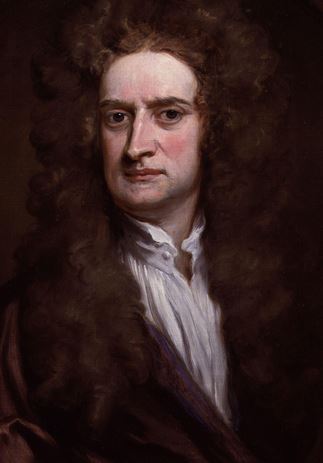
Sir isaac Newton December 25-1642 - March 31, 1727

          Sir Isaac Newton, born December 25, 1642

Are you ready? Just 7 more shopping days until December 25th – Newton’s birthday.* People celebrate Sir Isaac Newton’s birthdate in interesting ways. In this part of the world, there are a lot of coloured lights, decorated trees, and shiny tinsel. Stores all over our city are running specials (although the best sales are on Newtonian Boxing Day, December 26). All in all, it’s a festive occasion and a great way to remember the man who brought us gravity, optics, calculus, and all those laws of motion. Newton would be 372 years old next week, had he not been stricken by the infirmities of elderliness. But I wonder what the world would be like if he had never been born? Would gravity work the same as it does today? Probably, but we should still celebrate the great man of physics.

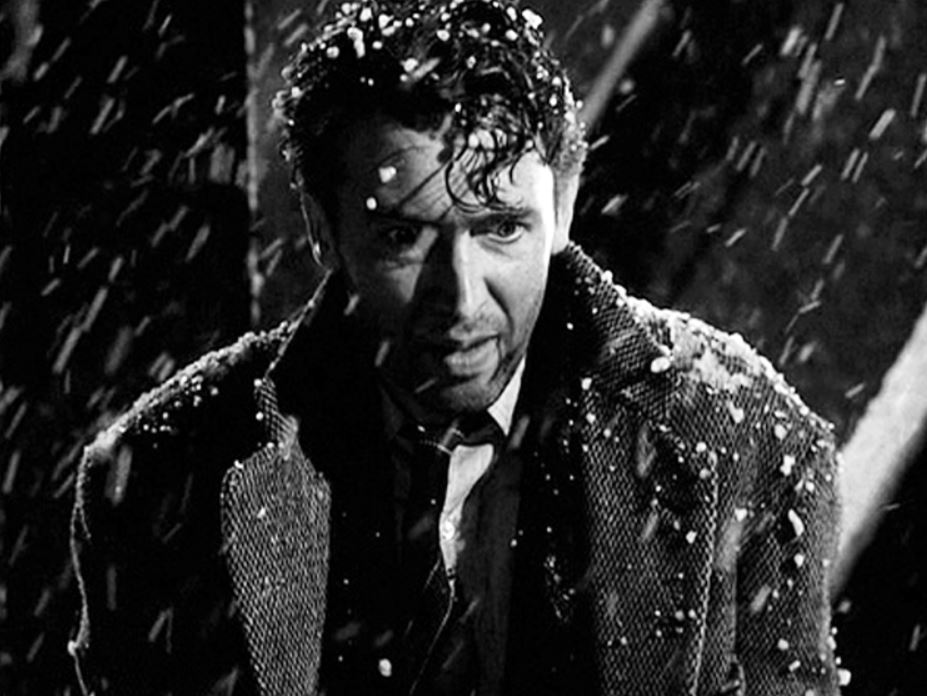
George

George

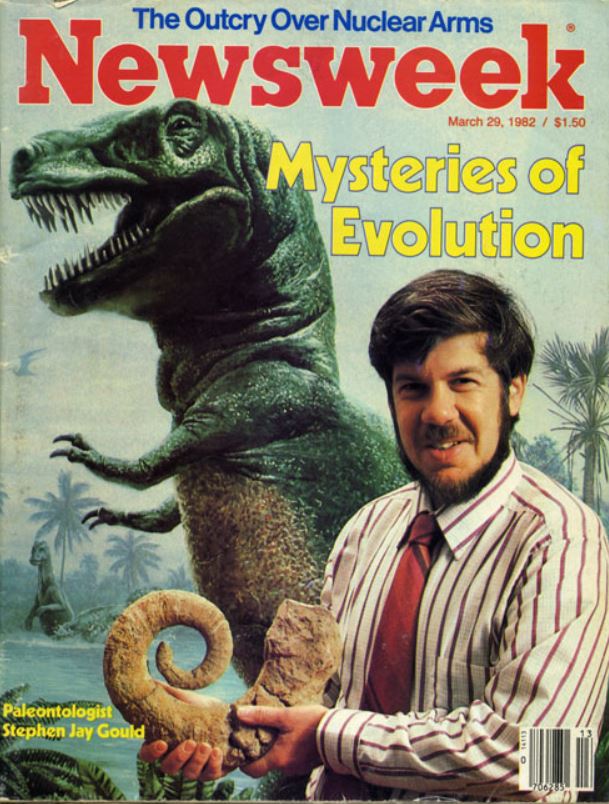
There are a lot of fun ways to commemorate Newton’s birthday – each year one of our local TV stations broadcasts the great science fiction classic, It’s a Wonderful Life, in honour of Newton. The movie probes the idea of how vastly different the world might be if one person – let’s call him George – had never been born. In the absence of George, the Earth suffers a devastating dystopia as gambling, jazzy music, and boozing abound. Without George, the world is a far different place. It’s just a movie, of course, so we will never know the impact of just one George. However, Harvard paleontologist Stephen Jay Gould pursued the idea by investigating the evolution of life on Earth as it might have been, had the peculiar creatures of the Burgess Shale survived and had the Cambrian extinction not taken place.

Stephen Jay Gould, cover of Newsweek, 1982

Stephen Jay Gould, cover of Newsweek, 1982

Gould’s thought experiment – what our planet would be like without that one single extinction event –  is part of his outstanding 1989 book, Wonderful Life. Catchy title, isn’t it? I have a signed copy of the book. Not signed by Professor Gould, but signed instead by my former co-workers who presented the book to me when I resigned from a big, big, big corporation (I think it is the world’s largest.) where I had briefly worked. The signatures of my co-workers mean more to me than Gould’s name inscribed in the book would have meant, though I liked Stephen Jay Gould and immensely enjoyed a talk he gave here in Calgary in 1991, the year Wonderful Life was a finalist for the Pulitzer Prize. Gould spoke about his book and the evolution of life. He was great.

Here is my three-paragraph recap of Gould’s Wonderful Life: The Burgess Shale and the Nature of History. Yes, the book has a subtitle. This narrows the scope of the book down to Canada’s Burgess Shale and the entire Nature of History. Gould is up to the task. Gould believed that chance was one of the crucial factors in the evolution of life on Earth and survival of the fittest might actually be survival of the luckiest. Controversially, Gould suggests that fitness for existing conditions does not guarantee long-term survival. If environmental conditions change abruptly, species survival may depend mostly on luck. It could also mean that the best adapted creatures for the present environment will be replaced by marginal creatures that have attributes unexpectedly suited to a suddenly changed environment. This certainly challenges “survival of the fittest” – those best adapted for the present environment might not win the longevity contest against some obscure maladapted creatures that were inadvertently prepared for some radically and abruptly changed future environment.

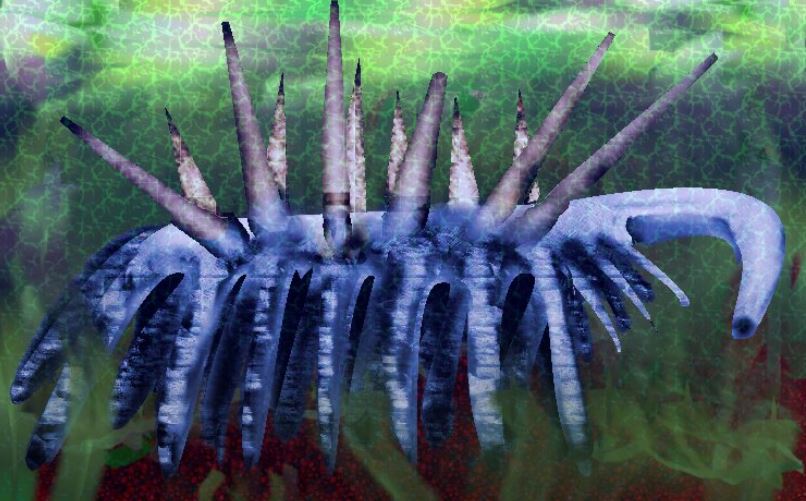
Hallucigenia - not your grandfather's ancestor.

Hallucigenia – not your grandfather’s ancestor.

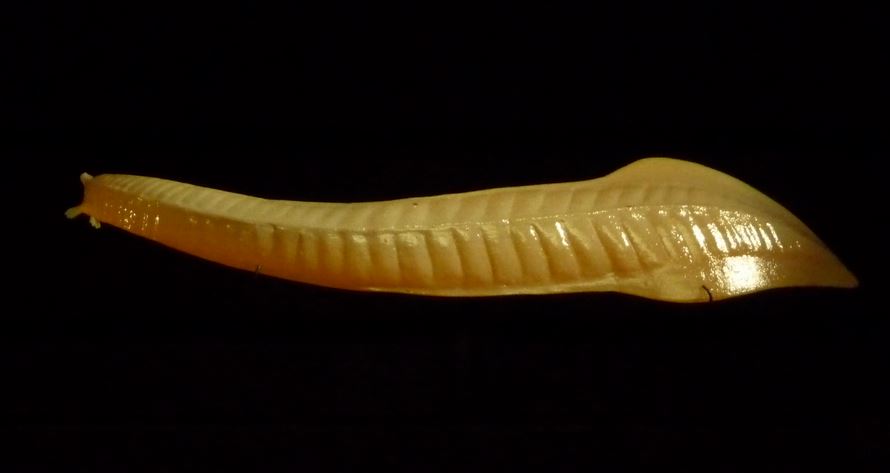
Pikaia, arguably your grandfather's ancestor

Pikaia – arguably, your grandfather’s ancestor

A large part of Gould’s argument is based on remarkably well-preserved fossils in British Columbia’s Burgess Shale. The type of animals that thrived just after the Cambrian explosion (around 505 million years ago) would not normally have left fossils, but the muddy conditions (now a shale formation in the Rockies) captured their soft bodies’ outlines in surprisingly clear relief. Gould argued that during the Cambrian the Burgess fauna were perfectly adapted to their environment, but most of them left no descendants because conditions changed. Most Burgessites became extinct.

Importantly for Gould’s thesis, surviving creatures did not seem better adapted than the ones that went extinct. Stephen Jay Gould invites us to consider what the world would be like if we could roll back time, change the happenstance of the extinction event, and imagine that the world is now populated by descendants of Hallucigenia rather than Pikaia. Would the distant offspring of Hallucigenia have evolved into bloggers who could ponder this question?

But here we are.  And now, with the big Newton holiday quickly approaching, you might consider lighting a candle to one of science’s most brilliant brains. Or perhaps buying a copy of Wonderful Life for the science geeks in your circle of friends. It is sure to be appreciated.  Maybe it can become an annual tradition.

*About Newton’s birthday on December 25th 1642 . . . Most references cite January 4, 1643, the date it falls upon with our Gregorian calendar. But it was a Julian calendar hanging on his mum’s cottage wall when he was born, and it said December 25, 1642. This gives you a chance to celebrate his birth twice each year.

Posted in Book Review, Culture, Geology | Tagged , , , , | Leave a comment

Dinos 101: Everything You Ever Wanted to Know

Greeter at Tyrrell Museum (photo - Miksha)

Greeter at Tyrrell Museum (photo – Miksha)

Want to know about dinosaurs? You’re in luck. The University of Alberta is offering a free 12-week course, a MOOC (Massive Online Open Course) starting January 3rd. I am thinking of signing up for it – the course is offered through Coursera, a giant MOOC-clearinghouse. I’ve taken advantage of Coursera before – I took their Philosophy of Science (University of Edinburgh),  A Brief History of Humankind (Hebrew University of Jerusalem), Origins – Formation of the Universe, Solar System, Life and Earth (University of Copenhagen). I haven’t studied any MOOCs that were taught via a Canadian school, so I am looking forward to Phil Currie’s lectures from the University of Alberta. Dr Currie ran the Royal Tyrrell Museum of Palaeontology here in southern Alberta and he is a smart and capable presenter.

If you have never taken a MOOC, maybe this is the time to give it a try. The Coursera program is free (although you can purchase “Verified Certificates of Completion” if you want – I haven’t done this myself).  Give Coursera’s MOOC a try. You can always drop out if the material or time commitment (about 3 – 5 hours/week) doesn’t work for you. The January 3rd course is called Dino 101: Dinosaur Paleobiology and it will cover topics in dino biology, as well as evolution, plate tectonics, and extinction. Course material claims it will also help you understand how science works. Go to this site to learn more.

As part of their promotion, the University of Alberta put together this fun page: Dinosaur Videos: 12 dinosaur myths that will blow your mind. I don’t know how these myths will actually “blow your mind” or even if that is something you want done to your mind. (I know, that silly title is just tedious click-bait.) But the webpage itself is not bad. Each myth is accompanied by a short video. If you aren’t jumping over to their site, here are three of the best of the U of A  blow-your-mind myths:

  1. Dinosaurs walked the earth, then mammals came. That’s a myth. Mammals actually evolved before dinos, but stayed in a repressed rat-like stage until the dinosaurs cleared out. Synapsids, of which mammals are the major modern representatives, arose 324 million years ago. They became rather large and dominant creatures until the Permian extinction, after which most were wiped out – except for the mammal branch. Those animals kept our bloodline alive, but were forced into cowering submission by the rising influence of the dinosaurs. Then, of course, most dinosaurs went extinct while others became birds, clearing the way for the rise of synapsids (as mammals) once again. 

  2. Some dinosaurs lived in water. That’s a myth, too. Even the super-big 100,000-pound fellows like Brachiosaurus and Apatosaurus were landed gentry. Somehow they had enough muscle to hold their bodies upright. (There is a theory that the Earth was smaller and gravity was weaker and that’s how the dinosaurs got so big. The Earth might be expanding, but I don’t think it was that much smaller during dino days.)

  3. Dinosaurs were slimey, featherless creatures. Another myth. According to the University of Alberta dino myth page, “Since the 1990s, paleontologists have discovered species after species of extinct dinosaurs that were covered in feathers. These were flightless theropods that may have used their feathery body coverings for insulation, protection from the elements and as displays for potential mates.

If this sounds like fun stuff to know, you will probably like Dino 101: Dinosaur Paleobiology. I suspect the actual course work will be more rigorous and challenging than this fun little introduction (and it might not blow your mind), but chances are it will teach you everything you ever wanted to know about dinos.

Posted in Science Education | Tagged , , , , , , | Leave a comment

The Greatest Science Quotes

Do you mentally collect and muse over science quotes? Some reasonably good web sites have already done this, but so far none of those sites has my all-time favourite. It’s obscure. It was spoken by a geophysicist fifty years ago and it is mostly lost to the annals of history. But it is worth resurrecting.

I will dash through a few of my runners-up before I get to the best of the best quotes (as defined by me, though my thoughts are open to revision). The following small group of also-rans have been adjudicated as superior only through my own myopic lenses, but you have likely seen them before. And some have the fun attribute of being fake.

Fake? The greatest quotations are attributed to people who may have never voiced the words. Carl Sagan’s reference to our planet as a pale blue dot is stirring and poignant – and because we have this video, we know for certain that he actually said it. But I like this one, too, which is also attributed to Sagan: “Somewhere, something incredible is waiting to be known.” This pithy statement reflects Sagan’s life – motivated by curiosity, seeking the unknown. It should be a guiding aphorism for all of us. It would be my favourite Sagan apothegm, but it was likely penned by journalists who wrote a Newsweek cover story about Carl Sagan. He probably never said it.

Similarly, Einstein is credited with “Everything must be made as simple as possible. But not simpler.” For those of us who aspire to write about science, culture, and history, these words serve as a fundamental maxim. Scientists do well by following this simple philosophy – but not any philosophy that might be simpler. It sums up Occam’s Razor – the preferred theory amongst any two is the simpler theory. Einstein certainly would have agreed with the simple statement, but there is no record that he said it. Ironically, the closest he comes is this very wordy version from a 1933 Oxford speech: “It can scarcely be denied that the supreme goal of all theory is to make the irreducible basic elements as simple and as few as possible without having to surrender the adequate representation of a single datum of experience.” A fine thought, but he could have expressed it more simply.

In a letter to his arch-rival Robert Hooke, Sir Isaac Newton gave us another of our great science quotes: “If I have seen further it is by standing on the sholders [sic] of Giants.” We credit this to Newton. But Sir Isaac was repeating an old and well-worn adage, attributed to the 12th century Jewish philosopher Isaiah di Trani: “Who sees further, a dwarf or a giant? …if the dwarf is placed on the shoulders of the giant who sees further? … So too we are dwarfs astride the shoulders of giants. We master their wisdom and move beyond it.” And there were others who said it, even earlier. Here, however, is perhaps a more original Newtonian quotation, one of my favourites: “I don’t know what I may seem to the world, but, as to myself, I seem to have been only like a boy playing on the sea shore, and diverting myself in now and then finding a smoother pebble or a prettier shell than ordinary, whilst the great ocean of truth lay undiscovered before me.”  The Cambridge library, in a recent Newton exhibit, says that Sir Isaac “is supposed to have remarked” this on his deathbed. Said or unsaid, Sir Isaac Newton lived the quote and it is a great one.

From these dubious yet credible quotations attributed to Sagan, Einstein, and Newton, I’ll add this unsourced succinct witness to scientific progress: “Science progresses one funeral at a time.” This one is attributed to anonymous, though it was undoubtedly muttered by some young assistant professor, growing weary while waiting for the department chair to die. It, of course, underlies the deeper sentiment that progress comes only when the defenders of old untenable beliefs finally exit the stage. This, you will find, is one of the main themes in my book, The Mountain Mystery.

As long as I am indulging in unsourced, unproven, and misappropriated science quotes, here are two of my favourite literary science selections. First, from Michael Crichton’s Jurassic Park, mathematician Ian Malcolm tells the scientists who think they have  sterilized their dinosaurs that “Life finds a way.”  Best heard in Jeff Goldblum’s voice, it is a reminder that we can’t control nature, nor can we predict all the variables in our experiments. My other prized literary quote is from Jules Verne. In Journey to the Center of the Earth, 1864, Verne’s protagonist (Professor Otto Lidenbrock) says:  “Science, my boy, is made up of mistakes, but they are useful mistakes, because they lead little by little to the truth.”  Little truths such as “life finds a way,” perhaps.

So, we have Sagan reminding us to be curious, Einstein admonishing simplicity, Newton celebrating childish wonder, Anonymous encouraging patience, Crichton warning caution, and Verne tolerating mistakes. The last one, from Jules Verne, (science progresses through useful mistakes) leads us finally to my favourite scientific quote.

In the mid-1960s, plate tectonics was slowly gaining acceptance as the best idea to explain how geology works. Before tectonics, large-scale geological phenomena (such as mountain ranges) were considered the work of an expanding Earth, or a contracting Earth, or perhaps a complicated system of rebounding geosynclines. At the time, moveable plates of crust were given less credibility than wild ape-men at carnivals. But a small and persistent group of geophysicists resolved the mechanics of plates in motion and guided geologists to accept the inevitable. Among the leaders was a soft-spoken southerner, Jason Morgan.

Morgan’s work was the final bit of research that completed the drift revolution and led to almost universal acceptance of plate tectonics. His was the last dab of polish on the theory.  Jason Morgan became world-renowned for his mathematical description of plate motion. A colleague asked Morgan what he could possibly do about plate tectonics to make an even greater name for himself. “I don’t know. Prove it wrong, I guess.” To me, Morgan sums up the beauty of science in his reply – there is no humiliation in making a mistake; there is honour in proving oneself wrong.

Good scientists expect and accept that their ideas will one day be rewritten or rejected. Science is not dead, not fixed in absolutes, not inscribed in an unerring tome of ideals. One of the most noble things any scientist can aspire to is to take deeply-held truths – especially their own truths – and examine the most fundamental of them closely, even if the result is to “Prove it wrong.”

Posted in History, How Geophysics Works, Philosophy, Plate Tectonics | Tagged , , , | 1 Comment

How the Earth’s Mystery Mineral Got Its Name

We seldom get to see a sample of the Earth’s most common mineral. It resides within the mantle at extreme heat and pressure not found on the surface. We think that the mineral resides within the mantle – we are not sure, but it is a good hypothesis. However, the mineral stays hidden far below the crust, so we can’t be sure until someone goes down there and fetches a piece.

Fifty years ago, a hypothesis was made that much of our planet is composed of a mineral designated MgSiO3-perovskite. Geologists estimate that 70% of the Earth’s lower mantle (670 to 2900 kilometers below us) is made of this one mineral. If true, it means 38% of the Earth’s volume is MgSiO3-perovskite. For 50 years, this probable existence of magnesium silicate perovskite was debated and generally accepted, but since no one had actually held a piece of it in their hands, the International Mineralogical Association could not approve a more catchy name for this most common of all minerals.

According to the Mineralogical Association, a mineral cannot be given a name until there is physical proof of its natural existence. Tests must be performed on an actual physical sample, not an expected theoretical mineral. This, I suppose, is a policy that prevents amateur chemists from concocting imaginary minerals (“some of this, some of that, a little of this, and Presto! – let’s call it Canadaite.”) For 50 years, no one had analyzed hand-held samples of MgSiO3-perovskite. Now there is an identified sample – and the mineral has finally been given a real name.
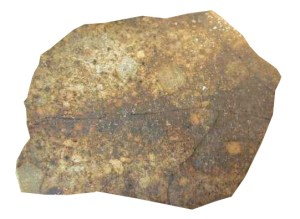
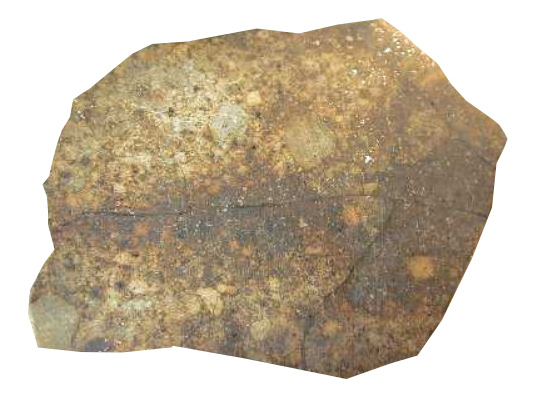
Australian Tenham chondrite meteorite - black blobs may contain the mystery mineral.

An Australian Tenham L6 chondrite meteorite  – black blobs may contain the mystery mineral that is common in the Earth’s deep lower mantle.

No one picked up the sample on a trip through the center of the Earth. Instead, it dropped out of the sky. Meteors, when they pass through the atmosphere and slam into our planet, are exposed to high pressure and temperature similar to those in the mantle. Scientists examined one of a group of meteorites called the Tenham L6 chondrites which hit near Tenham Station, Queensland, Australia, in 1879. Over 160 kilograms (350 pounds) of this broken-up meteor were recovered. The examined piece shows evidence that the impact pressure was about 240,000 times sea level (24 gigapascal) and the temperature was about 2100 degrees Celsius. These values are remarkably similar to what scientists expect the lower mantle’s environment to be.

Last month, researchers Oliver Tschauner of the University of Nevada and Chi Ma at Caltech reported in the journal Science that their work on the meteorite “concludes a half century of efforts to find, identify, and characterize a natural specimen of this important mineral.” The pair themselves had spent 5 years searching for MgSiO3-perovskite. The two conclusively identified tiny (30-micrometre) blobs of the mineral as the rumored magnesium silicate perovskite. With this positive identification, the material could be given a proper moniker. No, not Canadaite. Nor was it to be called Americium (that name was already taken and applied to element number 95).  Instead, this most common – but most secluded – mineral has been named bridgmanite. “Who?” you ask.
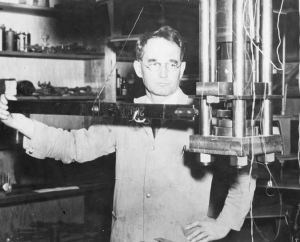
Percy Bridgman with his high-pressure experimental apparatus, around 1915.

Percy Bridgman with his high-pressure experimental apparatus, around 1915.

You might expect that the Earth’s most common mineral would be named for someone who did some amazing science. You would be right. Percy Bridgman is one of those great scientists of whom most of us have never heard. His expertise was the physics of enormous pressures. In 1905, when his machinery broke at his Harvard lab after pressing some material all the way to 3,000 times the Earth’s atmospheric pressure, he redesigned the apparatus and achieved 100,000 times atmospheric pressure. From thousands of experiments on tensile strength, viscosity, compressibility, electric and thermal conductivity of highly squeezed materials, he derived a set of basic equations which others have named the Bridgman Thermodynamics Equations. For this, Percy Bridgman was awarded the 1946 Nobel Prize in Physics.
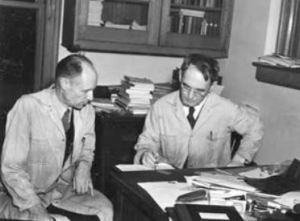
Bridgman, right, in his Harvard office.

Bridgman, right, in his Harvard office.

Some of the applications of Bridgman’s work worried him. As head of the physics department, he had to sign off on the transfer of Harvard’s cyclotron to the US Army for the Manhattan Project in 1943. The American nuclear bomb project was top secret, so the military told Bridgman that they were taking his machine to St Louis where it would be used to treat wounded soldiers. Bridgman was no dummy. He told the military, “If you want it for what you say you want it for, you can’t have it.  If you want it for what I think you want it for, of course you can have it.” His cyclotron went to Los Alamos (not St Louis) and was used to develop the atomic bomb, not medicinal isotopes, and he knew it. But after the war, Percy Bridgman saw the escalation of Soviet and American warheads as an impending disaster. Along with Joseph Rotblat, Linus Pauling, Max Born, Bertrand Russel, and Albert Einstein, he was one of the 11 signatories of the famous Russel-Einstein Manifesto, signed in Pugwash, Nova Scotia, in 1955. The manifesto called on world leaders to seek peaceful resolutions to international conflict and to find ways to disarm. The original meeting turned into the on-going Pugwash Conferences on Science and World Affairs.

Bridgman was passionate about the philosophy of science and about the way science affects society. In 1927, he wrote The Logic of Modern Physics which had a major and surprising influence through the 1930s and 1940s on the social sciences. Bridgman’s main subject looked at how we know what we think we know. Particularly, he wrote about the methodology of physics. His intended audience included physical scientists. But through Bridgman’s introduction of operationalism, his book had a huge impact on the field of psychology. Operationalism is a variation of positivism, and positivism is the very basic idea that knowledge can only enter the human mind (and science) through observation and sensory experience – there is no role for intuition, introspection, or divine inspiration.

BridgmanPositivism is not a new idea, but Percy Bridgman’s contribution was to move beyond its requirement for direct sensory validation. He included things that can not be directly measured but instead can be described by related elements which are readily observed. A common, everyday example of operationalism is measurement of the fuzzy idea of “health” in terms of empirical things like biomass, heart rate, and the number of trips to the hospital – things that can be counted and measured. From these, one gets a second-hand, but accurate, measurement of “health”.

Similarly, the second-hand, measured side- effects of quantum mechanics and subatomic particles can define quantums and subparticles. This is important because it means that even if something can not be seen and directly measured, it can still be real – it is not the product of intuition, introspection, or inspiration.  And this idea loops back to bridgmanite and geophysics.

Geophysics (like astrophysics) is at an enormous disadvantage compared to chemistry, botany, newtonian physics, and most other sciences. The latter can be subjected to testable, experimental hypotheses. You might speculate that an upside-down seed will still send roots downward, so you experiment – you turn a seed upside-down and observe and measure the root’s growth. You test your guess by designing an experiment and measuring the results. You can’t do this in astrophysics – you can not crash two supernovae together in a controlled experiment. You might simulate your experiment with a computer model, but you can’t possibly include all the parameters you need to get the right answer.

With the Earth, presumptions about the deep interior (including the existence of bridgmanite) have been indirectly confirmed. Ever since Sir William Gilbert deduced that the core is iron and is generating magnetism, up to modern observations that the crust is apparently burnt in places by fixed hot spots, discovering our planet’s inner workings has all been a series of indirect observations, followed by untestable hypotheses about what will never be seen. If a new observation negates an old hypothesis, the old hypothesis is revised or rejected. But there are no direct experiments and very few first-hand facts.

You can see how all this ties Bridgman to the Earth’s most common and most secretive mineral, bridgmanite. Percy Bridgman gave us the tools to experiment with high pressure, creating environments similar to the lower mantle; but he also gave us the intellectual tools to trust the existence of things which we can only know second-hand. Ironically, the International Mineralogical Association says you can not name a mineral until you can prove its existence and hold it in your hands (positivism),  yet MgSiO3-perovskite has been named bridgmanite to honour the man who said that measurable second-hand effects (operationalism) are good enough to prove that something exists – seen or unseen.

Posted in Biography, Geology, People, Philosophy | Tagged , , , , , , , , , , | Leave a comment

Banana Peel Tectonics

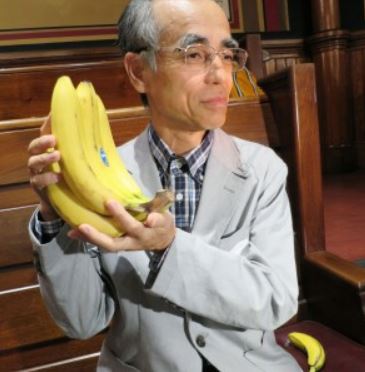
Ig Nobel Laureate Kiyoshi

Ig Nobel laureate Kiyoshi Mabuchi and some bananas

The 24th annual Harvard Ig Nobel Prizes were awarded to courageous trail-blazing scientists who pushed the limits of curiosity and credulity during the past year. Among the winners of the 2014 prestigious momento were a Canadian who won the Neuroscience Prize “for trying to understand what happens in the brains of people who see the face of Jesus in a piece of toast” while the Psychology Prize went to an Australian “for amassing evidence that people who habitually stay up late are, on average, more self-admiring, more manipulative, and more psychopathic than people who habitually arise early in the morning.” In their good company was a group of four Japanese researchers headed by Kiyoshi Mabuchi. That team’s winning Physics paper was Frictional Coefficient under Banana Skin. In other words, they studied the effect of slipping on a banana peel. Equipment included a shoe, a banana, and a linoleum floor. Apparently “polysaccharide follicular gel played the dominant role in the lubricating effect of banana skin after the crush and the change to homogeneous sol.” The elusive coefficient of friction was measured at 0.07. Ah, but didn’t the MythBusters already do that? Perhaps, but Mabuchi et.al. used more math.

The TV guys busted the myth – they found that it is hard to slip on a banana peel. They discovered that the slick underside of a fresh banana skin has some slippery properties, but things don’t get comedic until a pile of over-ripe banana skins are enlisted. To get a laugh, you need old rotten skins stacked like pancakes. Those old peels need to decompose into a soft slimy slippery texture.

If banana peels aren’t inherently slippery, how did they earn their sidekick reputation? And why did Mario’s Kart expel them as infinite point-stealing weapons? The story goes back to 1866 when Carl Frank started importing bananas from Panama into New York City. They were a novelty and sold at the 1876 Philadelphia Expo as if they were corn dogs. Soon people everywhere indulged – and discarded the peels on the street. In those days, big cities were filthy – the whiff of sanitation was not yet in the air. Thirty years later,  civic leaders were admonishing residents that their dirty throw-away habits were leading to broken arms and legs. And very lame vaudeville skits. Litter laws were enacted and trash removal was started, resulting in less hazardous streets. But the slippery-peel comedians thrived anyway.

Although Mabushi et.al. worked out the friction coefficient for soles skidding on peelings, it was actually the MythBusters who gave us a good experimental, qualitative approach. Alas, there are no Nobels (Ig- or non-Ig-) for television stuntmen, regardless their lofty talents and achievements. Nevertheless, experimental and qualitative investigation is closer to the heart of the average geologist trying to understand how rock layers slide atop one another. And that’s where this blog is heading.

Decollement cartoonIn the 50 years since mountain building was recognized as the result of colliding tectonic plates, thrust sheets have been understood in their true context.  As crustal rocks crash together, some wedges slide up and over others. They tend to do this along a décollement, which is a (relatively) slippery zone between different rock types that allows detachment for rock layers that decouple and move independently. You can see how that works in this cartoon. When compressional pressure squeezes this structural model, the slippery-as-a-banana layer slides along the décollement, the weakest link in the system. Layers get stacked, leading to crustal shortening. This phenomenon was first noticed in the Swiss Jura Mountains in 1907. Geologists there speculated that if all the Swiss stacks could be decompressed and returned to their pre-thrusted positions, Switzerland would be the largest (and flattest) country in Europe.

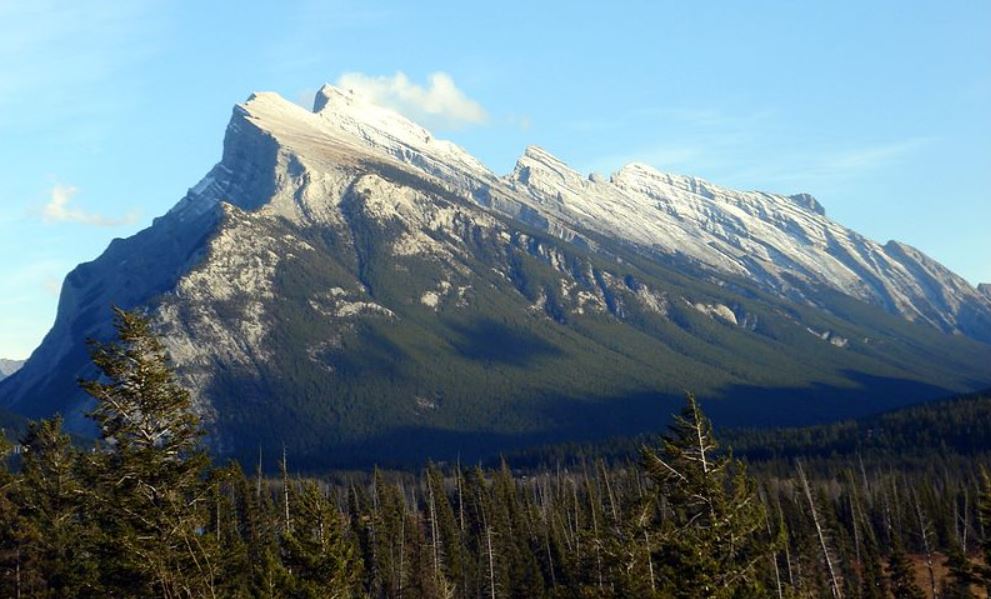
Meanwhile, closer to my Canadian home in Calgary, I can spy a few similarly stacked peaks from my living room window. These mountains were build as the Kula Plate rammed into the North American Plate and rocks folded, detached, and thrust above the plains. But these rocks didn’t break loose and slide without spending a bit of time resisting the urge to move. Just like the shoe on the banana peel, there is a coefficient of friction involved. Turcotte and Schubert, in their book Geodynamics (pp 352-353), do the math for us. In lab tests, the coefficient is about 0.85. But surprisingly, they discover that the addition of water in porous deeply buried rock layers reduces the frictional force to a coefficient of just 0.o6 – almost exactly the same as Mabuchi’s shoe on the fresh banana peel. Granted, the weights and forces get bigger when it involves mountains rather than fruits, but the skidding principle is the same.

A classic thrust sheet - Alberta Canada's Mount Rundle

A classic thrust sheet – Alberta Canada’s Mount Rundle (Wiki CC image)

Posted in Culture, How Geophysics Works, Plate Tectonics | Tagged , , , , , , | 2 Comments