Michele Bachmann’s Dirty Bones

Ms Bachmann

Ms Bachmann

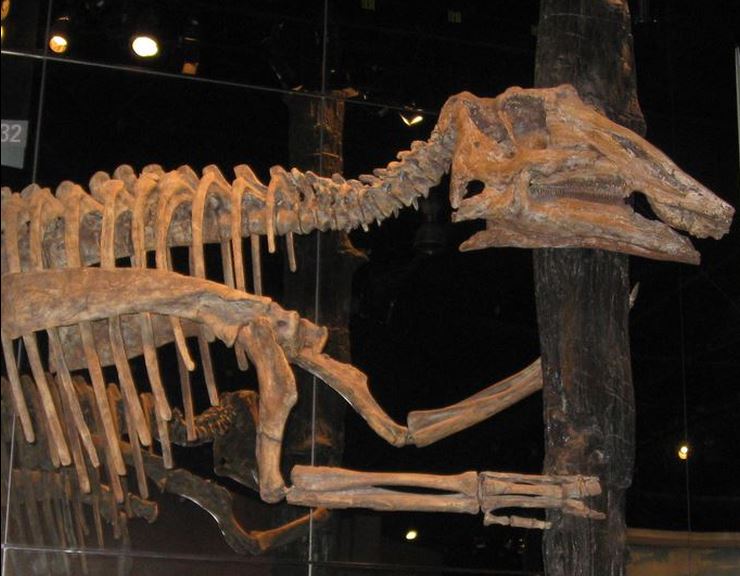
“If dinosaur bones have been buried for “millions” of years, then why are they so clean when they’re in museums?” asks Michele Bachmann. Is this just one more of the many thoughtful questions coming from this year’s crop of political deep-thinkers? Are these people really this stupid?

No, not really. Bachmann never said it. But lots of people believe that she might say something like this and that’s why the meme has appeared thousands of times on social media. The cretanic habit of accepting misinformation as fact has become so bad that Facebook is thinking of including “Satire” (and perhaps “BS”) tags that you can add to stories to prevent your friends from looking like idiots when they comment on such stories.

dino at tyrrell

Typical Dirty Dinosaur

I am not going to defend Bachmann, someone whom I believe opposes much modern science education. But I don’t think that she’s among the sharper knives in the cutlery drawer. For example, in August 2011, in Florida, she said that God was sending a taxation message to the American public by way of hurricanes and earthquakes. On another occasion, Bachmann told us that it’s “an interesting coincidence” that swine flu appeared in 1976 (when Ford was president), then again when Obama was president. [If this doesn’t make sense to you, that’s because you are normal.] She also claims that “there isn’t even one study that can be produced that shows that carbon dioxide is a harmful gas.” Not even one study? CO2 makes plants grow, of course, so maybe she’s right. You can find page after page of her interesting gurgitations on the internet. But she really never tried to use a dirty dino bones argument to claim a 6000-year-old Earth. She’s clean on that one.

All of this points to a problem that is much too common among people who lack sufficient critical thinking skills.  That means most of us. Questioning dubious information – even when you know for sure it must be factual – is an acquired skill of judgement. I know that I have failed more than once. We all fall for things that sound right, but aren’t. Although fictitious, they portray many elements of the truth. Almost 400 years ago, French playwright Jean-Baptiste Molière said, “It infuriates me to be wrong when I know I am right.” This explains why most of us (even scientists) can not throw out a perfectly good theory, even when it’s starting to make the entire fridge smell.

Paul is dead. Or just barefoot.

Paul is dead. Or just shoeless.

What can we do to upgrade our BS detector? Readers of this blog probably already know the most reliable steps. First, ask this question: “How do they know that?” If someone tells you that Paul McCartney is dead (as I learned in junior high in 1969), don’t just grin ear-to-ear, but ask for the source. Sure, he walked shoeless (symbolic of the dead) on Abbey Road,  and sure, John whispers “I buried Paul” on Strawberry Fields.  Or maybe he was just singing, “Cranberry sauce forever.” No one is quite sure. But Paul wasn’t buried, wasn’t dead, and I’m glad because in 1977, Paul McCartney and Wings released Mull of Kintyre – surely a song worth staying alive to record.

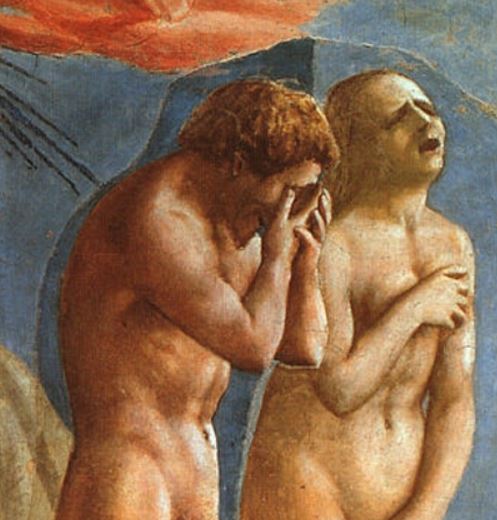
Expulsion by Masaccio, 1425

Expulsion from Eden,  by Masaccio, 1425

More BS detection skills. Always be wary. Everyone lies. Expect lies, look for omissions, exaggerations, understatements. Lying started a long time ago, back in the Garden of Eden, when God himself warned Adam that eating from the Tree of Knowledge of Good and Evil would kill him. As it turned out, Adam, his wife, their snake, everyone, were evicted from the marvelously beautiful garden where naked people sat around doing nothing all day. But they didn’t die. Not immediately, anyway. Eventually, sure – so perhaps that’s what God meant. Knowledge kills. Ignorance brings bliss and web hits. By the way, if you find any lies in any of my blog posts, feel free to think about sending me a note.

Here’s another BS detection tip. Language clues. Exaggerated language is usually a giveaway. For example, never say never:  She always says that he never picks up anything” may miss the subtle point that last Friday he picked up a co-worker and gave her a ride home. Always, never, everything, anything, nothing, and all superlatives should never be trusted. They always indicate BS. Trust me on that.

Finally, look for vested interests. What is being sold? Does someone want your money, your obedience, your soul?  If Michele Bachmann – or any other politician – tells you something, just smile, nod, and back away. Then turn and run because Facebook isn’t following you everywhere, offering satire and BS tags. Or is it?

Posted in Culture, Religion, Science Education | Tagged , , | 5 Comments

Scotland’s Verbose Expounditor of Geological Logorrhea

Pretty: along with The Flood, beauty was the principle concern of most pre-Hutton. geologists

Pretty: Along with The Flood, beauty was the principle concern of most 17th century geologists.

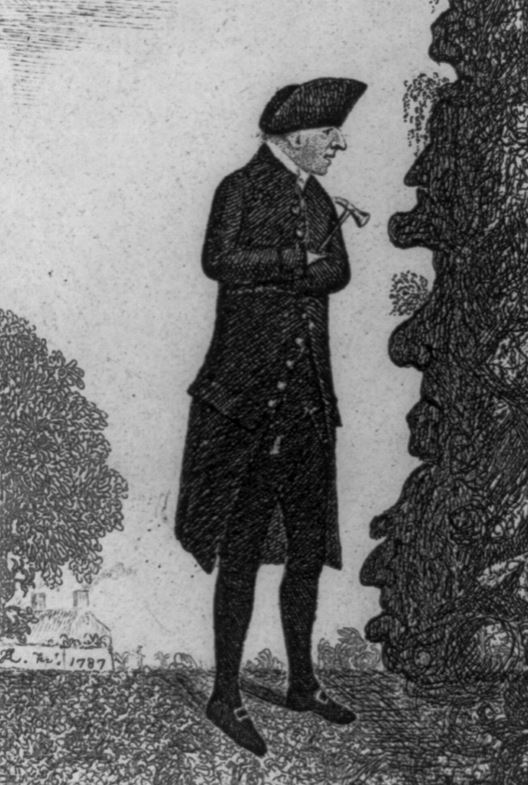
James Hutton (1726-1797), Scotland’s most celebrated geologist, had a way with words. A rather awful way with words. But his scientific brilliance is uncontested. He is credited with moving geology away from the La-Z-Boy recliners of seventeenth century drawing rooms and onto the craggy cliffs where rocks are actually found. Until Hutton, gentleman-geologists were often preachers with parishes and parsonages to tend. They seldom ventured into the hills to study geology. If they collected rocks at all, it was the pretty ones they displayed in their cabinets. Such men philosophized about geology, Creation, and The Flood. They kept their fingernails clean. After Hutton, geology became the stuff of adventurers, travelers, experimenters, and above all, men and women with picks and hammers. Hutton was the founder of modern geology. He spurned divine intervention as the mechanism that created mountains, rivers, and oceans. Hutton advocated gradual processes as the only explanation for natural landscapes. Steady rain, over millions of generations, carved more features than any single great flood, regardless its potential Biblical proportions.

James Hutton (1726-97) in the field. Illustration in: Original Portraits and Caricature Etchings, 1877

James Hutton (1726-1797)
from Original Portraits
and Caricature Etchings
, 1877

Today, on the 289th anniversary of James Hutton’s birth, we remember the man who promoted the principle of uniformitarianism. Hutton showed that the same geological processes at work today explain everything that has occurred in the past.

He introduced the idea of cyclicity – mountains eroding and mountains rebuilding – and he saw such phenomena repeating over and over, through millions of years. He understood igneous and metamorphic rocks, rejecting the common notion of his time that all rocks (even granite) were made of ocean sediments.

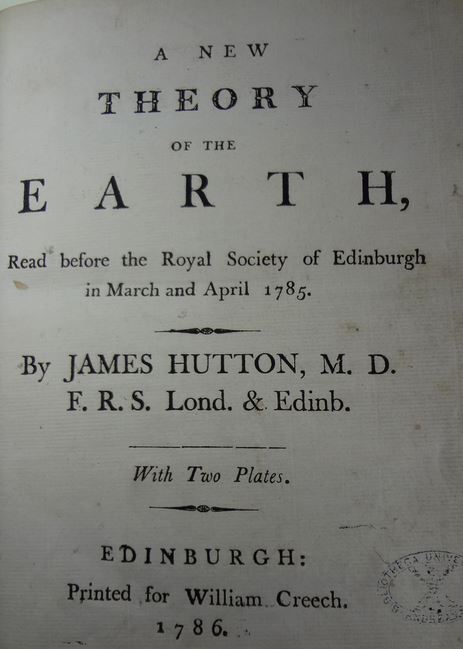
In his 1785 book Theory of the Earth, Hutton even introduced ideas of gradual evolutionary change in animals. But all of his great ideas were muddied by an inability to write to the point. He rambled incessantly and he used sentence structures that were arcane even in his own time. Today, it is almost impossible to read Hutton for simple pleasure. I have a copy of his masterpiece. It is as dull as it is dazzling. Alas, it is seldom opened.

Although James Hutton understood geology with brilliant clarity, his sentences filled paragraphs and paragraphs filled pages. There are certainly precious gems buried within Theory of the Earth, but rambling was Hutton’s literary forte.  It took him several rewrites to arrive at his most famous quote, the Earth is “without vestige of a beginning, without prospect of an end.” Unusually succinct, but typically ambiguous. Scholars have argued about whether he meant this literally (all the original rocks of the Earth have been recycled) or figuratively (the vastness of time – past and future – can not be contemplated), or both.  He is generally considered such a poor writer, a true ambulator of thought and champion of disorganization, that his ideas might have been lost if they hadn’t been rewritten after his death by his loyal disciple, Charles Lyell.
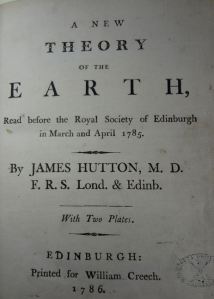
Theory of the Earth - the book of modern geology

Theory of the Earth –  a book of modern geology

James Hutton trained as a physician and worked as a farmer. These avocations helped him see the Earth as a living organism “not just a machine but also an organised body that has regenerative power.” To him, the Earth was a living organism with an indeterminate longevity. Hutton was among the first to seriously contemplate the true vastness of time. Deep time, as it is sometimes called, is something he described as “a thing of indefinite duration.” Hutton imagined endless cycles of mountain building, destruction by erosion, draining of sediments to the sea,  consolidation, and then another uplifting, forming fresh continents. Recycling forever. Continents destroyed; continents rebuilt. Nothing remains of the original Earth and there is no end to the cycles.

James Hutton championed a new theology. Everything was originally designed by God; God created the Earth to provide a place for man. But it had been created in a way that required no further divine maintenance. Even the process of recycling rock through erosion was designed to rejuvenate the soil for man’s agriculture. Mankind used the Earth’s resources, but everything would be replenished. Hutton rejected the theistic geology of miracles and floods – his grasp of geology was far deeper and his role for a deity was much narrower. Burnet’s Sacred Earth (1681), Woodward’s Essay of the Earth (1695), and Whiston’s New Theory of the Earth (1696) all have a similar thesis. Their subtext varied as each tried to explain the planet’s evolution within a biblical context, but they all reflected a common understanding of the Earth’s recent origin, brief existence, and rapidly approaching end.

Hutton was different. Though his faith was deep and his geology included religious considerations, Hutton is sometimes cited as the first modern geologist because he insisted that natural processes were the sole tool for geological transformation. His work reinforces deism (the idea that reason, observation, and science reveal God) and discounts theism (the belief that revelation of God is only possible through prayer or sacred texts). For Hutton, deism’s supreme being is an absentee landlord. The deist rejects the theist notion that gods intervene in the daily affairs of man and Earth. Hutton was central to the Age of Enlightenment in England, northern Europe, and America, and the surging concepts of reason and individuality. The deist aspect of Hutton’s explanations for Earth’s evolution found a willing enlightened audience.

In 1768, at age 42, Hutton turned over his farms’ daily operations to tenants and moved to Edinburgh, where his closest friends included philosopher David Hume and economist Adam Smith. Hutton spoke regularly at the Royal Society of Edinburgh, which became his stage for teaching what he discovered about geology.

oystersHutton’s other venue for discourse was the Oyster Club, which he founded with his friends Joseph Black and Adam Smith. The club’s weekly discussions were raucous affairs – debate was rumoured to be only part of the fun. There was a wild mix of widely disparate intellectuals (most of Edinburgh’s brightest, as well as regular visitors such as Ben Franklin) who gathered for heavy drinking, loud laughing, deep conversation, and oysters. Hutton, Black, and Smith formed such a deep friendship that when the famous father of modern capitalism died, Hutton and Black were executors of his estate. They divided up properties according to Adam Smith’s instructions. Ever loyal, they also followed Adam Smith’s last request – all his unfinished works were to be destroyed. Thereupon, Hutton and Black reluctantly burned 16 volumes of their brilliant friend’s unpublished memoirs and economics manuscripts.

Hutton, 1775

Hutton, 1775

Regardless his magnificence of thought, Hutton’s unfortunate logorrhea made his writing largely inaccessible. [Since you’ve read this far, allow me to offer a definition. Logorrhea is excessive incoherent wordiness, usually considered pathological. In a colloquial use, it is emblematic of unbridled rambling, not disease. I don’t intend this word to imply Hutton suffered an illness – but his writing is always described as rambling and wordy. Examples are coming up.] When Theory of the Earth was announced at the Royal Society of Edinburgh, his friend, the chemist Joseph Black, read the first chapter aloud to the assembled members who slowly drifted off to sleep. Hutton’s work was saved from slipping into its own coma by the fact that it contained revolutionary pearls about the natural of the Earth – and because Hutton’s friend and protégé, Charles Lyell, kept his work alive.

Like Hutton, Lyell was born in Scotland. At Oxford he studied geology, but graduated as a Master of the Classics, as literature and dead languages were  called. With such a degree, Lyell was qualified to practice law. Within ten years, Charles Lyell gave up law and began studying geology and writing about it full time. His own observations confirmed Hutton’s theories. Lyell published revisions of Hutton’s discoveries, writing with more clarity and charm than a typical lawyer with a classics education.  Within his first book, Principles of Geology, Hutton’s concept of uniformitarianism was presented so convincingly that it became the fundamental theory of geology for a century. The theme of Lyell’s Principles, “the present is the key to the past,” is essentially a restatement of Hutton’s more verbose “from what has actually been, we have data for concluding with regard to that which is to happen thereafter.” Lyell was much more than the interpreter of Hutton, he was an innovative and observant geologist who built upon Hutton, expanded and proved Hutton’s theses, and promoted the ideas of evolutionary change. We will visit Lyell again, on another occasion.  For now, let us end with these thoughts of Hutton:

On the nature of sedimentary rock: “Having thus proved, that those strata had been consolidated by simple fusion, as proposed, we now proceed to show, that this mineral operation had been not only general, as being found in all the regions of the globe, but universal, in consolidating our earth in all the various degrees, from loose and incoherent shells and sand, to the most solid bodies of the siliceous and calcareous substances.”

On answering a critic about the nature of science: “Our author [Irish geologist Richard Kirwin, Hutton’s primary critic, “who has formed his notions of geology from the vague opinion of others, and not from what he has seen.”] has surely perplexed himself with what writers of late have said concerning primitive mountains as they are called, a subject of deeper search, than is commonly imagined, as I hope to show in the course of this work. It is an interesting subject of investigation, as giving us the actual view of those operations of nature which, in forming my Theory of the Earth, more general principles had led me to conclude might be. But, it is a subject which, I am afraid, will lead me to give farther offence to our author [Kirwin], however innocent I may be in giving nothing but what I have from nature.”

On the nature of time: “I am blamed for having endeavoured to trace back the operations of this world to a remote period, by the examination of that which actually appears, contrary, as is alleged, “to reason, and the tenor of the Mosaic history, thus leading to an abyss, from which human reason recoils, etc.” In a word, [says Kirwin] “to make use of his own expression, We find no vestige of a beginning. Then this system of successive worlds must have been eternal.” Such is the logic by which, I suppose, I am to be accused of atheism. Our author might have added, that I have also said—we see no prospect of an end; but what has all this to do with the idea of eternity? Are we, with our ideas of time, (or mere succession), to measure that of eternity, which never succeeded any thing, and which will never be succeeded? Are we thus to measure eternity, that boundless thought, with those physical notions of ours which necessarily limit both space and time? and, because we see not the beginning of created things, Are we to conclude that those things which we see have always been, or been without a cause? Our author [Kirwin] would thus, inadvertently indeed, lead himself into that gulf of irreligion and absurdity into which, he alleges, I have boldly plunged.”

Much of the preceding about Hutton was pilfered from my book, The Mountain Mystery, the story of how scientists figured out that mountains were formed by plate tectonics. The book is published by Summit Science Publishing and printed by Amazon, where it is available on line.

Posted in Biography, Culture, Geology, History, Philosophy, Religion | Tagged , , , , , , , | 2 Comments

What happens when a Young Earth Creationist discovers a 60,000,000-year-old fossil?

Reblogging this great piece. I live in Calgary, the place where these 60 mya fish fossils were unearthed during excavation of a basement. The fellow who spotted the fish in a block of sandstone during the construction deserves credit for calling the university and getting them properly identified. The fossils are rare for this part of the world (we have lots of dinos, not so many fishes) so they will be displayed at the Royal Tyrrell Museum, about an hour east of Calgary.

Paul Braterman's avatarPrimate's Progress

Five nearly perfect fish fossil specimens were found in a block of sandstone excavated in the northwest Calgary community of Evanston. Photo courtesy Darla Zelenitsky, University of Calgary Nearly perfect fish fossil specimens found in a block of sandstone excavated in the northwest Calgary community of Evanston. Photo by Darla Zelenitsky, University of Calgary

Fortunately, Edgar Nernberg of Calgary is a keen Young Earth Creationist, and indeed sits on the board of Alberta’s very own Creation Museum, at nearby Big Valley. Fortunately, because this has given him a keen interest in fossils, and a sharp eye for spotting them.

So when he came across something out of the ordinary while backhoeing out a basement in Calgary, he immediately recognised it as important. What he had found was a group of five small fossil fish, a few inches long, embedded in the 60 million year old sandstone of Alberta’s Paskapoo Formation. Fossils from this time are rare, and give insight into what was happening directly after the dinosaurs and their marine relatives were so dramatically removed from their ecological niches. For this reason…

View original post 215 more words

Posted in Culture, Geology, Reblogs, Religion | Tagged , , , | Leave a comment

Nepal’s Missing Volcanoes

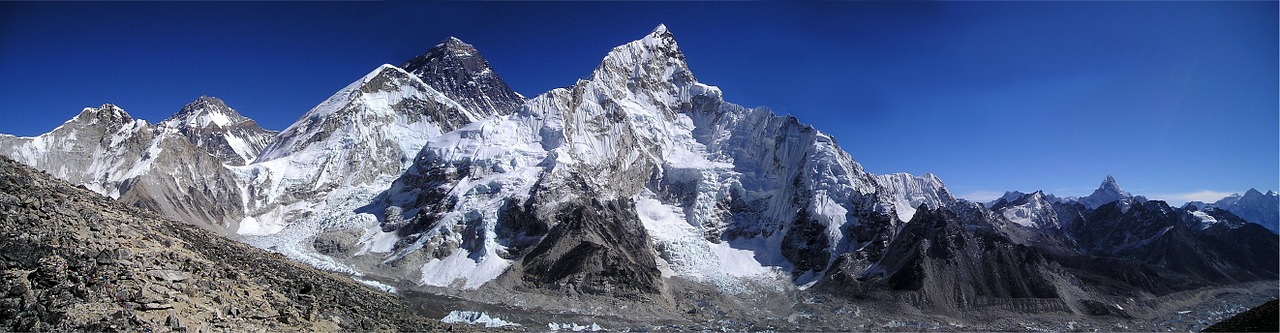
HimalaysLast month’s devastating earthquakes in Nepal were caused by the collision of the Indian subcontinent crashing into and (partly) under the bulk of Asia. The Himalayas are being created by the collision of tectonic plates. So, where are the volcanoes? That’s what I was asked when a friend wanted me to explain the Katmandu disaster.

Well, there are no volcanoes in Nepal. Nepal has huge mountains, of course, but not every mountain in the world is caused by a volcano (only a small percentage are, actually) – and relatively few nasty earthquakes are triggered by volcanoes. The nearest volcanic activity to Katmandu is a thousand kilometres northwest, in western China, where an eruption last occurred over 60 years ago. The action in far western China has produced a few cones, but no volcanic mountains. No one was hurt when the 1951 Kunlun cone erupted. In fact, the eyewitnesses – a road crew working in the excruciatingly remote region – reportedly said, “What the heck was that?” when the 1951 volcano shook and smoked. Then they went back to work. Before that, the last Kunlun Volcanic Group eruption was in 1850. To say the place is volcanically quiet is an understatement. And these are the nearest to Nepal of any volcanoes.  The Himalayas are not on fire.

There are no fire-spitting volcanoes in the Himalayas, yet most people think of volcanoes when they think of earthquakes,  mountains, and (Opa!) breaking plates. A “ring of fire”, for example, surrounds the Pacific Ocean with, well, a ring of volcanic fire. But there’s the rub – an ocean of water lubricates the subduction zones surrounding the Pacific. Ironically, water allows the ring of fire to exist while the lack of an ocean of water in the landlocked Himalayas quenches any possible volcanic action there.  When India and Asia collided 90 million years ago, the continental crust of the Indian tectonic plate sank under the Asian plate, deep into the Earth’s mantle, to a depth of 200 kilometres or more. It was a continent-on-continent convergence of rock. Sans water, except perhaps a bit that got mixed in when India first arrived from across the sea, from present-day Madagascar. But that was 90 million years before Nepal’s current borders were drawn on a map.

https://commons.wikimedia.org/wiki/File:Limu_o_Pele.jpg

Water – making volcanoes happen. (USGS Photo)

Why is water so important? Water decreases the melting point of rock. When water is conveyed into Earth’s deep nether places,  solid rock down deep may melt. The making of a volcano requires runny magma – melted rock. Oceanic plates have water-saturated sediments and crust, at least in their shallower sections. In places like Chile, Tonga, and the American Pacific Northwest, those wet sediments and oceanic crust end up deeply buried where the water vaporizes, rises, melts overlying rock, and forms volcanic magma. In the Himalayas, water doesn’t entire the mix. Instead, continental crust collides and piles up into mountains. No water, no melted rocks, no magma, no volcanoes. Just deadly earthquakes instead.

Posted in Geology, How Geophysics Works, Oceans, Plate Tectonics | Tagged , , , , | 13 Comments

Harry Hess and the Sea’s Floor

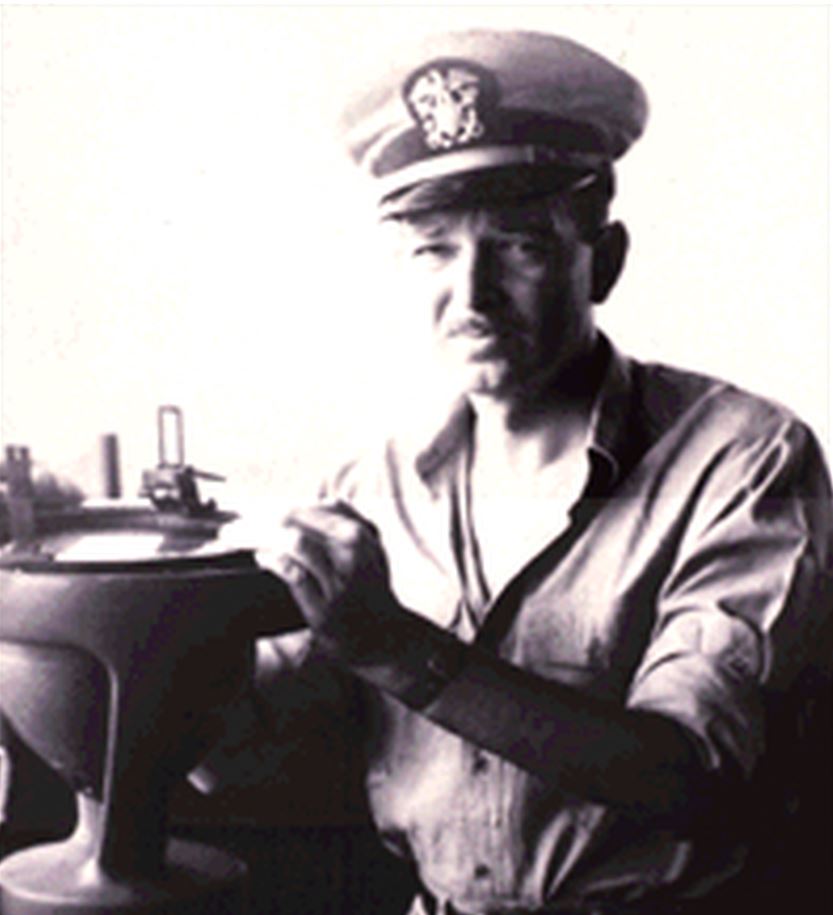
Captain Hess

Captain Harry Hess, 1945

What does a commander of a World War II assault transport ship do in his spare time? If the captain is Harry Hammond Hess, he would be gathering geophysical data enroute to Iwo Jima. Later, he would use the data to prove plate tectonics.

Geology professor Harry Hammond Hess was born in New York City on this date – May  24 – in 1906. The city was bustling with new immigrants and phenomenal growth. The world’s second largest city, it had nearly five million residents and was adding an incredible million people every five years. Harry Hess’s grandfather, Simon Hess, had started a construction company, which grew to include harbour dredging and dam construction. Harry’s father, Julian, became a member of the New York Stock Exchange. Harry’s mother came from Hammond, Indiana, where her father Julius owned a liquor distillery. That Indiana town was the origin of Harry Hammond Hess’s unusual middle name.

From Manhattan’s 22nd Ward, his parents moved to nearby Asbury, New Jersey, where Harry graduated high school with a focus on languages. He entered Yale at 17, tried electrical engineering, but switched to geology, then promptly failed his first mineralogy course. His professor advised him to change his major, convinced there would be no future for Hess in geology. I have great sympathy for Hess’s mineralogy fiasco. Except for the grace of my own mineralogy professor, I might have likewise been tossed from my studies. I am severely colour-blind, which I never disclosed to my instructor. Mineral identification depends on colour recognition and a good eye for shapes and patterns. I have none of that. The results of my lab exam were abysmal. My professor kindly looked for the few things I had accidentally identified correctly and (I suspect) nudged my mark up to a very slim pass. Coincidentally, my professor, Leslie Coleman, had been a Princeton student of the same Harry Hess who had failed his own introductory mineralogy exam. Despite Hess’s lack of eye for mineral structure and thin-section identification, Harry Hess stuck with geology and became one of the most innovative scientists of the twentieth century.

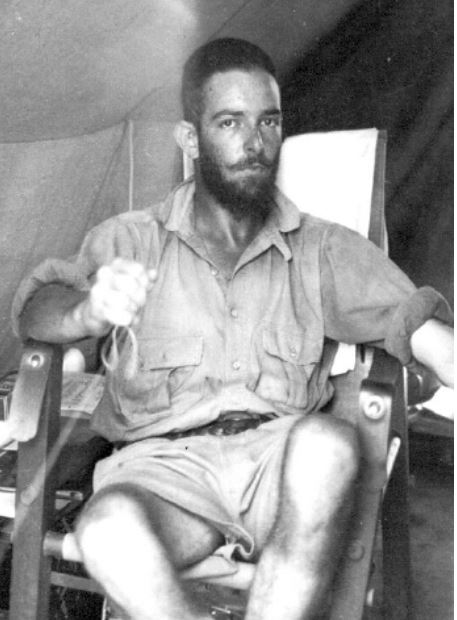
Harry Hess selfie, 1929

Harry Hess selfie, 1929

Hess finished his geology degree. Then, in a brash move, he left America and spent two rough years in remote northern Rhodesia, working and living in the bush with a native African team. They were prospecting in what is now Zambia, a country rich in copper, nickel, and uranium deposits. Harry Hess’s son, Professor George Hess, told me that this photo (right) is a selfie which Harry took while camped in Zambia – you can see the string he set up to snap the picture – it’s in Harry’s right hand. After two years, Hess returned to school, enrolling in graduate studies at Princeton in 1929. He once said he would have preferred Harvard, but had noticed “No Smoking” signs in all the geology labs. Knowing he could never give up his cigarettes, he selected Princeton.

Princeton, with its lax smoking regulations, was a good choice for other reasons. The geology program was solidly established. And Richard Field, a grandiose geologist who knew how to find research money, was established there. In three years, Hess had his doctorate. He studied a pale green rock called peridotite, an unusual igneous pluton made of olivine material originating deep below the crust, in the upper mantle. Those rocks –  his doctoral thesis material – had a similar structure to the last minerals Hess would ever hold in his hands, forty years later, just before his early death from heart disease aggravated by a lifetime of smoking. The final rocks in Harry Hess’s life were small chips of olivine which Neil Armstrong had brought for him from the Moon. Hess had helped make Armstrong’s trip possible – but we are jumping ahead in the Harry Hess story.

As a Princeton graduate student, in 1931, Hess assisted one of the first submarine explorations of the seafloor, working with Dutch scientist Felix Meinesz, a geodesy expert who was developing equipment to measure seafloor gravity while on a pitching, rolling boat. This was a near-impossible feat, similar to trying to measure one’s weight while swaying on a bathroom scale. Scales prefer quiet stability, the sort of calm a submarine offers when it sinks below the roiling seas. In the early 1930s, the submarine was the best vehicle to gather a reliable set of gravity data – but not every university had one. Through Richard Field’s formidable connections, Meinesz and Hess were outfitted with a US Navy sub to explore gravity anomalies in the West Indies. Six-foot seven-inch Meinesz worked cramped and hunched – submarines are built for much shorter men – as he measured the Earth’s gravity field by timing the swing of a pendulum. It was the first of many treks to the Caribbean for the scientists. To help with paperwork and approvals, Field made sure the government ranked Harry Hess as a reserve Lieutenant officer in the Navy. Ultimately, Hess would rise to the rank of Admiral.

Shortly after their last Caribbean expedition, the scientists were fighting World War II. Thanks to Field’s meddling, Hess was already in the Naval Reserve. The morning Japan bombed Pearl Harbor, Hess reported for duty. His first assignment during the war kept him in New York City, using geophysics to uncover enemy submarine positions in the North Atlantic. The navy was so successful that within two years the German submarine threat was neutralized and Hess transferred to battle duty in the Pacific.

As commander of the attack transport USS Cape Johnson, Hess made four major combat landings – including Iwo Jima, the most fierce battle in the Pacific. Hundreds of the 1,500 troops he personally piloted ashore died, though the Americans eventually overpowered the small island’s Japanese defenders. Ferrying troops and supplies around the sea was, of course, Hess’s main assignment. But between his various engagements across the Pacific, Hess gathered oceanographic data for the navy. Like many transport ships, the USS Cape Johnson was outfitted with depth-sounding equipment so the ocean bottom could be mapped – with military applications in mind. The depth-device, the fathometer, helped ships avoid crashing into submerged reefs, rocks, and enemy traps during beach landings, but as the forces edged closer to Japan, vessels with fathometers collected data which the navy turned into the first crude Pacific seafloor maps. Such maps helped captains confirm their ship’s position (often estimated by less reliable compasses and sextants) by noting features like submerged canyons and ridges. Hess and others mapped the ocean floor’s topography, knowing it would help the war effort, but Hess knew it would also be useful data for his science, helping unravel the nature of the seafloor and its evolution. Hess was not disappointed.

By mid-1945, Hess had measured many of the Pacific’s nether parts, including trenches ten kilometres deep among the canyons and crevasses that were nearly everywhere. Geologists had thought the seafloor was a broad and flat dirty sink collecting mud from the continents. Quite the contrary, according to the Hess data. The seafloor was alive with unexpected geological activity and unexpected topography. Harry Hess and his colleagues would eventually use these unlikely observations to prove the floor of the ocean was in motion, creeping along in murky darkness.

Fifteen years later, in 1960, Harry Hess put the Pacific data – along with his earlier studies from the Caribbean – together into a theory of seafloor spreading. Most of the world’s geologists were fiercely opposed to the idea of spreading seafloors and its corollary, drifting continents, so at first Hess cautiously presented his theory in a manuscript that became widely xeroxed and informally circulated.  Two years later, he published “History of Ocean Basins,” within an obscure collection called Petrologic Studies. He anxiously described his work as geopoetry, apparently in an attempt to diffuse some of the criticism he knew it would attract.

Hess hypothesized that the seafloor widens at the great global rift system’s volcanic fissures where hot magma emerges. Extreme pressure along the rift forces new ocean crust away from the ridge, then moves the crust across half the ocean. At the end of its enormous conveyor belt, it sinks at subduction zones, disappearing in the mantle. The basaltic ocean crust doesn’t pile up or accumulate. Hess’s spreading, subducting, mobile seafloor explains why so little sediment accumulates on ocean floors. And it explains why ocean crust is relatively young. Hess calculated the oldest ocean crust has survived 300 million years, but continental crust is more than ten times older. Within 300 million years, the new seafloor journeys from rift to trench, then descends into the mantle, never to be seen again. Meanwhile, continental material mostly stays aloft. By this insight, Hess explained the puzzling age difference between marine fossils found on the ocean floor (actually less than 200 million years old) and marine fossils lifted to mountain slopes (sometimes over 500 million years old). Any fossils not safely thrust up onto the non-recycling continents remain in the seafloor mud and are eventually destroyed at subduction zones.

Harry Hess, explaining the ocean crust cycle from spreading rift to subduction, 1968.

Harry Hess, explaining the ocean crust cycle from spreading rift to subduction, 1968.

“History of Ocean Basins” had critics, of course. But the paper was well-received by the new generation of scientists. For the first time, a scientific position on mobile continents was attracting more supporters than detractors. Hess’s history of the ocean basins was perhaps the single-most important contribution to the development of modern plate tectonics. His paper was cited more frequently than any other geophysics research paper, geopoetic or not. For a dozen years, it was the source material other geophysicists used when they wrote their own papers. Hess stated that the evidence for mobile continents was strong, however, in presenting his paper, he cautioned “It is hardly likely that all of the numerous assumptions are correct.”  But the most important ones were. The oceans spread; the continents move.

Harry Hess passed away at a relatively young age. He was just 63 when he collapsed at a meeting of the Space Science Board of which he had been chairman for years. It was in August 1969, within a month of the arrival of the first moon rocks. Hess had been one of ten men in America scheduled to perform tests on those first lunar samples. He made a few preliminary examinations and he hoped further studies would reveal evidence about the Moon’s formation. He lived long enough to see his theory of seafloor spreading and his contributions to plate tectonics widely accepted. Harry Hess, the navy admiral, scientist, and geopoet is buried at Arlington.

The preceding was pilfered from my book, The Mountain Mystery, the story of how scientists such as Harry Hess figured out that mountains were formed by plate tectonics. The book is published by Summit Science Publishing and printed by Amazon, where it is available on line.
.

Posted in Biography, Exploration, Geology, History, How Geophysics Works, Oceans, Plate Tectonics, The Book | Tagged , , , , , | 12 Comments

An Oil Man Blames the Russians

richmanThe wealthiest person in Oklahoma, conspiracy theorist Harold Hamm, claims that Russians are financing the anti-fracking movement in America. Of course they are. Russian spies meet at select Starbucks locations and hand over sealed envelopes stuffed with rubles so that Communist-anti-frackers in the USA can pay for water contamination tests in Pennsylvania and photos of frackingly-collapsed homes in Oklahoma.* It is reassuring that Mr Hamm is calling our attention to the Russian infiltration of the environmental movement. We need to be wary, Hamm figures.

poorguyOklahoma’s richest person is a fascinating character. Hamm is the youngest of 13 kids in a sharecropper family. He once worked at a gas station, pumping gas and changing tires. He went to work with a small oil company and built it into one of America’s largest businesses, Continental Resources Inc. (America’s Oil Champ, according to the company’s home page). It’s a world leader in fracking. He owns 70% of the company, making his share worth about 20 billion dollars – before the oil crash this winter. The drop in commodity prices (plus a one-billion-dollar settlement in his second divorce) cleaned out half of Hamm’s fortune. He seems to be making a string of mistakes. He sold off his oil futures in September, thinking oil would recover. It was $80/barrel at the time. Instead of rising back to $100 as he expected, it dropped into the 40s. He fracked up royally – this mistake that cost him billions. His company is not in trouble yet. He has slashed corporate spending 50%. But if oil settles below $50 (and I think it will for the next year or so), then Continental may be bankrupted.  It is rather painful to see an old man blame the world for his problems, but this seems the case now with 69-year-old Harold Hamm.

billion dollar cheque

Cheque Number 1004 from the Harold G. Hamm Trust to his ex-wife, for $974,790,317.77.
Makes you wonder who got the first 3 cheques from this account, doesn’t it?

The wealthy oil man claims fracking – which his company does very, very well – is being attacked by Russian-funded environmentalists. He brought this revelation to a conference sponsored by Forbes, the Reinventing America Summit in Chicago. He told Forbes that Russia has spent a lot of money to “cause a panic over fracking.” It seems more likely that the panic is because of polluted water and wrecked homes. But, maybe we can blame the Russians – they would like to wreck Mr Hamm’s business so more Russian oil can be sold.

Mr Hamm has other enemies to fight, too. He has been accused – according to the big pro-business publisher Bloomberg – of trying to get scientists fired from the University of Oklahoma’s semi-attached Oklahoma Geological Survey. It seems those earth scientists are finding a relationship between fracking and the earthquakes which have destroyed homes in Oklahoma.  Rather than looking for solutions and trying to mitigate the damages, Hamm is accused of trying to silence the messengers. Although severe earthquakes have increased 400-times in frequency since deep injection came to Oklahoma, Hamm seems to feel the two events are unrelated.

To the credit of the University of Oklahoma, the administration seems to have not buckled. Apparently, no scientists have been fired because of Mr Hamm’s demands. An e-mail exchange (released through an access to information) indicates that Hamm has had long talks with the university president and has been accused of pressuring for the firing of scientists who have claimed a link between fracking water disposal and earthquakes. Specifically, one e-mail written by the dean of the school’s Earth Sciences department after a meeting with Hamm says, “Mr Hamm is very upset at some of the earthquake reporting to the point that he would like to see select OGS [Oklahoma Geological Survey] staff dismissed.” The e-mail goes on to say that Mr Hamm would be happy to sit on the committee that would select the fired scientists’ replacements. I’m sure he would be. Nice that such a busy man would be willing to sit on a selection committee picking a couple of university research scientists.

Hamm, energy advisor to Romney: that job cost him nearly one million dollars.

Hamm, energy advisor to Romney:
that job cost him nearly one million dollars.

Mr Harold Hamm has been lauded for his philanthropy. He donated over ten million dollars to the university’s Harold Hamm Diabetes Center. But others have pointed out that this gift represents 1/1,000 his wealth and is the same as a typical middle-class American family (worth, say, $100,000), making a charitable donation of $100. And, since Hamm has Type 2 diabetes himself, it sort of becomes much less selfless. Still, it is ten times more money than Hamm donated to Romney’s presidential campaign. (He gave $985,00 to Romney’s Super-PAC Restore Our Future.) Hamm also allegedly exceeded the legal contribution limit by giving $117,000 to other candidates, according to news service Reuters. However, it is still a nice gesture for Hamm to give a wad of cash to the university’s Harold Hamm Diabetes Center. But if there are implicit expectations attached, it becomes less honorable.

The tragic part of this story is that Mr Hamm’s obstreperous antics threaten his entire industry. Until alternatives replace it, America needs its fracked gas. It is cleaner than the coal which it is rapidly replacing. It keeps America’s fuel money at home, out of the hands of Putin’s mafia. Gas production employs thousands of decent American folks trying to raise families. It has paid for kids’ piano lessons and university educations. But irresponsible dogmatic truculence might destroy the chance for environmentally-responsible development. Had he not been so ham-fisted, Hamm might have contributed to the Oklahoma University’s scientists’ effort to understand the earthquakes and to find effective remedies. Instead, Hamm provokes shutting the whole thing down – as happened in New York, Quebec, New Brunswick, some European countries, and dozens of American counties. Without proper environmental oversight, it should be sut down..

It seems Mr Hamm’s time is up. He was apparently not able to influence the university’s staffing decisions. His candidate did not become president, even after the million dollar donation. His company’s value has fallen in half. It will fall further when his loans are called this autumn – and not many creditors will care if the Russians are behind Continental Resource’s misery.

*Oil-related companies bought three houses after drinking water was ruined; 13 houses were destroyed in Oklahoma by fracking-related earthquakes.

Posted in Culture, Exploration, Geology | Tagged , , , , | Leave a comment

Mount St. Helens Day

Mount St Haelens, May 18, 1980.

Mount St. Helens, May 18, 1980.

Today is one of those trigger dates that remind me of how small I really am, a day that invokes memories of my life in younger years. Somewhat like September 11, 2001. (I was on Crowchild, heading towards work in downtown Calgary when I heard the radio report from New York.)   Today is May 18 – the 35th anniversary of the most destructive volcano most of us will probably ever experience. Mount St. Helens Day.  To tell the story of the volcano from my perch about a thousand kilometres north and east of the eruption, I’ll draw upon a short section from my book, The Mountain Mystery:

A Sunset of People

One of my geology professors at the University of Saskatchewan took great delight in describing what occasionally happens to volcano spectators. To be caught in a firewall from an active volcano is to be swept over by pelting fiery-hot ash.  Your lungs suck in red hot dust – if the shards of volcanic glass carried by hurricane-speed winds have not already stripped your flesh to the bone, which would ignite and disintegrate, of course. When the professor gave that description, it seemed he had been close to a volcano or two in his research.

But not as close as Katia and Maurice Krafft, a French husband and wife team who spent years filming unpredictable pyroclastic volcanoes from unsafe distances and repeatedly photographing lava flows within a whisper. In June, 1991, they were filming eruptions of Mount Unzen, on a southern island of Japan, when a pyroclastic flow unexpectedly swept out of a channel and onto the ridge where they and 41 other people were standing. They died instantly, along with journalists and several research observers – including Professor Harry Glicken. Glicken’s death by volcano also seemed inevitable.

The American volcanologist was the scheduled observer at Mount St. Helens ten years earlier, when that mountain exploded. Had he been there, it would have killed him. But Glicken had to attend business at a college in California and missed experiencing the 1980 St. Helens eruption. His replacement for the day, David Johnston, died instead of him, manning the doomed observation post that had been Glicken’s. Johnston, a promising young scientist, reported the explosion in his final words over a two-way radio: “Vancouver, Vancouver. This is it.” And it was. Meanwhile, for a few years, Harry Glicken postponed his own predestined death by volcanic eruption.

Rocks, trees, and people were pulverized during that 1980 Mount St. Helens eruption. I was twelve hundred kilometres away from the explosion, living and working in a Saskatchewan village near the Montana border. Two days after the explosion, the daylight sky turned grey. Although I was over a thousand kilometres from the explosion, enough volcanic dust had settled on the white cab of my truck that I could etch my name on the vehicle’s hood. I did not realize that parts of 57 humans were in that thin grey grit.

Volcanic ash and dust made the Saskatchewan evening skies spectacular with vivid pink, orange, and red accompanied by unusual shades of green and purple. Particles of dust from the mountain, several million trees, and those few dozen incinerated people tinted our Saskatchewan sky that spring. It was a dreary sort of lovely.

A Sunset of People

A Sunset of People

Posted in Geology, History, The Book | Tagged , | Leave a comment

Isostasy Man

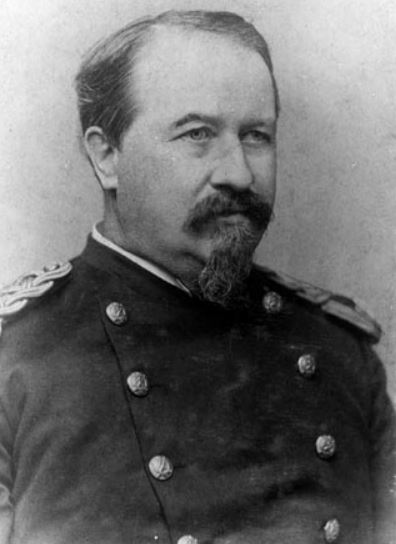
Major Clarence Dutton, around 1880.

Major Clarence Dutton, around 1880.

Since it was Major Clarence Dutton’s 174th birthday yesterday, I thought I’d give him a nod for creating a simple geological concept that almost every geo-freshman finds impossibly confusing. Isostasy should be as easy to understand as a melting iceberg on a warm Arctic afternoon, yet I have seen so many students throw up (their hands) and whine that they just don’t get it.

The word isostasy was invented by Major Dutton who used isos (equal) and stasis (standstill) to describe the way less dense crust (such as continental) stays aloft, hoisting mountain peaks high above us, while denser crust (oceanic) lies low – yet each exerts equal pressure on the materials underlying the crust. In a future blog I will explain the concept with a couple of examples. Today, I want to write a rambling piece about the soldier who was once described by Pulitzerer Wallace Stegner as America’s Poet of the West and who became a renowned and innovative geologist.

As a child of the early 1850s, Dutton was indoctrinated with the conservative religion of the New England boarding school which his parents selected for him. At age 15, he entered Yale divinity college in preparation for life as a minister, but something rational happened to him there. It took just two weeks for Yale divinity school to transform him into a lifelong agnostic. Dutton left divinity school but stayed at Yale, transferring to chemistry and physics. He particularly liked gymnastics and chess, though literature seemed his most natural subject – he won the Yale Literary Prize in his last year at college, in 1860.

Major Dutton

Major Dutton

The War Between the States started shortly after his Yale graduation. Dutton enlisted and participated in nasty  battles at Fredericksburg and Petersburg. He stayed in the Army after the war and then drifted, fully under-utilizing his recognized genius by simply taking mindless bureaucratic army posts – though he wrote a few significant papers in practical chemistry journals as a hobby. He was married, but not very ambitious – preferring to use his weekends drinking, puffing cigars, and debating science. After ten listless years, Dutton became best friends with the great American explorer John Wesley Powell who convinced Dutton to become a geologist. Major Dutton was soon one of the country’s best. He spent much of the rest of his life in the American West, exploring mountains, earthquakes, erosion patterns, and lava flows. The soldier from Connecticut was head of the United States Geological Survey’s Volcanic Geology Division – a role that placed him on volcanoes in California, Oregon, and Hawaii. His exploits included measuring the enormous depth of Crater Lake in Oregon and paddling down the Grand Canyon. Back east, he chaired a committee of like-minded geographers who formed the National Geographic Society.

Through his friendship with the explorer Powell, Dutton became expertly and intimately tied to the Grand Canyon, working on his geological study of the Colorado River and Grand Canyon area while he was a member of Powell’s survey. In 1882, he published The Tertiary History of the Grand Cañon District. His book was the first geological summary and atlas of the Grand Canyon and included this wonderful, colour woodcut made by artist William Holmes, under Dutton’s direction:

Dutton and Holmes, Panorama from Point Sublime, 1882

Dutton and Holmes, Panorama from Point Sublime, 1882

Dutton, after mapping the Grand Canyon and sounding the depths of the extinct Crater Lake volcano, turned to the study of earthquakes. He saw two possible causes: The world’s various earthquakes were either created by volcanoes or by who-knows-what – the latter being some unknown tectonic force. Dutton had a feeling that the restlessness of the Earth was related to a “layer of plasticity” beneath the planet’s thin crust. Although most geologists in the 1880s doubted the existence of such a fluid inner layer, Dutton felt so certain it existed that he wrote, “Reasoning or induction scarcely enters into it, it is substantially an observed fact.”

He suspected that this fluid layer was involved in the ever-shifting crust – building mountains, folding and shearing strata, and lifting or dropping masses of rock. He was nudging up close to the idea of plate tectonics a century before it was accepted science. He had a knack for creative critical thinking: Dutton also noted that earthquakes were thought to be a cause of mountain growth and faults in rocks. Dutton said the cause and effect were backwards – breaking rocks caused earthquakes; earthquakes were not the cause of broken rocks. “Just as thunder is an effect of the electric discharge, and not the cause of it,” he wrote.

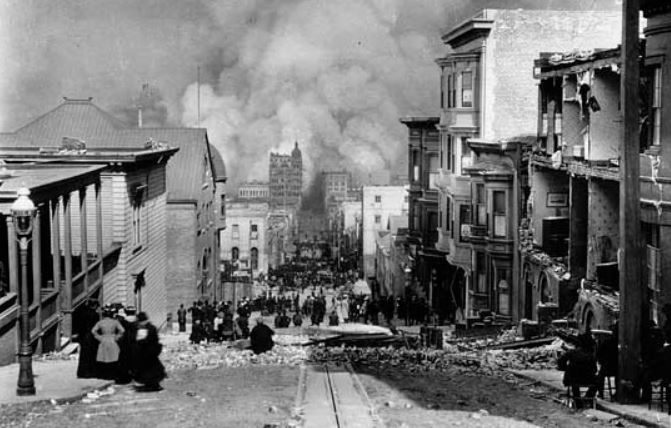
San Francisco, 1906

San Francisco, 1906

He was right, but at the time, it seemed that earthquakes, with their enormous destructive force, caused rocks to break and faults to appear. Quite obviously, earthquakes shear buildings and split streets. But Dutton was seeking the deeper cause, the force that actually generates earthquakes. This drive to understand the phenomenon really came to the country’s attention after the San Francisco earthquake. Geologists decided to map, measure, photograph, and trace all the faults they could in order to identify possible future dangers. Industrialist, robber baron, and philanthropist Andrew Carnegie stepped forward with cash for the Lawson Commission when government money didn’t materialize. The Commission’s goal was to try to understand and hopefully predict future events. From their studies, the geologists discovered that the San Francisco quake, and similar ones, occurred along pre-existing fault lines. They showed that the Earth’s crust slowly bends until it is suddenly returned to an undistorted position with the violent snap that creates an earthquake – exactly what Dutton had speculated.

Just before the 1906 San Francisco earthquake, Major Clarence Dutton wrote the best textbook about earthquakes up to his time. Dutton was a gifted writer and his book, Earthquakes in the Light of the New Seismology, does not disappoint. It reads like a novel and includes this passage about the earthquake experience:

“When the great earthquake comes, it comes quickly and is quickly gone . . . a matter of seconds. . . The first sensation is a confused murmuring sound of a strange and even weird character. Almost simultaneously loose objects begin to tremble and chatter. Sometimes, almost in an instant, the sound becomes a roar, the chattering becomes a crashing. The rapid quiver grows into a rude, violent shaking of increasing amplitude. Everything beneath seems beaten with rapid blows. . . Loose objects begin to fly about . . . the shaking increases in violence. The floor begins to heave and rock like a boat on the waves. The plastering falls, the walls crack, the chimneys go crashing down, everything moves, heaves, tosses. Huge waves seem to rush under the foundation with the swiftness of a gale. . .”

Dutton continues this description until the house is gone. “Or,” says Dutton, “suppose we are out in the country and the earthquake comes suddenly upon us. The first sensation is sound, a strange murmur. Some liken it to the sighing of pine trees in the wind; others to the distant roar of the surf; others to the far-off rumble of the railway train; others to. . .”  Well, you get the idea.

We celebrate Major Clarence Dutton. He was an engaging writer, intrepid explorer, and brilliant geologist – even if his legacy includes the difficult to digest idea of isostasy.

Posted in Biography, Geology, History | Tagged , , , , , | 2 Comments

Solid to the Core

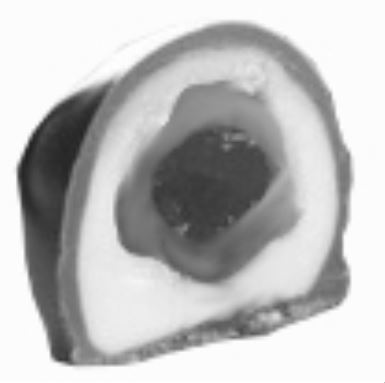
Choco-earth; choco-moon: both are equally edible.

Choco-earth

The Earth is like a chocolate-covered cherry. A bit bigger and harder to eat in one bite, but there are similarities. Like a cherry, the core is solid, but floats in a liquid. Next comes a thick layer of creamy fondant (in the candy) or mantle (in the Earth). Top this with a thin layer of crusty chocolate or crusty crust. Understanding the layers has been a slow process of earth-awareness. It was long obvious that the surface is solid and volcanoes suggested that something runny lies just beneath. Perhaps the biggest breakthrough in understanding the planet came from Sir William Gilbert who used magnetism experiments to figure out that the Earth has an iron core. That was around 1600 and not much happened for 300 years, as far as discoveries about the layers beneath our feet are concerned.

One of the first modern advances in understanding the Earth’s structure came in 1914. Beno Gutenberg, a German-born American, used the travel paths of earthquake shock waves to deduce that the center of the Earth is liquid. Earthquakes send seismic waves along the crustal surface – these, of course, knock down cows and houses. But at the same moment, two types of seismic energy (shear and pressure waves) travel downwards and pass through the Earth, emerging at distant parts of the globe. When they do, shear waves skirt a huge section of the inner Earth. They seem to disappear, causing a shadow zone on the opposite side of the planet. Gutenberg realized that the ripping, sideways-shaking shear waves would not pass through a liquid. He proposed, therefore, that the core of the Earth was a fluid. He was about half right.

Gutenberg’s discovery matched the 1914 data he worked with, but within a few years newer data made his hypothesis less sound. He had calculated a large, totally liquid core, but soon, seismic data from advanced seismometers didn’t quite fit the model. Although the shear waves were certainly missing, some of the pressure waves that passed through the core were emerging at unexpected places on the surface.

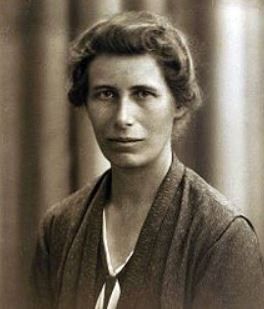
Inge Lehmann, 1935

Inge Lehmann, 1935

A remarkable Danish geophysicist, Inge Lehmann, fixed the discrepancy by theorizing that there are two different parts to the liquid ball which Gutenberg had imagined. An inner core was deflecting some of the seismic energy, allowing it to appear as the shadowy signals found on more modern records. She was right. Today is the 127th anniversary of Inge Lehmann’s birth. In 1936, at age 48, Lehmann made the discovery that the Earth’s center was not one homogenous ball of fluid. There are both inner and outer cores.

Lehmann’s father was an experimental psychologist who placed Inge in a progressive school run by Hannah Adler, the aunt of Nobel-winning physicist Neils Bohr. Lehmann credited her math and science skills, her creativity, and her perseverance to Hannah Adler’s gymnasium and to her father’s encouragement. She studied mathematics in her hometown at the University of Copenhagen, then attended Cambridge in 1910, at age 22. Soon she was mentally exhausted and left school to work at an insurance office for a few years, calculating actuary tables and premiums. Seven years later, she returned to Cambridge and completed her math and physics degree. With this, she returned to Copenhagen to assist a professor of actuary mathematics, but then she returned to work at another actuary office.

It would have been easy to expect Lehmann’s career to linger in a back room insurance office forever. Expectations and opportunities were not great for a female mathematician in the 1920s. However, she found work as an assistant to the Danish mathematician Niels Nørlund.  He placed her in charge of setting up seismological observatories in Denmark and Greenland. This was her first experience with seismic data, a field that demands clever math skills – which suited Lehmann very well. In 1928, she was accredited a doctorate in geodesy (the science of the Earth’s shape). Soon after, she accepted a position as Denmark’s state geodesist. She also headed the department of seismology at the Geodetical Institute of Denmark, which was led by Nørlund.

The discovery of the Earth’s inner core was a perfect convergence of a brilliant mathematician, a collection of appropriate data, and the vexing puzzle of errors in the model of Gutenberg’s liquid-core Earth. The appropriate data was from the seismic records she herself gathered from the network of seismic observatories she had spent years developing. Some of the world’s nastiest earthquakes happen in the south Pacific, a location that should render their energy mute when it arrives at her stations in Denmark. But instead she found the sneaky seismic waves exactly where they should not be. At first, she suspected equipment failure. But then she had her great idea.

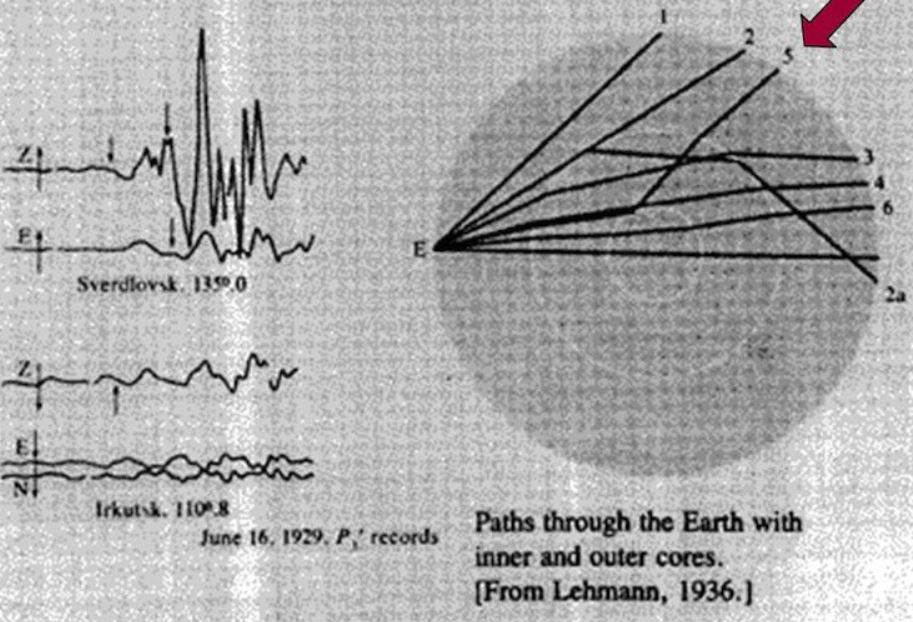
Attributing the seismic energy’s travel path to a boundary or interface within the core did not come to her in an inspirational flash. She spent years agonizing over the data, drawing little diagrams on bits of cardboard, filling notebooks with calculations. The solution finally emerged in 1936. She published her discovery in a paper named for the pressure waves that bent at a boundary within the core – she called the paper P’ (possibly the most succinct title for any scientific paper, ever).  Just for clarity – and not to take anything away from her amazing discovery – Lehmann did not claim that the inner core was solid in her landmark paper. She just recognized that there are both inner and outer cores which create the boundary that bends P-waves. It wasn’t until 1940 that Francis Birch and others realized the inner core was solid.

Ray paths of seismic energy, from Lehmann's 1936 paper, P'

Ray paths of seismic energy, from Lehmann’s 1936 paper, P’

Her discovery and her P’ paper were almost immediately accepted by most of the world’s geophysicists. One can almost feel the pain of 1,000 facepalms when the other scientists saw her work. Like many of science’s greatest discoveries, it is retroactively self-evident. But it was Inge Lehmann’s brilliance that brought the obvious forward.

Lehmann's new Earth model: from avocado to chocolate cherry

Lehmann’s new Earth model: from avocado to chocolate cherry

Lehmann’s work was far from over. She continued running the seismic observatories and worked at the university. But World War II, the German occupation, and Denmark’s isolation restricted her research for years. She was finally eligible for a full professorship, but was turned down – more likely due to her age (she was 64 when the missed opportunity came) than her gender. So, in 1953, Lehmann crossed the Atlantic to work with the indefatigable Maurice Ewing at his huge Lamont Geological Observatory in New York. She worked there for a number of years, investigating the Earth’s crust and upper mantle. Almost 70 (she lived nearly 105 years), her work led to the discovery of yet another seismic discontinuity, but a much shallower one than her inner-outer core boundary.

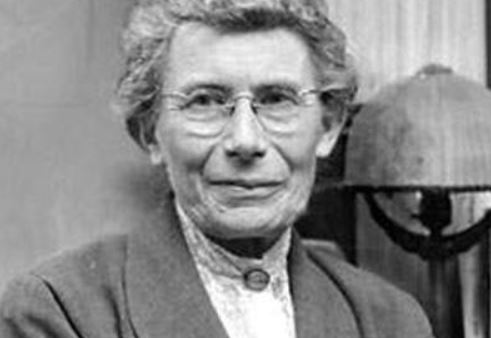
Lehmann, in the 1980s

Lehmann, in the 1980s

Lehman’s new boundary lies at depths between 190 and 250 kilometres. We call it the Lehmann discontinuity. It’s an interesting feature, but we aren’t really sure what it’s good for. The boundary is deeper than the better-known Mohorovičić discontinuity (upon which the crust glides), but the Lehmann hasn’t been associated with moving materials – not yet, anyway. There is a possibility that the Lehmann discontinuity is related to isolated plumes (such as Hawaii), but for now they are of a mysterious nature. Geophysicist Francis Birch noted that her discovery of the shallower discontinuity involved tedious techniques “by a master of a black art for which no amount of computerization is likely to be a complete substitute.” As much as the inner functioning of the planet, a human mind such as Inge Lehmann’s is also a wonder of nature. She made both of her amazing discoveries through mathematics and reasoning, deducing phenomena that occurs in a hot, dark, inaccessible place which no one will ever visit, unveiling mysteries using little more than pen and paper.

Posted in Biography, History, How Geophysics Works | Tagged , , , , , | Leave a comment

A Year of Mystery

I began writing this blog – The Mountain Mystery – exactly one year ago. So, as far as blogs go, this is a young one. It is a loosely cohesive collection of stories about the Earth. The only real themes around this place are a love of earth sciences and an occasional piece on the men and women who figured out where mountains come from (that’s the mystery). There really isn’t anywhere else that’s assembling a collection of vignettes about the nearly forgotten scientists who (just 50 years ago!) unraveled the mystery of mountain-building and showed that plate tectonics is the ultimate creator of all things high.

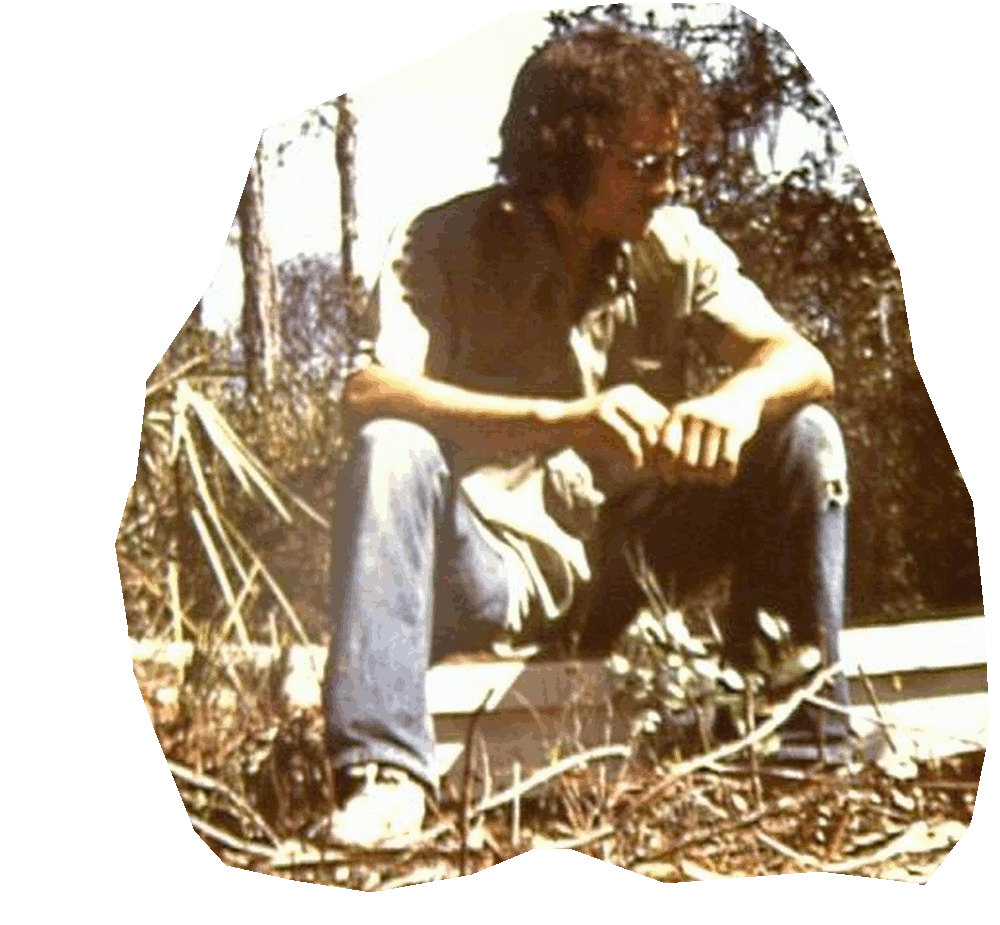
The author, hive sitting in Florida.

The author, hive sitting in Florida.

Since you are bothering to read this blog, you deserve to know a bit about the author. I was a Pennsylvania farm kid many years ago. We had honey bees on that farm so when I was 18, I  became a professional beekeeper by trade. That lasted for about 15 years. Those years were among my best – my bees produced a million pounds of honey and I sold it for them. In our exchange, I took the honey money they earned and I bought new boxes and new queens for those bees.  I helped them tour apple orchards in West Virginia, orange groves in Florida, and clover pastures in Wisconsin. The bees wanted to experience Saskatchewan when they heard that the sun always shined and bees always prospered on the wide plains – so I brought them to Canada.

Ron at Machu PichuEventually, the bees begged their freedom, so I left them and moved to Saskatoon, attended university, and earned an honours geophysics degree. Bessel functions, autocorrelation, and paleomagnetism were my thing. Among much else, geophysics took me on a magnetic survey looking for diamond-studded kimberlite pipes and took me to Peru where I taught something about seismic. Geophysics opened my eyes to the joys of critical thinking and scientific study – I hope a little of that comes through in this blog.

For these posts, my intention is to draw attention to the planet, the massive spinning rock we too often surficially take for granite. This old iron-hearted lady is much more than what meets the feet. She has great depth and many, many peculiar quarks.  I have a bit of curiosity about the history of scientific discovery, so I also occasionally write commentary on the way earth science became known. But in producing these postings, I quickly discovered that most readers of this blog are attracted to topics which stray towards controversy, especially  societal interference in scientific endeavours – the main theme of my book, The Mountain Mystery.

Among the 101 posts (85,000 words of pop-wisdom) published here in the past year, the relationship of science and society has comprised the most popularly read, linked, and commented material. My stories about Senator Cruz (Ted Cruz, the Science Guy), Stephen Hawking (The Theory of Everything), oil reserves in Cuba (Has Cuba Got Oil?), fracking (World’s Biggest Fracking Quake), and Russia’s warmongering in the Arctic (Russia’s Growing Pains) have been among the most visited. When I write about religion, evolution, pollution, and climate, my pages leap forward in the battle of the search engines. On the other hand, some of my articles on plate tectonics, magnetic rocks, and eighteenth century geologists have largely drawn yawns. Nevertheless, my first love has been science, so I will continue to bore the masses with tales of petrified bones and radioactive stones, even if only a few dozen people enjoy them – and even though they tend to be harder for me to research and write than the opinion pieces.

On the other hand, I will not shirk the responsibility of presenting and responding to controversy. I remind myself daily of the Greek lawmaker Solon who decreed it criminal for any citizen to avoid controversy. (I am guessing he grew up in a noisy household.)  Solon’s intention was to legislate community activism. That was around the year 600 BCE and his efforts led to the eventual invention of democracy. This blog will not invent democracy, nor even restore it to places where it is eroding – like Canada (where I live) or the USA (where most of my readers reside) although that is one goal. Hence, I will continue my political ramblings in this science blog for another year. Sunlight is a great sanitizer. And even a little artificial light sends cockroaches scurrying – as I discovered during my years of living in Florida.

Posted in Culture, Science Education, The Book | Tagged , , | Leave a comment