Infinitesimal

I just finished Infinitesimal –  a book that describes how a peculiar new idea was undermined by religion. Careers were ruined; people were imprisoned for promoting this idea that ran counter to prevailing religious notions. This time, I’m not talking about evolution. Nor the Earth’s position in the solar system. Nor the discovery of germs, the roundness of our planet, the existence of sub-atomic particles, nor the age of the universe – nor any of the many other discoveries that have left preachers and priests irritated and vengeful (until they eventually agreed with the science). For about two hundred years, it was math that was sinful. People who advocated calculus as a tool to investigate science could find themselves in considerable trouble with authority types.

infiniesimal bookThe book, Infinitesimal: How a Dangerous Mathematical Theory Shaped the Modern World, recounts (in considerable detail) the struggle between the Church and a group of mathematicians who found it useful to divide time, length, area, and volume into tiny pieces, then sum up all the pieces to solve various math problems. The volume of an irregular pyramid, the interest owed on a loan, and the circumference of a circle were early problems. When it became apparent that accuracy improved as slices became thinner and more numerous, mathematicians began to realize that exact answers might be found by summing up an infinite number of infinitely small pieces. That’s the heart of calculus and modern science requires this approach.

But the thought of anything being infinitely small and infinitely numerous was anathema to the bosses at the Vatican in the year 1600. It was contrary to spiritually derived knowledge – and contrary to the prevailing interpretation of Aristotle’s science. Such math was blasphemous. Books were banned and the idea of infinities was rooted out. A number of clever priests saw the value of calculus (as did scientists such as Galileo) but others (especially the Jesuits) saw heresy in calculus. God is infinite; oxcart wheels, beer steins, and cumulative interest are not.

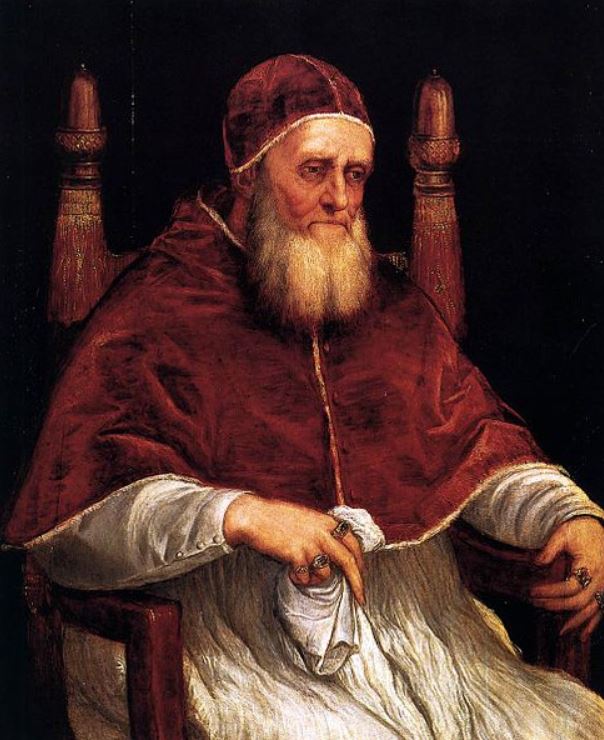
Pope Paul III - grantor of the Jesuits' charter, 1540. Ignatius, founder of the Society of Jesus told the pontiff it would be "The pope's own army," an enforcer of papal decrees.

Pope Paul III – grantor of the Jesuits’ charter, 1540. Ignatius, founder of the Society of Jesus told the pontiff it would be “The pope’s own army,” an enforcer of papal decrees.

Infinitesimal is an interesting book because of the era described and because of the tenuous situation mathematicians faced three or four hundred years ago. Unfortunately, I found Amir Alexander‘s telling of the story a bit tedious with much material revisited too frequently. I was paying attention and didn’t need to  be reminded of what I had just read. For example, some players were introduced two or three times, as if each occasion was their first appearance in the book. Infinitesimal needed a good edit before hitting typeset. Worse, parts of the book are simply dry, making for tough chewing.

Nevertheless, it is a fine historical documentation with convincing research and analysis. Until reading Infinitesimal, I was completely unaware of this particular Church vs Science battle. The author makes a strong case that religious opposition caused Italy to fall far behind northern Europe in math and science, dropping from first-place to something rather dismal, a condition from which Italy never recovered scientifically. The Church dictated what could be taught in schools under Rome’s influence. Calculus, for 200 years, was not part of the curriculum. Inevitably, it seems, churches eventually  do catch up with science. But sometimes it takes centuries.

Posted in Book Review, Culture, History, Religion | Tagged , , , , | 4 Comments

Monkeys on Trial

Darwinian Monkey-Man, 1871

Darwinian Monkey-Man, 1871

The monkey trial.  It was 90 years ago. We know the key players – the fabulously successful criminal trial lawyer who defended Scopes (but lost) and the 3-time Democrat presidential candidate (and erstwhile preacher) who attacked Scopes (and won). It was Clarence Darrow against William Jennings Bryan. But what about John Scopes – the young man on trial? Scopes, the teacher-defendant during the 1925 monkey trial was found guilty of subverting young minds with scientific ideas. You might think his life was ruined. And the judgement should have ended the pro-evolution and pro-science nonsense that was so rife back in the 1920s. The guilty verdict against the teacher should have put an end to the theory of evolution. But science keeps rearing it’s ugly head. So today, we know about things like DNA and mutations and genetic manipulations. We treat congenital disease, try to disrupt rapidly evolving bacteria,  and we fight cancer with ideas taken straight from The Evolutionist’s Songbook, instead of The Methodist’s Hymnbook. What went wrong? And what ever happened to John Scopes?

Scopes was 24 years old, hired to replace Dayton High School’s biology teacher for one year. But he actually taught algebra and physics during that year, and likely never gave a single high school lecture in evolution – which by 1925 was a 65-year-old scientific reality pretty much universally accepted by biologists everywhere. But Tennessee had outlawed teaching the idea in the state’s schools, believing that teaching evolution to children would make them act like monkeys.

Some inspired businessmen in Dayton, Tennessee, hatched a plan to put their town on the map and into the history books. Their leader was George Rappleyea, a geologist and the manager of a local coal company. Knowing Scopes had just a one-year teaching contract, Rappleyea asked Scopes if he’d mind very much becoming famous. The American Civil Liberties Union agreed to fund the defense of John Scopes. The trial attracted Clarence Darrow, the world’s most famous trial lawyer, as Scope’s defense attorney. In opposition was William Jennings Bryan, a fundamentalist, professional populist, and perennial failed Democrat candidate for president of the United States. In July 1925, radio was new and the trial was broadcast to a bored public that didn’t have much else to gossip about that summer. The Dayton businessmen were right – the trial caught the attention of the country and made their town famous. Think of it as, say, the 1925 equivalent of CNN’s coverage of the missing Malaysian airliner or OJ on a slow drive through LA. After eight days, Darrow lost, Scope’s was found guilty of teaching evolution and he was fined $100. But the case was overturned on appeal for a technicality. The anti-evolution legislation stayed on the books in Tennessee for just another 42 years, being repealed in 1967.

I guess everyone knows the cultural effect of the Scope’s Trial. Monkeys were allowed in biology textbooks, evolution was accepted by everyone, and science prevailed. Or maybe not. But some interesting points were made. Clarence Darrow cautioned that the Bible mentioned a talking snake, Eve’s construction from a rib and the mysterious appearance of Cain’s wife. (Where did she come from, anyway?) So it was obvious, to Clarence Darrow, that the Bible was not intended as a science textbook. If only such logic prevailed everywhere. Astonishingly, hostility against science in America seems as strong today as it was in 1925 – even if the anti-science folks don’t mind using scientific discoveries each and every moment of their miserable lives.

John Scopes, 1925

John Scopes, 1925

What happened to John Scopes? He learned his lesson. He quit teaching school. Scopes became a geologist. He realized his reputation as an earnest young Tennessee science teacher wasn’t going to carry his career very far. So he went back to college. Scopes earned a master’s in geology (he had minored in geology for his first degree). He worked for Gulf Oil in Venezuela, where he met his future wife. He was baptized as a Roman Catholic before they married. The couple settled in Houston where Scopes found oil and gas for United Gas Company. (Reserves that are millions of years old and made from the fatty bodies of some of our ancient cousins.) Scopes had a good career. John Scopes died in 1970, aged 70, in Shreveport, Louisiana.

Posted in Biography, Culture, Geology, History, Religion, Science Education | Tagged , , , | Leave a comment

License Plate Tectonics

I write about plate tectonics. I eagerly jumped from my news feed to the story: “License Plate Tectonics” after I read the headline. About time, I thought. We license everything else – hunting, fishing, driving, marriage. Why not license plate tectonics? There must be some money in it for the government. Make magma pay. License plate tectonics. When the story opened up on my computer screen, I slowly realized that I had fallen for click bait. Bait obviously intended to trick thousands of geophysicists into cranking up the Richmond Times Dispatch’s rank on search engines.

The word license, as used by the Dispatch, is an adjective, or perhaps a noun, forming the compound noun ‘license plate’. I thought it was a verb. In every part of the world (except for the USA) English speakers have licensed two licences. Here in Canada, with an ‘s’ it is a verb; with a second ‘c’ the word is a noun. But the Dispatch is an American paper, so they recklessly (and correctly) used the ‘s’ spelling for every instance of licence. After a while I realized the article was talking about licence plates – the clever sheet of metal attached to the rear ends of cars to give out-of-state tourists a reason to fear traveling. There was no magma anywhere in the story. (I read it twice, just to be sure.)

I am not going to go into a lengthy discussion on clarity of writing and honesty of intent (after all, it’s the internet that we are talking about); nor will I speculate about what Steve Pinker might write about the curse of knowledge and how it relates to this story. But I will continue to lament my disappointment – for both the lack of tectonic stories in the newspaper and for the persistence of Confederate symbols on Virginia licence tags, which is what the piece was really about.

Here’s an excerpt from the Richmond Times Dispatch story:

license plate tectonics

Posted in Culture, Plate Tectonics | Tagged , | 3 Comments

Another day, another dinosaur

You have to wonder when all the dinosaurs will be found. When will nothing remain to be discovered? That day is apparently a long way off. New dinosaurs keep popping out of the ground. In my home province, Alberta, it’s another day and another major discovery. Last month, it was Regaliceratops peterhewsi — a new genus and species of ceratopsid, or horned dinosaur. It lived about 68 million years ago and has been nicknamed Hellboy because it resembles Hellboy, a comic book character with yellow eyes and (usually) a cigarette dangling from its muppet-like mouth. I suppose that’s what Regaliceratops also looked like when she was alive and smokin’ back in the Cretaceous.

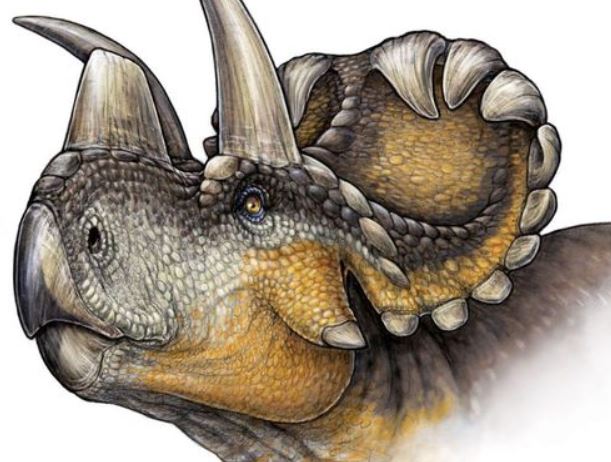
Wendiceratops

Wendiceratops pinhornensis

Today another new triceratops was announced. The triceratops family is growing – there are twice as many species known today as just ten years ago. The latest find is the Wendiceratops pinhornensis. Named either for the little girl from Peter Pan’s world, or else for Wendy Sloboda, the intrepid legendary Alberta humanis who regularly discovers fossils of exciting new species. Congratulations to her for having a huge three-horned animal with a six-metre body and a large, frilled bony-shielded face as a name twin.  The 79-million-year-old bones represent a nosey, socially active creature that travelled in herds and probably used its frills, horns, large nose, and spectacular (though as of today, unknown) colouration simply to attract attention. Very nice and very sociable, but it is the real Wendy that I’d rather have tea with.

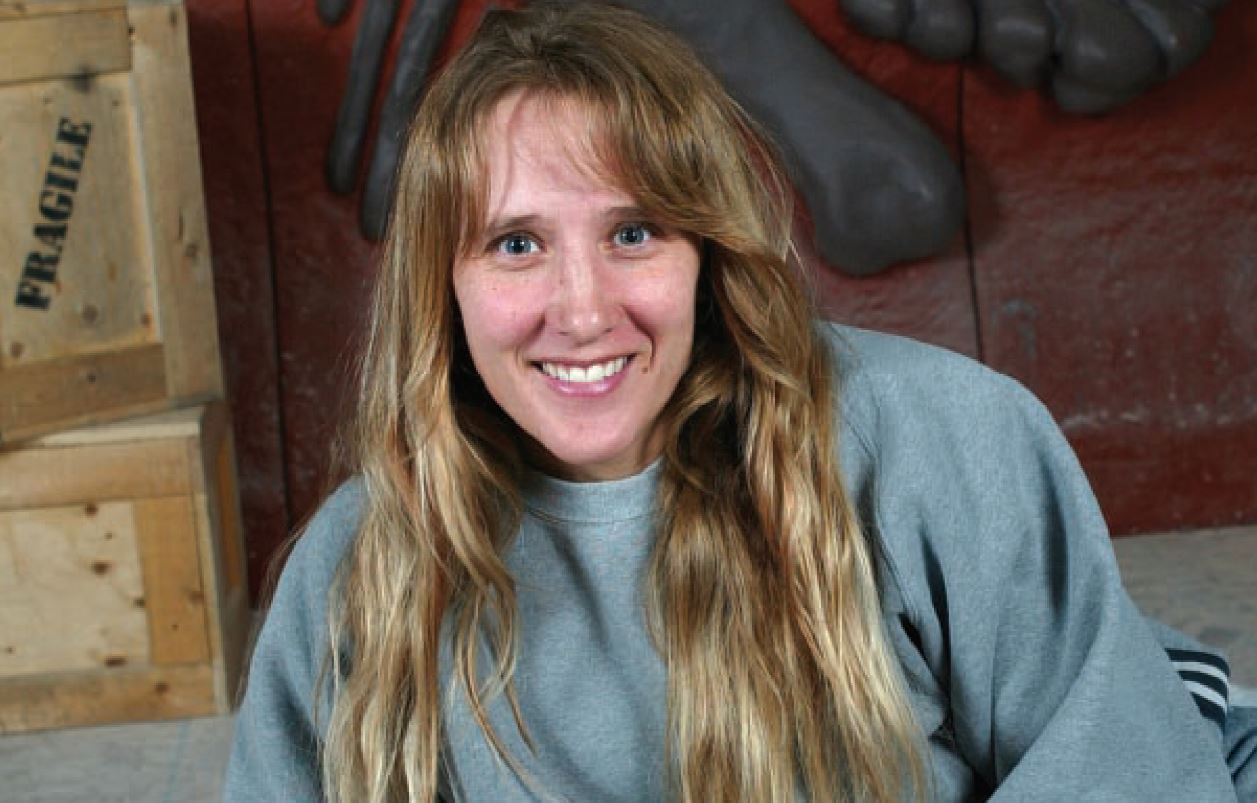
Wendy Sloboda. Photo from Journal, the University of Lethbridge Alumni Magazine.

Wendy Sloboda. Photo from Journal, the University of Lethbridge Alumni Magazine.

Wendy Sloboda is a paleontological technician with a Bachelor of Arts (2001) from the University of Lethbridge (Alberta).  She discovered bones in Mongolia’s Gobi Desert that may be another new dinosaur species. And last year in Argentina, Sloboda discovered the footprint of yet another new dinosaur. They named it for her – it’s the Barrosopus slobodai, a ground-dwelling birdish carnivore. Imagine if the two creatures named for Wendy Sloboda (Wendiceratops pinhornensis and Barrosopus slobodai) were assembled in a museum as one giant man-eating, big-nosed bird-footed three-horn. The Wendiceratops slobodai. Ah, that would set paleontology back a few decades, wouldn’t it?

Posted in People | Tagged , , , , | Leave a comment

Finished Science

I have been reading Jerry Coyne’s new book, Faith vs Fact, and the evolutionary biologist makes a clear point that scientific understanding evolves as much as biological entities. In his book (which is a solid testimony of what science is really about), Coyne reminds us that “Absolute and unalterable truth is for mathematics and logic, not empirically based science.” He reinforces that sentiment with examples of how our understanding of diverse realms such as astrophysics and biology have mutated with the advent of new knowledge and new theories. There is the implied caution that we shan’t be too comfortable in our current state of scientific brilliance: tomorrow’s Rutherford may see the career of today’s Lord Kelvin end in a similarly pitiable heap of discredit.

I briefly set aside my copy of Faith vs Fact and read a brief note from Science AAAS/News: “Earth’s colossal crater count complete.” That’s a rather unambiguous statement of scientific empiricism. The article claims that there are precisely 128 large impact craters on the surface of the Earth. Of those, 70 have diameters greater than 6 kilometres. And, says the Science piece, no more are left to be discovered. We have found them all. It is a bold statement, but there will be a fall from grace when another crater is discovered – either after melting ice exposes Greenland or Antarctica to careful examination or in some hither-to-undiagnosed ring of crumpled earth.

The original paper of this crater-count study, to be published in a September issue of Earth and Planetary Science Letters, is less unambiguous than the leader-column that appears in Science AAAS/News. In the original’s abstract, the research geophysicists make the less bold statement that the crater inventory is “probably complete.” I am comfortable with that caveat, but I wonder how many news organizations sold their stories based on the promo release and didn’t bother to read the fine print.

The most important point in the paper by Stefan Hergarten and Thomas Kenkmann (The number of impact craters on Earth: Any room for further discoveries?) is their calculation that there are approximately 340 smaller unknown craters with diameters between 250 metres and 6 kilometres which aspiring explorers may seek. To make this estimate, researchers Hergarten and Kenkmann, both at the University of Freiburg, considered the number of meteorites that strike our atmosphere, the number of strikes that result in meteors which create craters, and the endurance rate of those craters.

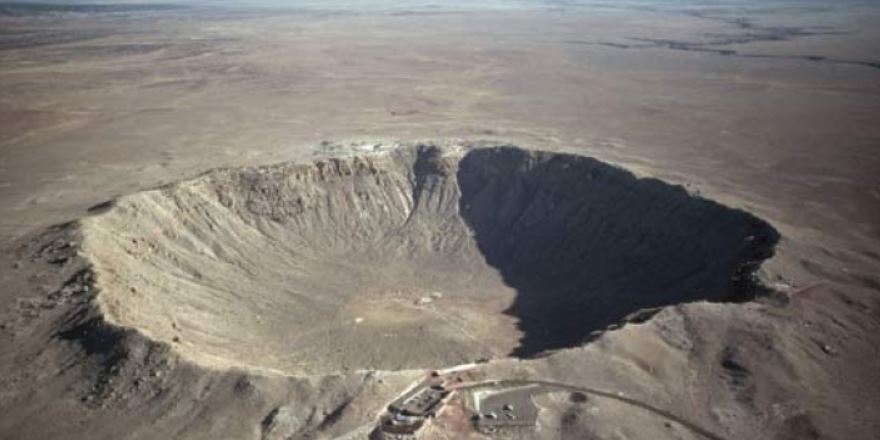
Meteor Crater in Arizona: Slowly eroding.

Meteor Crater in Arizona: Slowly eroding.

On the Earth, a conspiracy of wind, rain, and ice reduces craters to plains. The oceans, of course, mostly absorb impacts without building any craters. And a small portion of impact craters are digested at tectonic subduction boundaries. Mars – with no oceans, a thin atmosphere and no active surface tectonics – has about 300,000 visible craters; the moon has millions. By the way, even in its lunar vacuum, the moon’s seismically dead surface is still affected by a thin cloud of dust which very, very slowly erodes structural features. One day Neil Armstrong’s lunar footprint will live only as an image in a future species’ data storage. Today’s smaller lunar craters will flatten. But it will take billions of years.

Why should we seek these small unknown Earth-craters? Because each has the potential to reveal some new nugget of science fact. Craters, for example, have taught us most of what we know about mineralogical changes due to extreme heat and pressure – industrial applications have resulted. Each new crater also has the potential to reveal some literal nugget in the form of a fresh meteorite which may tell us more about the solar system or even (though less likely) about life on Mars.  And finally, geophysicists will seek the remaining craters just to satisfy insatiable curiosity and to be able to announce – perhaps a hundred years from now – that all the craters have been discovered. But even then, they will probably be wrong.

Posted in Exploration, Geology, Space | Tagged , | 8 Comments

The Mystery of The Worldwide Hum Phenomenon

I am reblogging this because it is intriguing and I don’t know what to think about it. A worldwide hum? It is not quite worldwide as it seems to other the ears of the wealthy North Americans and Europeans more that any other people. Is it a hoax? A First World Problem? What do you think?

Posted in Culture, Environment, Reblogs | Tagged | Leave a comment

USA and Vietnam may go to war again – as Allies

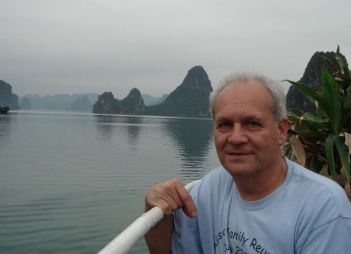
This author, at Ha Long Bay

A geophysicist at Halong Bay

I was a kid during the Vietnam War. I remember the nightly television scenes of boys not much older than I was, crawling through rice paddies while explosions ignited around them. Some of the young men were relatives, others were neighbours.

A few years ago, I was in Vietnam and reflected again on the war which the Vietnamese call the American War. For the youthful people whom I met, it was their grandfather’s war. I was a gray-haired North American on the streets of Saigon (Ho Chi Minh City) in a wheelchair and was often mistaken for one of the many American veterans who now come to meet ghosts of their past and to pay tribute to their fallen comrades. The Vietnamese were enthusiastic in their remarkable kindness towards me, other visitors, and the infrequent American war vets.
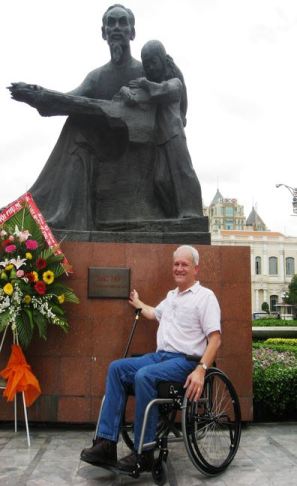
Bac Ho (Uncle Ho) says the plaque. Bac is a title of great respect in Vietnam, which honours Ho Chi Minh as the father of the country's independence from French colonial rule.

Bác Hồ (Uncle Ho) says the plaque to my right. Bác is a title of great respect in Vietnam, which honours Ho Chi Minh as the father of the country’s independence from French colonial rule.

After America’s grueling 8 years of war in southeast Asia, few would have expected the warm reception which Americans now receive in the country (which still reveres Ho Chi Minh and still waves the same communist star from flag poles everywhere). In Saigon, my only anxious moment happened when I was alone, crossing a busy street. I was in my wheelchair and had almost made it to the opposite curb when the light changed. Unfortunately, the opposing sidewalk which I had reached was about ten inches higher than the street and there was no ramp.  I couldn’t get up to it, and I was in danger of being flattened by several hundred on-coming vehicles. In a flash, two rough-looking young Vietnamese men hopped down from the sidewalk and lifted me and my chair to safety.

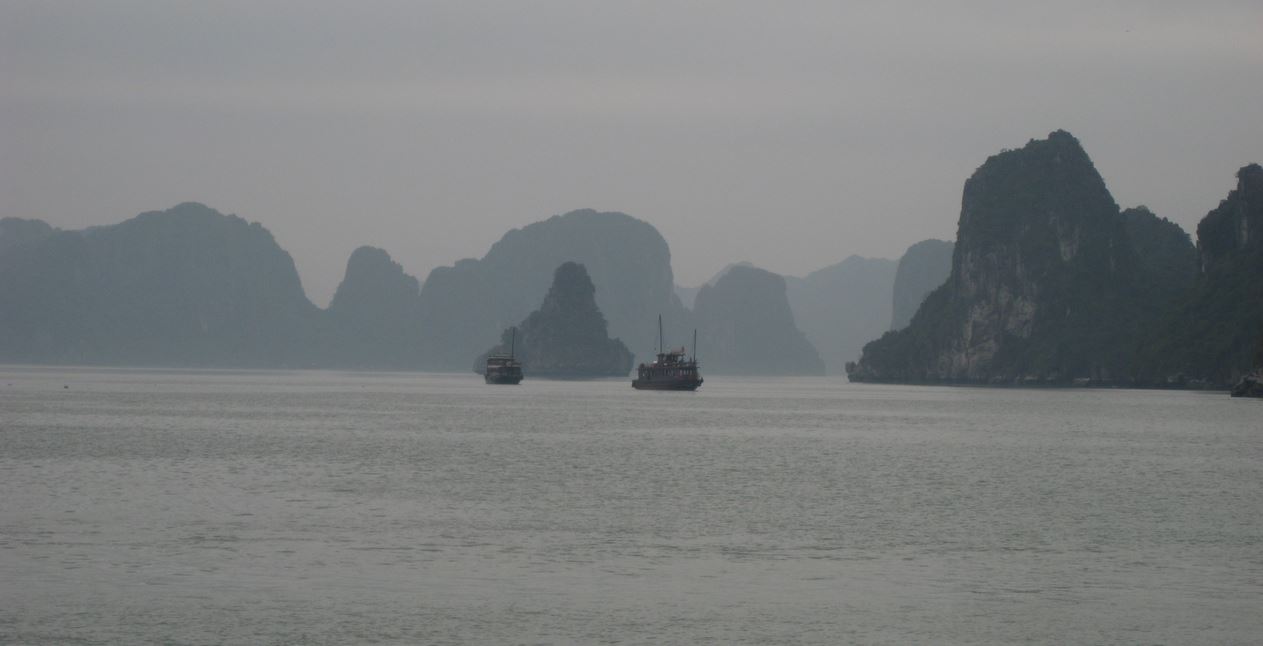
During my stay, which was partly a business trip, I sailed on Vietnam’s Halong Bay, within the Gulf of Tonkin, in northern Vietnam. I wanted to see the amazing limestone islands that poke through the water like gray and leafy-green bowling pins. In the ancient past, reefs built upon reefs upwards a thousand metres while the sea deepened, then a karst erosion and tectonic uplift created today’s eerie landscape. On the sea, between islands with cliffs, cays, and caves, are floating villages of fishermen while deep below are fields of oil.

Reaching Halong Bay is a small adventure – it’s 120 kilometres from Hanoi. This took 4 hours by minivan – we met thousands of bicycles, heavy trucks, buses, and a single train whose track intersected the QL-18 Highway again and again, giving us a chance to wave at the same engineer each time his locomotive blocked our path. At the gulf, it was physically challenging for me to clamber down the steep concrete steps to the gangplank, then clamber aboard the craft. (I can walk a bit, but usually need a wheelchair to get around.) It was worth the challenge. After a lady on a heavily-laden boat sold bananas and pineapples to our captain, we drifted further from the shore, then roamed the islands along the coast for six hours. I was there for the geology. I didn’t expect a lesson in politics.

ha long village2Aboard our boat were twenty tourists. Most, like me, were from far away – Singapore, Holland, the USA, Finland, Canada. Other tourists were Vietnamese. As our small craft plied between the islands – looping to Cat Ba, Sung Sot Cave, and back to Halong, everyone mingled and chatted. English was the common language. I had spent a few months studying Vietnamese before leaving Canada – I was, of course, relieved that English was the language of discourse.
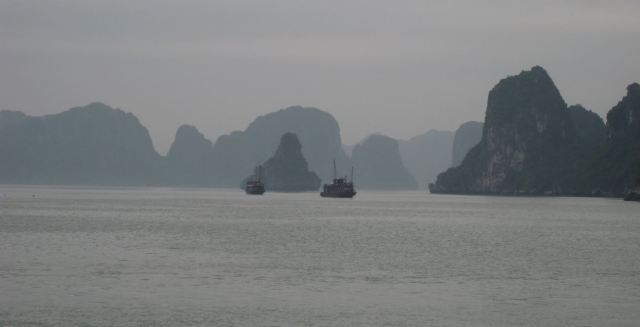
halong ships and islandsOur tour of Halong Bay was rather cheap ($20/person) and included a great lunch of seafood and fruit. (Beer was extra.) I sat between someone from China and someone from Saigon as we dug into the fresh fruit and sea food. The person from Saigon, I discovered, worked for Petrovietnam. She had a well-paying job and could afford to travel north and tour her country. I remarked that Vietnam has quite a lot of offshore oil and gas, especially far to the south. Almost as an instinctive reaction, the person from China shouted, “No! It’s ours!”

My innocent remark unleashed a short-lived but energetic discussion about the South China Sea and the control of its petroleum. The remote marine oilfields had the attention of both countries. To me, Vietnam has the stronger case. China is far from the petroleum and the hotly-contested cluster of reefs and islands, but China has claimed groups of islands on what they say is an historical basis. “Our ancestors used to fish the entire South China Sea,” says Sheng Ding Li, a spokesman at Shanghai’s Fudan University. Possession of the seas depends on historic use, but in international law, occupation and presence is a big part of ownership.

Territorial claims in the South China Sea

Territorial claims in the South China Sea
Image from Japanfocus.org

Distances out here are much larger than you might expect. For example, my 2-hour flight from Saigon had taken me 1,200 kilometres north to Hanoi. This is greater than the distance from Italy to Sweden, yet I was still in Vietnam.  It would have been half as far to fly out to the garrison guarding the contested Vietnamese islands in Trường Sa, also known as the Spratly Islands. Mainland China is about 2,000 kilometres from the Spratlys. The Spratly Islands are one of several island groups that figure large in any discussion of sovereignty and oil in the South China Sea. Parts of the South China Sea are claimed with equal passion by China, Vietnam, Malaysia, Japan, the Philippines, Indonesia, and the Sultanate of Brunei. The Philippines claims eight islands in the Spratlys while Malaysia claims three. Vietnam, Taiwan, and China each claims all the islands of the Spratlys and the Paracels farther north, as well as nearly all of the South China Sea. Although international economic zones are limited to 200 kilometres (120 miles) from a country’s coast, possession of distant islands can expand the amount of ocean waters claimed one hundred fold.

No one knows how much oil may lie beneath the waters here. The South China Sea reaches a depth of over 5,000 metres where the seafloor is basaltic ocean crust and petroleum is absent. But that patch of tough ocean crust – all of it at least 3,000 metres below the waves – is a relatively small part of the South China Sea. Surrounding the oceanic crust is a larger region of shallow (200 metres) continental shelf. The ring of continental shelf has a lot of oil and gas, much of it within reefs similar to what I saw exposed in Halong. The Halong reefs are limestone islands; the oil-rich reefs to the south are below the sea, buried in reservoirs deep within the continental shelf. I worked with some of the seismic data from Petrovietnam. The pools that have been built by tectonically shifted crustal blocks are messy for geophysicists to figure out, but there are plenty of oil-soaked structural traps in the South China Sea. Some of the pools of oil are hundreds of metres thick.

The disputed South China Sea has cautiously estimated reserves of 7 billion barrels of oil and an incredible 900 trillion cubic feet of natural gas. There is likely much more awaiting discovery – China has announced they expect the total recovered South China Sea oil will be 130 billion barrels.  That may be an overstatement. But maybe not. Countries have gone to war for much less.

Not long ago, state-owned China National Offshore Oil Corporation placed rig HYSY-981 within disputed waters close to Vietnam. This caused anti-China riots in Vietnam and led to 21 deaths among Chinese, many of whom were citizens of Vietnam who had been living in the country for decades. To protect the oil rig near the Viet mainland, the Chinese government surrounded their platform with 112 military vessels. Vietnamese fishing boats that got too close were hit with water cannons, boarded, and fisherman were detained for weeks. Having proved their power – if not the well’s success – the Chinese national oil company removed the drilling platform and its Navy withdrew. For the moment.

Besides pressing oil rigs into waters claimed by other countries, China has also engaged in island-building exercises. This is a crafty way to expand territorial claims. China is pumping millions of tonnes of reef debris atop slightly submerged atolls, raising little knobs of drowned land high enough to permanently post soldiers and Chinese flags. Such manufactured islands are also buttressing lighthouses, artillery, and airstrips.

China's island building - photo by Bloomsberg

China’s island building – photo by Bloomberg

The Paracel Islands – reefs and atolls that have a slightly higher elevation – were grabbed by China during a brief aggressive war against Vietnam in 1974. Vietnam, exhausted by the American War which had ended just a few months earlier, was no match. China’s claim to the Paracels has not been generally recognized, but in July 2012, China established the “city” of Sansha in the Paracel Islands when it plopped a thousand people into the city. Again, under international law, occupation and presence is a big part of possession.

The Vietnamese military can not stop China’s sand pumps, island occupation, or its battle ships on the seas. The Chinese navy is perhaps a hundred times larger. China’s economy is 40 times larger than Vietnam’s. China has 1.4 billion people, Vietnam has 90 million. Vietnam’s response has been mostly diplomatic, and mostly ineffective.

Holiday Cruise

Holiday Cruise, anyone?

Like the Chinese, the Vietnamese established garrisons on several remote islands. In a novel attempt to assert ownership, one can board a holiday cruise in Saigon and sail out to the Spratly Islands as a signal of solidarity with the Vietnamese. I can hardly imagine a less interesting cruise, unless your tour boat is hit by Chinese water cannons or you are arrested and held by the Chinese for trespassing. Tour-stops include Nam Yết, one of the larger of the Spratlys. There is not much to see. Nam Yết is less than a kilometre long, and not quite 120 metres wide. On this speck are a couple hundred soldiers, some vegetable gardens, paved footpaths and palm trees. This I observed from Google Earth, which is about as close as I will get to walking on a Spratly.

China’s oleaginous rig stunts, island-building, and aggressive cannon flexing has aroused the attention of regional neighbours (Japan, the Philippines, Malaysia) as well as powerful potential allies such as Russia and the United States. Russians and Americans have entered on the side of Vietnam and other states which are growing nervous about China’s aggressive expansion. Russia has defense treaties with Vietnam – the Russian navy is the only one in the world allowed to enter Vietnamese ports without prior permission. (Other nations are allowed one unannounced visit per year, though that will likely increase.) The entire issue melts down to an international effort to curb China’s claims to ninety percent of the South China Sea. A successful claim by China would interfere with maritime freighters. About a third of the world’s trade passes through the sea. There is also the issue of oil, of course.

Vietnam has reached out to the USA, seeking help in its defense. The Americans insist that the USA is not a claimant in the disputes, but instead is concerned about the militarization of the South China Sea. Americans surveillance planes have spotted Chinese artillery on disputed islands. The irate Chinese responded by ordering American planes to quit spying and leave the area. They even issued a statement that if Americans continue to provoke them, war would be “inevitable”. Visiting Hanoi, American Defense Secretary Ashton Carter said that the USA “will not be intimidated” by China.

Declaration of IndependenceIt would be terribly ironic if the United States should fight alongside Russia to defend Vietnam’s sovereignty. The Vietnamese consider the American War a war of independence against colonial rule. At the War Remnants Museum in Saigon (Ho Chi Minh City), I took this photograph of a prominently displayed sign. It is the first paragraph of the American Declaration of Independence – something which I memorized as a Pennsylvania school child, and which I still recall verbatim, as do many people who were educated in the USA.  It may be that Americans – motivated by China’s expansion and the existence of petroleum reserves – will again be involved in  Vietnam’s independence.

Posted in Culture, Exploration | Tagged , , , , | 4 Comments

Global warming: Science-denying Senator tells scientist Pope to listen to scientists

I’m reblogging an interesting piece written by Paul Braterman on his blog site. It’s a commentary on the rather dismal state of science and politics as the US presidential race enters its final stretch (just 17 months to go, folks!). Here’s a brief clip: “Ted Cruz tells us that Galileo was condemned for denying that the Earth was flat. But the trial was in 1633, 141 years after Columbus had sailed to America, 111 years after Magellan’s expedition completed the first circumnavigation of the globe…” No, Senator Cruz, Galileo was not spending his time denying the “Flat Earth” theory. Instead, the Church was denying Galileo’s idea that our planet circles the sun. Ah, but those are just facts. Misleading angry rhetoric is what America’s new Science Guy really wants.

Paul Braterman's avatarPrimate's Progress

Coat of arms of Franciscus.svg Pope Francis’ Coat of Arms

Well, perhaps not quite a scientist, but Pope Francis really does have, on his CV, a chemistry lab technician’s diploma and related work experience. And Rick Santorum is not quite a Senator, either, more of an ex-Senator, having lost his seat in 2006, but nonetheless a candidate (yet again) for the Presidency of the United States.

Pope Francis also worked for a while as a nightclub bouncer. Nothing to do with the matter in hand, but I thought I’d mention it.

One further irony is that Santorum is a devout Catholic, who describes Catholicism as the source of his politics, and attends Mass almost daily.

Galileo Galilei, age 60, by Ottavio Leoni

As Santorum should know, Popes have for quite a while had a reasonably good record of listening to scientists. There was, of course, that unfortunate business of Galileo, but that…

View original post 1,836 more words

Posted in Environment, Reblogs, Religion, Science Education | Tagged , | Leave a comment

Criminalizing Geology

A law in the state of Wyoming makes it illegal to sample, photograph, or even make written observations about a piece of land that belongs to someone else – if the information will be sent to any government agency, state or federal. Presumably, the 8-year-old in the back seat, randomly snapping pictures enroute to Yellowstone, is exempt. So who is this law targeting? It will stop anyone wanting to submit photos or samples of pollution dumped into streams or rivers which cross private property from accurately reporting such misdeeds. This should be a bone to mining companies, heavy supporters of politics in Dick Cheney’s home state.

cjonescu's avatarThe Grumpy Geophysicist

Yep, the New York Times notes that, among other odd state laws, that Wyoming has enacted a law that “makes it a crime to take photographs of or make written observations about a piece of land that belongs to someone else.” While the Times includes it in a collection of kind of humorous laws, Slate has a piece that outlines just how pernicious this bill really is (the assertion in that piece is that this is to discourage collection of any data that would be used to invoke the Clean Water Act).

You can read the law yourself.  Basically it outlaws, among other things, geologic mapping in the state as you cannot

…take a sample of material, acquire, gather, photograph or otherwise preserve information in any form from open land which is submitted or intended to be submitted to any agency of the state or federal government.

So watch…

View original post 36 more words

Posted in Environment, Reblogs | Tagged , | Leave a comment

Getting Naked on Mount Kinabalu?

Goofing off on Mount Kinabula. It's all fun and games until you're thrown into a Malaysian prison. (photo from Mount Kinabula Facebook page)

It’s all fun and games until you’re thrown into a Malaysian prison.
(photo from Mount Kinabula Facebook page)

If you have been following the seismic news, you have heard that a small group of merry-makers are being held in Malaysia for showing flesh on the wrong mountain. Their antics caused an earthquake, killing at least 13 people. The tourists were allegedly posing nude and/or nearly nude near the summit of Mount Kinabalu. Since the mountain is sacred to the fragile sensibilities of the Malay, such disrespect rankles the righteous. As it should. Personally, I’d be quite irritated if people stripped to their birthday suits on Mount Sinai, for example. Or if they sported a swimsuit while touring Saint Mark’s Basilica on the flooded Piazzo San Marco. Should I be so prudish? Yes. If there is a god guarding such holy places, surely he wouldn’t care. I would hope he has a sense of humour. Besides, he can always burn the miscreants’ souls in Hell later. But my irritation against anyone not following the rules is not because I think it offends any invisible friends, but because it offends people in the local community. Why should a dying grandfather or an aging nun on a pilgrimage in Venice put up with giggling 20-somethings wiggling half-clad bums at an altar of veneration? Should it be different if the people are Malaysian? Whether you believe the spot is sacred or not, it is simply not polite or respectful to other people who are serious about such things.

The group of foreigners (including two Canadians, which really irks me!) were among an entourage touring Malaysia’s outback when they allegedly slipped away from the other guests, removed all their clothes, and snapped some memorable pictures.  Yipee for them! It’s like, “look Dad, no clothes and no common sense”. Perhaps the party-makers will make a defence that they were ignorant of the law. They might argue that this is their normal behaviour whenever they leave their Saskatchewan home and go to the sacred mountains of Banff, Alberta. Or they may say that they’ve done this on the prairies where sweat-lodges make photogenic backdrops. Well, such antics in Canada may be overlooked. But anyone visiting Malaysia should have read the fine print in their Lonely Planet Rough Guide. They would have learned that Malays are even more prudish than I am.

However, there is more to the Mount Kinabalu story. The mountain is sacred to to the people who leave around it. They believe that Mount Kinabalu is home to the spirits of their relatives who await entry into a final afterlife. Such spirits are easily disturbed. As a result of the insult against the mountain and its spirits, there was a deadly earthquake. The Malaysian Foreign Minister feels that the 10 foreign tourists offended the spirits, who alerted the mountain, which shook in anger.  As a geophysicist, I have other ideas about the cause of earthquakes. However, I am used to religious people rejecting science in favour of inherited myths, so I am not surprised that the honourable minister would say this.

Yeah, they really did this. (photo from social media)


Yeah, they really did this.
(photo from social media)

The 5.9 magnitude quake, allegedly caused by the prancing naked tourists, dislodged rocks, killing at least 13 (6 more are missing). The ensuing landslide closed a popular hiking trail, trapping at least 170 others on the mountain.

One or more of the cheeky participants in the infamous photos posted their dirty deed on Facebook’s unofficial Mount Kinabalu page. (The photos have since been removed.) The two Canadians who posed together nude (or maybe semi-nude) are a brother and sister from southern Saskatchewan. Let’s hope they don’t have to spend more than a couple of years in a Malaysian prison. In fact, a local priest, anxious to calm the disturbed spirits, says that the 10 foreigners should just be required to donate 10 water buffalo. Male or female – the priest said either will be just as effective. (He is undoubtedly right about that.)  I presume the animals will be led up the mountain trail, then sacrificed. And that will surely prevent earthquake aftershocks.

Posted in Culture, Religion | Tagged , , | 4 Comments