Throwing Spitballs in Geology Class

Rule #1 (credit)

Rule #1   (credit)

Chemistry Lab: Tie you hair back. Wear lab coats and safety goggles!
Physics Lab: Get assistance before lifting wave tank. Use sturdy shoes!
Biology Lab: Always wear goggles, rubber gloves, and face mask!
Geology Lab: Here’s a rock. Take turns licking it.

I went to high school in the 1970s. The sciences were Grade 10 Biology, Grade 11 Chemistry, and Grade 12 Physics. I don’t remember geology being taught at all, except in Grade 8 where rocks and volcanoes were mentioned along with a bit of astronomy and meteorology. About 40 years later, I’ve got kids in the local public school and they don’t have geology as a standard science offering, either. But that’s changing.

Howard would enjoy geology more.

Howard would enjoy geology more.

I’m in Calgary, a Canadian city of over a million. There are a lot of opportunities for kids in this community. Geology is important here and public school classes in the science are offered. Geology has a lot of advocates – Calgary has 3,000 resident geologists and 350 geophysicists.

We can see the Rockies from our living room, so plate tectonics and Devonian fossils are literally in front of us, all the time. To the east, prairie soil covers billions of barrels of oil while the nearby mountains are made of concrete-grade limestone. They also have silver, copper, and bits of jewelry scattered among crinoids and ammonites. Just south of town is the world’s largest erratic, delivered to us by a 500 kilometres along a glacial train. It’s proof of the power of ice, glaciers, erosion, and changes in geomorphology. A short drive to the east, among badlands and hoodoos, is our world-class Tyrrell dinosaur museum, home to the bones of  local Albertosaurus and Tyrannosaurus specimens. Our provincial government is concerned about carbon dioxide and global warming, so that’s also a topic geology students are studying. There are plenty of reasons to teach earth sciences here. Or anywhere, for that matter.

Calgary is also home to a major office of the Geological Survey of Canada. I’ve worked with some of its scientists. They are all keen to help people learn about geology and geophysics. One of the GSC folks is Godfrey Nowlan, who has helped design a high school geology course for Calgary schools. It’s called Geology 25, which means it is directed towards 17-year-olds in either Grade 11 or 12.

Here’s what the school board says about the new course:

Geology 25  Credits: 3
– provides learning opportunities for students to explore the geological landscape
– discover connections between geology and the world around you through illustrative
examples
– examine the economic, environmental, and societal implications of geological
exploration and development in Alberta and beyond
Prerequisite:   successful completion of Science 10 or Science 14

The high school geology modules were designed to offer 3 hours of lecture and 1 of tutorials each week. There’s not much time for kids to get bored and throw spitballs – nor should they want to, considering the interesting material and activities.  There are also labs focused on three key studies: 1) examination of an item for its mineral content and study of the geology of mines that produced the components; 2) dissection and background of sample fossils; and, 3) study of geological/geophysical disasters and responses. Glaciation and climate change are topics of field trips.

It’s surprising that such a course isn’t offered everywhere. I’m searching for feedback from teachers and students of this or other similar programs offered in other parts of the world. If you’ve got such experiences to share, drop me a note, please.

classroom sample

Posted in Culture, Science Education | Tagged , , , | 2 Comments

Have Geophysicists Found Suleiman the Magnificent’s Heart?

geophysicist seismic acquisition

Geophysics fun – seismic acquisition (Credit: Miksha)

What does a geophysicist do? Almost everything that involves looking beneath the soil. Geophysicists study everything from buried tombs to the boundary between the Earth’s inner and outer core. They perform a sort of fancy X-ray magic which can include seismic, electromagnetic rays, magnetism, gravity – things that let us peek beneath the Earth’s skin without actually going there.

A friend of mine is a senior geophysicist at an environmental reclamation company. She uses her geophysics skills to supervise the remediation of spills and leaks, cleaning up other people’s earthly mistakes. A university colleague – someone whom I’d hired to work at my company – went on to use high-frequency radar to monitor the walls of potash mines, a kilometre below the surface. Another has been listening in our planet’s inner core’s low-frequency ringing. Still another looked for minerals in Costa Rica until his misadventures sent him packing. Quite a wide range, but none of my buddies has used geophysics to find coins and buttons on sandy beaches. Or tombs in central Europe.

Suleiman the Magnificent

Suleiman the Magnificent in 1530
(Portrait attributed to Renaissance artist Titian)

One tomb that had been lost to time, history, and the weathering of rocks and soil belonged to Suleiman the Magnificent (or Terrible, depending on which side of his border you were on). In the 16th century, Suleiman expanded the Ottoman Empire, strengthening control of the Levant, while capturing north Africa through Algeria, and Asia east to Persia. In 1564, he sent his navy to protect the sultanate of Sumatra, in Indonesia from Dutch interests. Suleiman conquered a huge chunk of central Europe, directing the troops himself. Twice he sieged Vienna and twice he conquered Budapest. He ruled an empire with 30 million citizens for 46 years – the longest reign of any Ottoman sultan. Under his rule, the empire reached its pinnacle in arts, science, and architecture – Suleiman rebuilt Jerusalem’s Old Wall and renovated the Kaaba in Mecca.

He was a complicated man. It’s alleged that he killed two of his sons because he didn’t think they’d be much good as heir to his throne. But he wrote endearing poetry under the pen name Lover. He ruthlessly crushed internal uprisings and rebellions, but usually treated his defeated foreign foes with mercy – when he captured Rhodes, the defeated Knights Hospitallers were given a civil send-off and provisions so they could sail to Malta (where they continued to fight him as the Knights of Malta).  Under his rule, subjects were free to practice their choice of faith, but preferential jobs were given to converts to Islam. His personal physician was a Jew exiled from Spain. Suleiman’s childhood friend, a Christian slave from northern Greece, converted and eventually became commander of all the empire’s armies. Suleiman’s wife was the daughter of a Ukrainian orthodox priest. After converting, she ruled alongside Suleiman. He was infatuated with her. Suleiman, a respectable poet, wrote of his wife Roxanna, “[You are] my wealth, my love, my moonlight. My most sincere friend, my confidant, my very existence, my one and only love.” It sounds even more convincing in Turkish.  But don’t take my word on any of this – it’s all in a soap opera, Magnificent Century, currently watched by 200 million people every week in 52 countries.

monuments to zrinski and szuleiman

Monuments to Zrinski and Suleiman near Szigetvár

Geophysics played a role in the discovery of something that looks like the final resting place of Suleiman the Magnificent’s internal organs (the rest of his body was carried back to Istanbul). He died, at age 71, in his tent in southern Hungary while laying siege to a castle known as Szigetvár. The great sultan died but his men weren’t told, lest they quit fighting. The fortress, held by 2,300 Croatians and Hungarians, was no match against 150,000 Turkish soldiers. On the last day of battle, General Nikola Zrinski, a Croatian nobleman, died leading a suicide cavalry charge with his remaining 600 troops. About a dozen survived. They were spared and sent home by the Turks who said they greatly admired their adversaries’ spunk.

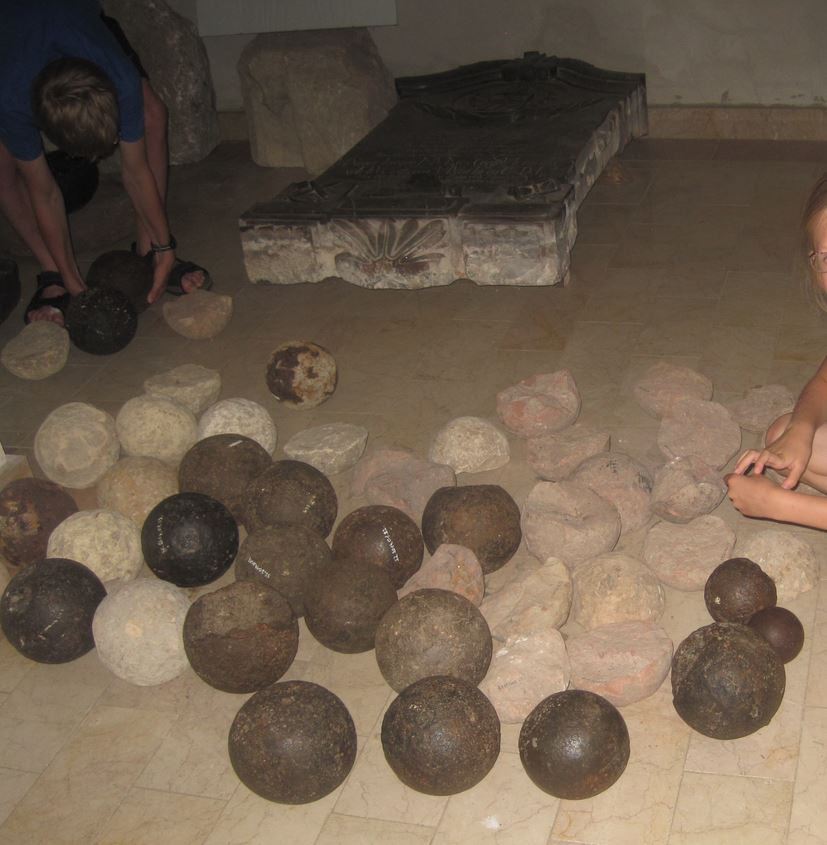
Cannon balls launched at Szigetvar

Counting a few of the 10,000 cannon balls launched against Szigetvár
during the 1566 siege. (Credit: Miksha)

According to legend, upon Suleiman’s death, the king/general/poet’s heart and liver were placed in a tomb on a hill above the castle. A Turkish town grew around the death shrine of Suleiman the Magnificent. Turbék had a dervish monastery, shops, and an inn for travelers who came to pay respects at the tomb over the next 150 years. But then the Ottoman Empire collapsed and the Turkish village on Hungarian soil was destroyed. Within a few generations, no sign of the former shrine or town remained. Instead, in 1919 a plaque was stuck on Saint Mary’s church, a kilometre away. The marker is still there, declaring Suleiman’s tomb is under the church, but there is no evidence that the church was actually built atop the sultan’s shrine.

Archaeologists, armed with geophysicists as tools, think they have found the neglected site. It’s in a vineyard on a knoll above the church. It is hidden under soil now, 450 years after Suleiman’s death. The newly discovered location seems to include a mausoleum, several small buildings, and possibly a dervish monastery. All of that may seem hard to miss, but Suleiman died in 1566 and everything was abandoned and wrecked when the Ottomans left the area in the 1680s. Remote sensing (satellite images) and geophysics have helped place the forgotten tomb.

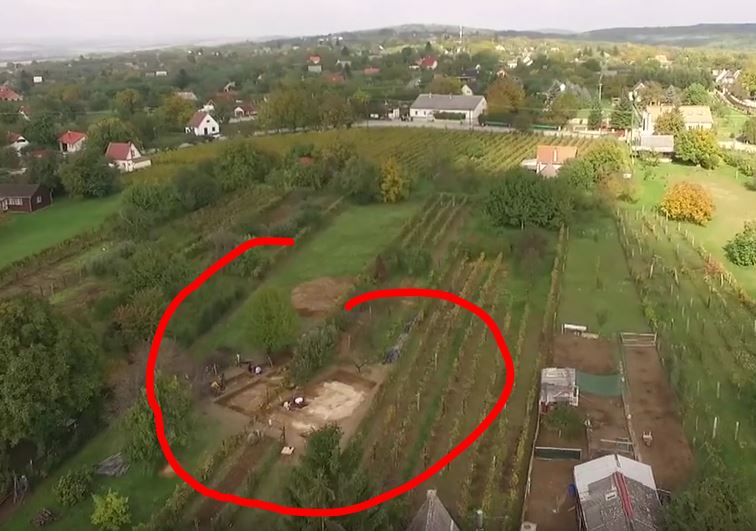
Lead geographer Norbert Pap  from the University of Pecs began looking for the tomb by searching in the vineyard rather than at the church grounds after studying ancient maps and letters that indicated the approximate location of the long vanished village of Turbék. Aerial photographs helped, but the sleuthing is still remarkable. Would you have spotted the right place to dig from this photograph if I hadn’t placed the huge red circle on it?

Dig site searching for Suleiman's shrine.

Archaeological dig site in the search for Suleiman’s shrine.

dig in vineyard and orchardNext came an archaeological trench which uncovered. . . something. It looks very promising. Shards of pottery with Arabic writing, some tiles, and the foundation of a building were found among the excavated grape vine roots. But looking at the soil, nothing resembles a lost town. It was time to call in the geophysicists.

Three types of geophysics were used to try to delineate the bounds of the buried ruins – magnetic, electrical, and radar. In October 2014, ground conductivity (EM, or electromagnetic) and vertical magnetic mapping techniques were attempted,  but the area had too much wire and reinforcing mesh (unrelated to the shrine) nearby to get consistent readings. Ferric material is obviously trouble for any methods using electrical conduction or magnetism. The EM system should have found the boundaries of disturbed subsoil by measurements of electric flow, but the interference from ground contamination wouldn’t allow clear results.

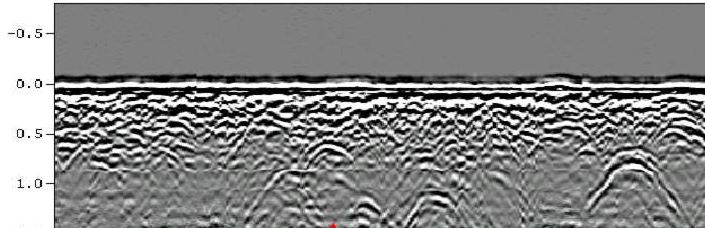
Typical GPR radargram. Depth, shown to the left, in metres.

Typical GPR radargram.
Depth, shown to the left, in metres.

The geophysicists switched to ground-probing radar (GPR).  GPR blasts the soil with extremely high frequency signals which echo back to receivers. It’s similar to seismic exploration but GPR resolution is much finer, though it works only on shallow targets.

The GPR tests resulted in locating a large building with numerous small rooms, long buried below the vineyard. Archaeologists interpreted this as the dervish monastery. But the GPR’s prize discovery, at a depth of 100 to 125 cm (3 or 4 feet) below ground level, was a square building precisely aligned towards Mecca. They think it’s Suleiman’s shrine.

You may find this paper, written by Norbert Pap (et.al.) of the University of Pecs, an interesting read: Finding the Tomb of Suleiman the Magnificent in Szigetvár, Hungary: historical, geophysical, and archeological investigations.

Posted in Culture, How Geophysics Works | Tagged , | Leave a comment

A 2015 Review

ron machu pichu 2ron machu pichu 3I wish there were two of me. I’d write twice as much or twice as often. As it is, I was able to post 81 times in 2015. That’s certainly not as prolific as some of my favourite bloggers. But over the past year, I’ve enjoyed reporting and opining about geology and geophysics from my offside perch .  I research what I get curious about, so this blog occasionally meanders like a prairie stream. But this blog has had tens of thousands of visitors this year, so I’m guessing that some of what I was curious about was also interesting to you.

I began this blog site in 2014. I wanted to draw attention to a book which I was just finishing. My book (The Mountain Mystery) is a casual romp through the history of the idea of plate tectonics.  It was just 50 years ago when we figured out why the Earth has mountains. The fact that this discovery is so recent still astounds me, even though I spent years working as a geophysicist. (The book, by the way, is still undergoing revisions, though drafts may be purchased from Amazon.)

Despite the tie-in to the book, this blog quickly acquired its own life. I allowed it to wander freely across the geological landscape. The blog escaped its original purpose as a complement to the history of geology book and became a repository for some disparate gems of earth science: fracking, Russia and the Arctic, Ted Cruz the Science Guy, and four-legged snakes are a few of 2015’s highlights.

Here is a quick review of this year’s most popular posts:

My series about the renewed attempt to drill to the center of the Earth (well, to reach the mantle, at least) was the year’s most popular story. If you missed it, you can begin with Drilling into Hell – read that blog and its two subsequent sister segments.

The review of the movie The Theory of Everything was next in popularity during 2015, though it was published in November 2014. I’m glad that it had staying power because this review of the Stephen Hawking biography is particularly poignant to me – like Hawking, I also have a variant of motor neuron disease. The illness is progressive and has lingered for years, though my affliction is not yet as severe as his. I’m glad that people watched the movie and understand a bit more about Hawking’s life and his challenges.

It will surprise no one that my story Getting Naked on Mount Kinabalu attracted thousands of readers.  Ah, we are a shallow species, aren’t we? I still have disdain for the kids who wanted to take nudie selfies on the sacred mountain. (And I’m an agnostic, for God’s sake!) I think that they should have spent a few weeks in that Malaysian prison. Not for their nudity stunt, but for their disrespect that woke the dead elders’ mountain spirits which in turn caused an earthquake that killed local villagers. Disturbing vengeful spirits is a crime in Malaysia, but this time the punishment wasn’t enforced.

Fracking shook people up early in 2015, but with the crash in commodity prices, there are now fewer shale wells and fewer man-made quakes. Nevertheless, it continues to be a newsworthy story.  I wrote World’s Biggest Fracking Quake to describe the cause and effects (and politics) of the largest frack-induced earthquake seen, so far.

These (and 75 other pieces) kept my free time occupied during 2015. I’m glad so many of you have been along for the ride. Thanks for reading!

Posted in Culture, Religion, Science Education | Tagged | 3 Comments

A Glowing Holiday Gift

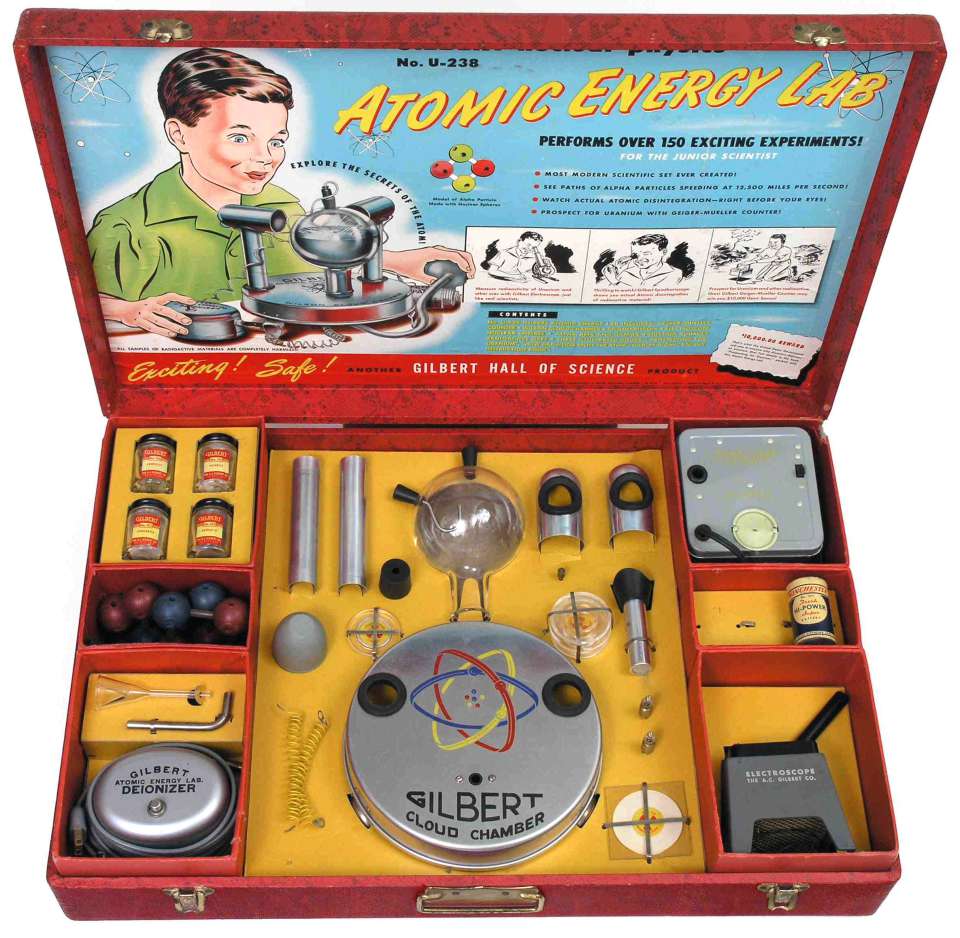
atomic energy lab kit from 1951Christmas Eve, 2015. A bit late to buy The Gilbert U-238 Atomic Energy Lab for your favourite budding young nuclear physicist. 65 years too late. It’s hard to imagine that Dad could once easily buy uranium, radium, and all the trappings for Junior’s birthdays and holidays. It’s difficult to believe that he’d buy the Gilbert Lab because in 1951 the Atomic Energy Lab cost $50 – that’s over $400 in today’s currency.

I would have been thrilled to get that uranium kit, but I wasn’t even born yet, so I missed out. For my 8th birthday, I did receive a radium glow-in-the-dark wristwatch.  I wore it night and day in the mid-60s. I was proud of it. But $50 was out of line for any gift in our family in those days, even if the lab had not been discontinued by then.

Gilbert promoThe lucky boys who did receive the U-238 Atomic Energy Lab would be 80 years old now – if they survived the side-effects of their fathers’ radioactive gift-giving. (I mention only fathers and sons because this toy was sold in the days of the traditional ’50s nuclear family, the days when atoms were considered manly stuff.)

The Gilbert lab included uranium ore, polonium, a Geiger-counter, and a cloud chamber, so the manufacturer had thought of everything. Except an anti-radiation pill and lead-plated underwear.

Some of the young people who handled the Gilbert Atomic Energy Lab really did become nuclear physicists – Columbia University bought 5 sets as training accessories for their physics students. But the Gilbert Company’s aim was to sell thousands of these kits to kids for good old-fashioned fun and for home-schooling nuclear physics lessons.

In his autobiography, written in 1954, the founder of the eponymous A.C. Gilbert Company wrote:

The most spectacular of our new educational toys was the Gilbert Atomic Energy Laboratory. This was a top job, the result of much experimentation and hard work. We were unofficially encouraged by the government, who thought that our set would aid in public understanding of atomic energy and stress its constructive side. We had the great help of some of the country’s best nuclear physicists and worked closely with M.I.T. in it’s development.

So, with M.I.T, the federal government, and some of the best nuclear physicists encouraging the U-238 Atomic Energy Lab, you’re probably wondering why it’s no longer sold in all the finest toy stores (or, at least, Toys ‘R Us).  The Atomic Energy Lab was on the market for just 2 years, 1950 and 1951. You would need to have been a youngster in the early 1950s to have received this dandy opposure to the Darwinian awards.

Safety was not the reason the kit was dropped like a hot fission pellet.  As the ad  radiantly states, it was a completely safe and harmless science kit.  But A.C. Gilbert had trouble making a profit from the toy. The price and the level of sophistication needed to assemble the cloud chamber were seen as the main obstacles that prevented this toy from becoming a perennial Christmas favourite.

By the way, if you are still upset that your dad didn’t buy the $50 atomic kit for you six decades ago, you can remedy your disappointment. I saw the labs listed on E-Bay.  This piece of nostalgia will cost you at least $2,300, but imagine how much fun you’ll have – you’ll be literally glowing with delight!

Posted in Culture, Science Education | Tagged , , , | 1 Comment

Why Some ‘Quake Shakes Arrive Before Others

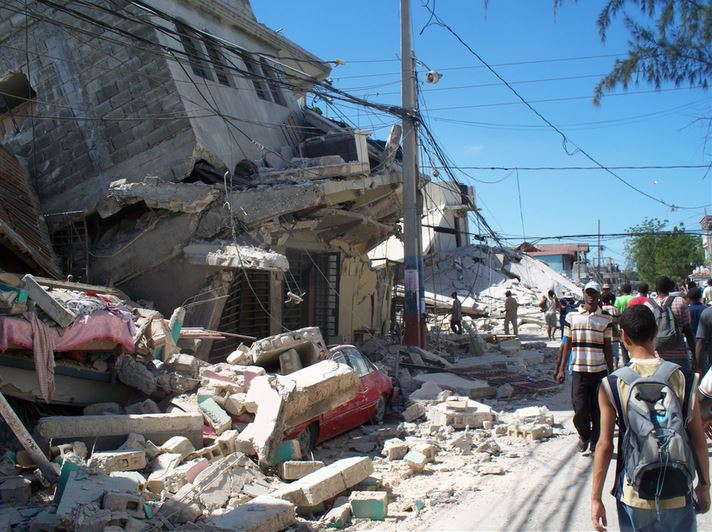
Haiti earthquakeWhen a big earthquake quakes, different sorts of vibes spread through the Earth. Two of the main destructive seismic waves – the P and S – travel at different velocities.  P-waves (Primary or Pressure) will shake your dishes a few minutes before the arrival of the severe side-to-side shakes of the S-waves (Secondary or Shear).  Why? What was the S-wave doing that delayed its visit?

I’m not going to give an explain-like-I’m-five summary. Understanding seismic wave propagation can’t be done like that. And here’s a trigger warning: mathematics is coming up. I usually don’t put much math into this blog because I’ve been told that for each equation a blogger publishes, a hundred readers melt. However, I’m afraid that we will have to melt a few.

This autumn I helped TA a MOOC offered by the University of Illinois (Urbana-Champaign). It was fun, interesting, and dreadfully time-consuming for the TAs. But I accepted the university’s invitation. I helped monitor and advise 3,000 students who were simultaneously suffering through an introduction to Earth science. The course, Planet Earth and You, explained earthquakes, volcanoes, mountain building, ice ages, landslides, floods, plate motion, gold deposits, oil reserves, and gravel pits. The course was particularly ensconced in plate tectonics, my geo-favourite. There was also coverage of societal implications of resource exploitation, plus basic geology and geophysics.

The MOOC was good.  It had excellent videos and challenging assignments.  As one of the folks charged with the task of answering student questions, I had a chance to see what non-geophysicists thought about during those fleeting moments when they thought about the Earth.

“Why are S-waves slower than P-waves? And why don’t the S-waves go through liquids?” asked a student. This was only lightly touched in the lectures. The student said that she was a chemistry teacher and she wondered if the answer lies in the chemical nature of the bonds of a material’s molecules. P-waves are compressional, S-waves shake side to side while propagating the wave forward. They travel at different velocities – is something going on at the molecular level? I was asked to explain the chemistry of seismic wave motion. It was a good question.

Well, it’s not chemistry. It’s physics. Geophysicists reading this will notice that I will slide over the most important issue – the derivation of the acoustic wave equation. It would take about 20 pages to start to explain it at an introductory level. I doubt that the non-geo folks who read this will feel deprived if I leave that bit out. However, I have a few good links embedded in the discussion ahead. And, of course, the incorrigibly curious reader could simply enroll in the geophysics graduate program at MIT to gain a more robust understanding.

* * * * *

Here’s why P-waves are faster than S-waves and why S-waves can’t travel through liquids:

The velocity of a seismic wave is best understood as developed from the wave equation. A thorough propagation explanation includes bits of Hooke’s Law (stress is proportional to strain), Newton’s laws of motion, and derivations of wave equations similar to the work of Maxwell and Schrödinger. For a nice overview, see these course notes, Basics of Seismic Wave Theory by Gerard Schuster at the University of Utah. Schuster will show you how to derive the acoustic wave equation, which looks like this in three dimensions, from a derivation used by Richard Feynman in his lecture Sound: the wave equation:

Feynman's wave equationGeophysicists apply the wave equation to the equations of motion using derivatives in 3 dimensions, representing a solid body. It’s a triple derivative, but if you have had second year calculus, you can follow it. A relatively easy piece is found on the UCLA San Diego website:   igppweb.ucsd.edu/~guy/sio227a/ch3.pdf    (See especially section 3.3.)

Here are the important resulting equations that follow from the preceding:

P-wave equationP-wave velocity = SquareRoot((K+4/3μ)/ρwhere K is the bulk modulus (the ratio between the increase in pressure and the change in volume as force is exerted),  μ is shear modulus (rigidity of the material), and ρ is the density of the material the wave travels through. Mostly, the primary wave’s velocity depends mainly on the density of the material.

Now look at this equation:

S-wave equationS-wave velocity = SquareRoot((μ)/ρ) or simply the root of rigidity divided by density. As a bonus, you can see why S-waves can’t pass through air or fluids (in those cases, μ, the material’s rigidity, = 0).

By comparing the two equations, you can also quickly see the causes for the difference in velocity. Remember that these equations go all the way back to first principles developed in the derivation of the wave equation, applied to earth materials by geophysicists (chapter 3 of the UC-SD link).

* * * * *

So, calculating the velocity of seismic waves originates with the rigidity and the density of the material. It’s not a chemical thing, it’s a physical thing. The explanation is derived from the physicist’s second-best friend, the wave equation. (Tied for first place are mathematics, soul mates, and dogs.)  And that’s the reason the shear wave follows the pressure wave during an earthquake.

Now, here’s my final crushing slog through the realm of seismic velocity. the wave equation and its application are fundamental to understanding earthquakes and to resource exploration, yet I will guess that few people other than specialized physicists and their geo-sidekicks understand any of it. That’s maybe ten thousand people in a world of 7 billion. And most of the geophysicists who once understood the derivation forgot all about it minutes after their third year Geoph 312 exam. That gets us down to maybe a few hundred folks in the world who have a pretty good grasp on this fundamental concept.

Most people would say this is all esoteric obscure knowledge, remote to everyday life. They are nearly correct. Yet, we depend on these scarce keepers of abstrusities – in genetics, hydrology, entomology, metallurgy, and everything else – to enable the entire world to function. Plus, there is the beauty of expressing something as complicated as seismic wave motion in a few mathematical statements.

Math is a Religion

Posted in How Geophysics Works, Science Education | Tagged , , | Leave a comment

Drilling into Hell . . . enjoy your visit!

Yesterday, I wrote at length about the many disastrous expensive attempts scientists and engineers made in their quest to collect material from the mantle. So far, they’ve all ended far short of their target. Drilling through crust material (granite on the continents; basalt under the oceans) to the mantle is very, very difficult. Perhaps impossible.

This makes the world’s deepest borehole even more astonishing.  It was a gallant effort, but the Russians who were drilling the well reached only one-third the way to the mantle. Drilling extended over 24 years, from 1970 to 1994. That was a long time ago, yet the Soviet-era engineers reached a depth of 12,262 metres (40,230 feet). That remains a world record. No one, anywhere, has placed a drill bit deeper.

I don’t want to dwell on the fact that under the Communist system, drilling a superdeep well worked better 40 years ago than any efforts conducted by capitalist countries today. But after reading yesterday’s blog entry about the utter lack of fortitude among the funders of pure science in the enlightened world, you may agree that it’s not that surprising.  Big talk of billion dollar projects manifests relatively few bucks in grants. This makes life hell for scientists and engineers who begin to drill into tough basalt, then have budgets killed.

Machines break, gale winds rock exploration ships, drilling gets behind schedule and over budget. I’d hate to be the science director answering the phone when someone like Ted Cruz calls to ask why we haven’t yet drilled deep enough to hear screams from Hell. What would you tell your senator/rep/MP? “If you give us more money, we’ll reach the mantle, for sure. Meanwhile, can I send you a nice piece of gray basalt we recovered last month?”

If an autocratic government seeking international prestige (like the USSR) is determined to commit to a project that will last decades, then funding can continue through inevitable setbacks. None of this is intended to detract from the Soviet scientists and engineers who actually did the work. They were brilliant. For most of them, the goal was discovery, though nationalistic pride was also a likely factor.

The Kola Peninsula Superdeep Borehole will be remembered for its remarkable depth and the tenacity of its drillers, but there was a breadth of knowledge gained as well.  First, we’ll look at the engineering. Before the Kola well, deep wells rarely passed 1,000 metres. The Russian scheme expected its initial phase to reach 15,000 metres.

Early Deep Wells

The first deep wells were drilled 4,000 years ago by Chinese engineers. They built rigs of bamboo and dropped heavy chisels that punched a hole in the ground. Some of these wells took generations to drill, and the deepest reached nearly 1,000 metres.

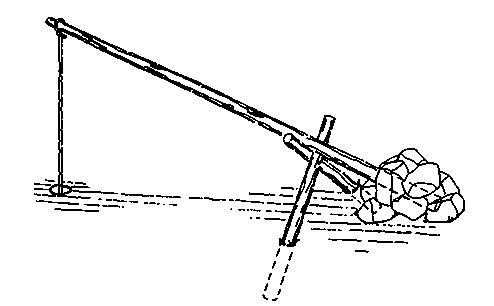
Spring pole drilling rig, 1806

Spring pole drilling rig, 1806

In Europe, wells were hand dug and water was the usual target. Around 1806 in the USA, the Ruffner Brothers invented the pole spring rig to hammer through bedrock to reach salt brine, a scarce commodity at the time. Theirs was the first American well known to be drilled instead of dug. The spring pole was a 10-metre tree trunk that was lifted a couple of metres above the ground at one end and anchored in the ground at the other. A fulcrum was fixed in place to keep the elevated end up and allow it to “spring” back after it was pressed down and released. This allowed a combination of gravity and springing action to do most of the work. The driller would work up a rhythm, bouncing the free end of the pole up and down while an attached rod with a chisel chipped a hole into the rock below. Pole spring wells often drilled hundreds of feet, usually searching for fresh water. It was an adaptation of the pole spring that was used in Titusville in 1859 to drill the first American oil well. Even today, rigs based on the idea are used around the world.
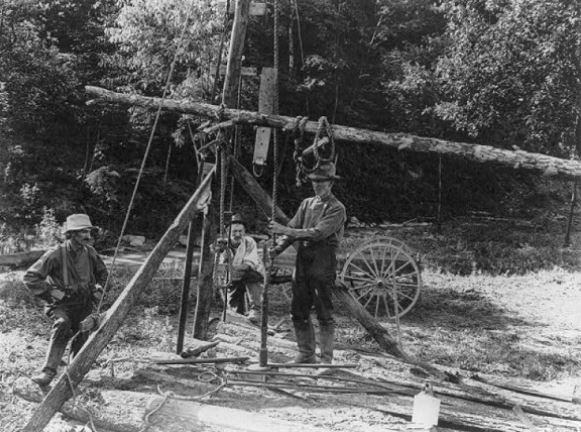
spring pole well, 1924, US Dept Interior photo

Spring Pole Drill, 1924,   (US Dept Interior photo)

The next major innovation in drilling deep wells required attaching a drill bit to a long series of iron pipes. Drillers spun the entire contraption at a high speed. This meant that all the pipes from top to bottom in the borehole turned rapidly. Their considerable weight pushed the drill bit into the rock below. Water and drilling mud were forced down the pipe to wash out the chips chewed out of the bedrock. In 1938, a California oil well almost 5,000 metres deep was completed. Enormous engines spun 200 tonnes of alloy steel pipe, forcing the drill bit deeper into the Earth. That was still the state of the art when the Kola well was being designed by the Soviets in the 1960s.

Kola’s Deep Drilling Technology

A key objective of the Kola well was to develop technology to drill extremely deep oil wells. The scientists on the project created a new way of drilling that revolutionized the way the task is done.

The Russian drillers realized that they could never gain enough torque to quickly spin 15,000 metres of pipe, which could weigh 600 tonnes. They used aluminum alloy pipes to reduce the weight of the pipe string, but they figured that it still wouldn’t work. In addition, the tubing would need to be pulled out of the hole every few days to replace dull drill bits with sharp ones. Lifting the pipe would take an enormous rig so in 1970 the engineers built a derrick 27 storeys tall. It was sturdy enough to hold half a million kilos of dead weight.

tricone drill bitBut with a depth of over 10,000 metres, the planners knew that no engine would be able to rotate the entire drill stem fast enough to cut into granite 15,000 metres below the surface. Further, it was doubtful that the pipes and joints would stand the strain. So they invented the first rotary bit. High pressure drilling mud was forced down the inside of the pipe. When it reached the drill bit at the bottom of the well, the mud spun a turbine that turned the bit at an optimal 80 revolutions per minute. This simple but elegant design revolutionized the drilling business. There were more discoveries coming from the well. Soviet geologists at the rig made an important find that changed the way we understand the crust. 

A New View of the Crust

A better understanding of the deep crust was expected to help future oil and gas exploration. The Kola well found resource minerals in the granite at great depths. Kola was spudded on the continental shield 250 kilometres north of the Arctic Circle. This is in an area rich in copper and nickel. The Soviets hoped they would learn something from their well that would help predict other mineral-rich terrain.  They also wanted to discover the physical nature of the deep crust itself.

Among the unexpected finds were fossils at 6,700 metres, gas release at all depths (helium, hydrogen, nitrogen, and most unexpectedly, carbon dioxide), and lots of hot mineralized water kilometres below the surface. The water was not predicted at the time and gave a new view of the makeup of our crust. They also encountered much higher temperatures than expected, making drilling more challenging and contributing to the decision to terminate the project.

The scientists discovered that the basic rock material deepest in the well was different quite from what most geologists had predicted. In 1926, the influential British geophysicist Harold Jeffreys had postulated that the Earth’s crust consisted of three layers. In Jeffreys’ model, sedimentary rocks covered granite which lay atop basalt. Jeffreys believed basalt could be found everywhere on Earth, just above the mantle, if we dug deeply enough. Supporting evidence for this idea was a velocity increase in seismic waves at about 9,000 metres. This, claimed Harold Jeffreys, was where granite gave way to basalt.

Jeffreys didn’t expect to be proved wrong in his lifetime but he was. Jeffreys’ theory was disproved when the Soviet drill bit found granite – not basalt –  at the velocity anomaly. The granite is metamorphosed, making it denser, thus  carrying seismic waves more quickly.                       

Harold Jeffreys, by the way, fiercely refused to accept plate tectonics. He was one of the leading senior scientists who tried to kill the nascent theory. Jeffreys never publicly recanted. Even as a 95-year-old emeritus in the late 1980s, he continued to believe that it was physically impossible for the planet’s crust to drift. But evidence from the Kola borehole supported continental mobility by showing continents to be entirely granite and quite different  from basaltic oceanic crust.

Culture, Religion, and the Superdeep Borehole

The Kola Superdeep Borehole was planned in the 1960s and drilled during the ’70s and ’80s. In 1989, the world’s deepest artificial point was achieved, 12,262 metres below the surface. Scientists were considering tactics to fight hotter than expected temperatures. They were preparing to switch to titanium alloy pipes to withstand the ascending heat when their project was shut down.

The rig was idle for a number of years while tests were conducted. By 1992, the Soviet Union was collapsing and the ruling autocracy was momentarily powerless. Funding was cut. Various seismic and petrophysics tests continued, but in 2006 the project was shut down completely. The world’s most important well was sealed. By 2008, even the nightwatchman had left. Today the place is abandoned and decaying.

The Kola Well, sealed for eternity

The Kola Well, sealed for eternity (Credit: Rakot13 )

The Kola well continues to influence our understanding of the deep crust. In a similar way, a deep borehole into the mantle might contribute startling changes to our perception and understanding of the Earth’s interior.

Meanwhile, Kola has inadvertently encouraged some odd religious misconceptions about what lies below us. There are still millions of people in the world who believe that there is a real, solid, literal Hell inside the Earth. Some of these people were elated when they learned – from a fundamentalist group – that the well had to be sealed because the Russians had reached Hell.

They claim that the well hit a hollow cavity and extremely hot temperatures. Scientists lowered a microphone down the borehole and heard the agonized screams of millions of burning souls. Many of the scientists immediately repented and joined the fundamentalist movement. Others fled the site and went insane, as would be expected of scientists who refuse to repent even after hearing the screams of damned souls.

There are plenty of people who are convinced that Satan, not Gorbachev, was the reason the drilling stopped. The story was allegedly first printed in 1990 by the Finnish newspaper Ammennusastia, which was published by a group of Pentecostal Christians from Leväsjoki, Finland. (They sort of put their town on the map, didn’t they?)

A story this remarkable doesn’t stay in a Finnish village. An American Christian outfit called Trinity Broadcasting Network spread it like hot manure all over their network, purportedly claiming it to be proof of the literal existence of Hell. After their original airing, Trinity Broadcasting followed up with more material supplied by a hoaxer. It was a thinly veiled hoax, complete with information Trinity could have easily used to dispel the trick. They didn’t fact check the material. Their trusted reporting and practiced style convinced people that the Russians had indeed opened a door to Hell. Unsurprisingly, according to Trinity Broadcasting, about 2,000 people were led to salvation when they heard the network’s radio and TV broadcasts about the screams from Hell.

.

Posted in Culture, Engineering, Exploration, Geology, Religion | Tagged , , , , , , , , | 14 Comments

Drilling into Hell . . . almost there
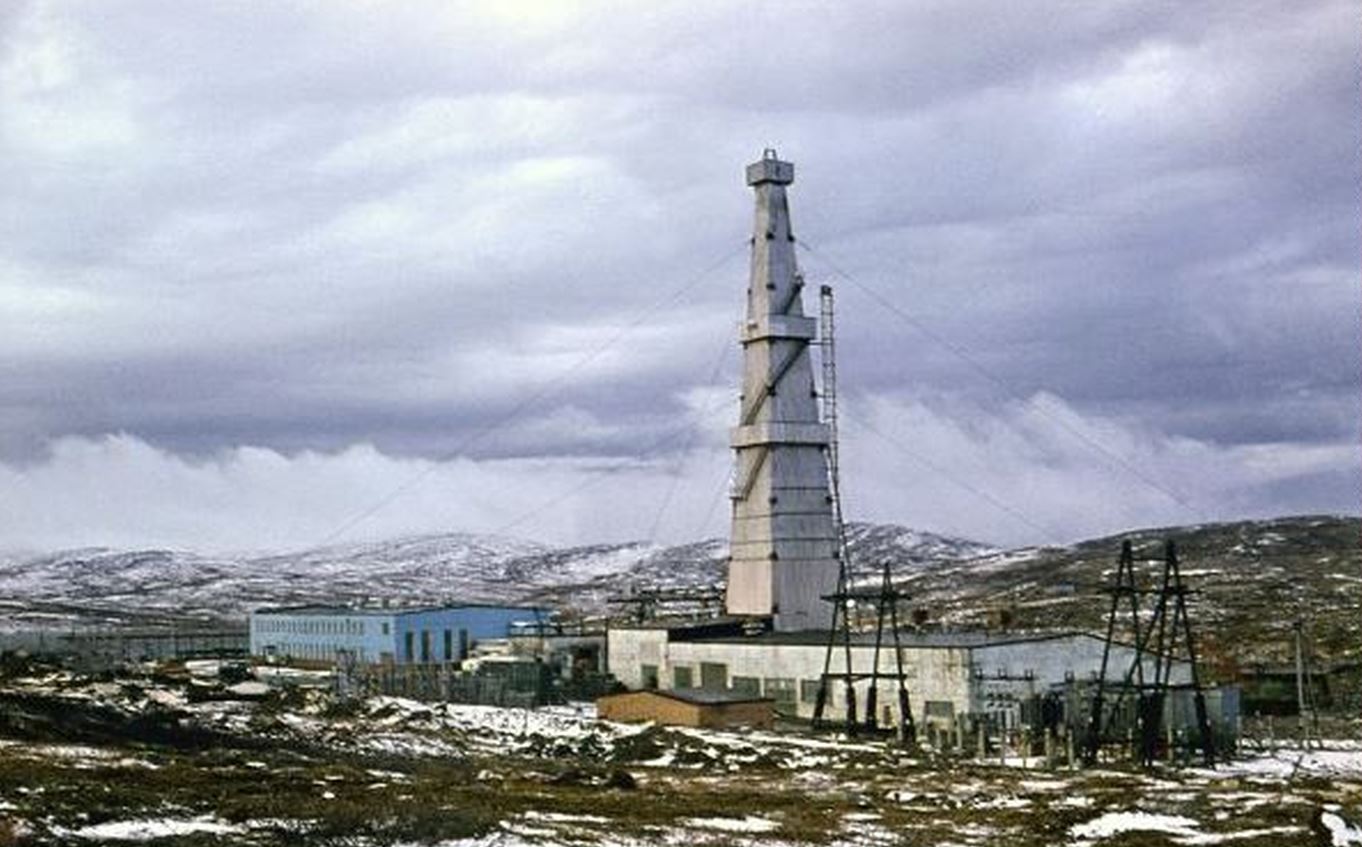
Kola super-deep scientific well derrick, around 1980.

Kola super-deep scientific well derrick, around 1980.

Chasing gold, humans have dug tunnels almost four kilometres into the Earth. Oil men have drilled down ten kilometres, but with occasionally disastrous results. Money is a strong motivator, but scientific curiosity is even stronger when measured in meters of pipe pushed vertically into the planet. At this moment, the deepest well ever drilled reached 12,289 metres. That was the Kola Superdeep Borehole. It’s in Russia, 25 kilometres from the Arctic Ocean and quite near the Finnish and Norwegian borders. It was started in 1970 and was an amazing feat of Soviet-era technology. The Russians weren’t after gold or oil. Their mission was to drill through as much of the Earth’s crust as possible and learn what they could about our planet’s deep geology and geophysics. 

It was a gallant effort, but they made it just one-third the way toward piercing the mantle. The drilling lasted 24 years (off and on) before it was abandoned. A few years were spent completing seismic and petrophysics tests around the well, then everyone went home. The expensive drilling stopped in 1994 – Russia had other priorities.

The area is now a disintegrating assemblage of rusting and ruined buildings. We’ll return to the Kola Peninsula tomorrow for both a look at its achievements and a glance at the persistent rumour that the Russians reached a cavity inhabited by demons. Some will tell you that Satan – and not the collapse of the Soviet Empire – was the reason the drilling stopped.

Project Mohole

The Russians weren’t the first to point a research drill bit towards the mantle. The Americans had Project Mohole, which was intended to reach the Moho, or Mohorovičić discontinuity. The discontinuity was discovered by a brilliant Croatian geophysicist who used seismograph data collected during a 1909 earthquake to discover the lower limit of the Earth’s crust. Near Zagreb, Andrija Mohorovičić found that continental crust extended down about 50 kilometres. Other scientists later discovered that oceanic crust is much thinner – only about 6 kilometres thick. If someone wants to drill through crust to reach the mantle, the job would be easier out in the deep sea where one-tenth the boring is required. That’s where the Americans set up Project Mohole.

CUSS I drilling ship, 1961

CUSS drilling ship, 1961

Project Mohole was very big news back in 1961 when scientists first ground into oceanic basalt. Life magazine sent John Steinbeck to the drilling ship. (Yes, the John Steinbeck.) Between writing The Winter of Our Discontent in 1961 and winning the 1962 Nobel Prize, Steinbeck stayed on board for ten days and wrote dispatches which were published in a big spread in Life. Here is what Steinbeck wrote on the days the team secured their first basalt oceanic core:

“Saturday  April 1 – Some kind of celestial celebration  The wind moderates. the swell begins to flatten.  With infinite care the core is lowered and grinds its way into the hard rock. The ship is on fire with expectation. This may be the second layer forecast by the echo instruments. We have slept very little, only short naps. Any change of sound from engines or drill rig perks us wide awake.

“Easter Sunday, April 2  – Delight on the CUSS. We brought up a great core of basalt, stark blue and very hard with extrusions of crystals exuding in lines – beautiful under a magnifying glass. The scientists are guarding this core like tigers.  Everyone wants a  fragment as a memento. We have broken drilling records every day but now we have broken through to the second layer which no one has ever seen before. We figure this core cost about $5.000 a pound. I asked for a piece and got a scowling refusal and so I stole a small piece. And then that damned chief scientist gave me a piece secretly.  Made me feel terrible. I had to sneak in and replace the piece l had stolen.”  – John Steinbeck, writing for Life magazine in 1961.

Project Mohole was cooked up by a bunch of goofy geophysicists at the American Miscellaneous Society. [Goofy: Their motto was Illegitimi non Carborundum and they annually awarded a stuffed albatross to a favoured geophysicist.]  Project Mohole was initially funded by the National Science Foundation. The USA was losing the Space Race in 1961, so science prestige was at stake. Mohole funding was killed in 1966 when the US began to win the Space Race and national prestige was no longer at stake. By then the American drillers had penetrated a small bit of shallow ocean crust under the Pacific, just off Mexico. Some dismiss Project Mohole as a dismal failure. In 1961, the drillers reached a depth of only 183 metres (600 feet). The west coast geophysicists didn’t stick their pipe in very far.  Mohole was dubbed No Hole by 1966.

Nevertheless, the Mohole folks broke some records. They drilled above 3,600 metres of water. This had never been done before. They didn’t use a platform, but had an untethered ship outfitted with drilling equipment. It was a floating rig and subject to drifting, but a ‘dynamic positioning system‘ was developed for the Mohole project. When they stopped drilling, the well’s deepest section included 13 metres of basalt – an incredibly difficult rock to cut through – so that was also a triumph. Oh, and they wrote a Mohole song, too. (I told you the geophysicists were a goofy bunch.)

The entire American project was intended as a proof of concept test. The scientists proved they could do it, but they would need to drill through a few thousand more metres of basalt to reach the mantle and they would need a few hundred million dollars more to do it. Congress, spending heavily on the war in Vietnam (and busy building an otherwise Great Society for Lyndon Johnson) cancelled the drillers’ budget. The Bulletin of Atomic Scientists (May 1968) called it “the most visible management fiasco in the scientific world to date.”  The American Miscellaneous Society soon disbanded – proving to themselves that their motto (Illegitimi non Carborundum, “don’t let the bastards grind you down”) wasn’t particularly suited to their drilling project. It had been ground down by both Congress and basalt. On the other hand, the society’s final report sedulously called the Mohole project Phase I.

Over the next couple of decades, there were a few other scientific attempts to drill through the crust and reach the mantle. These were mostly international efforts. Sometimes funding for pure research is more easily obtained if the petitioner can tell his/her government that France, or Japan, or whomever, were also on side. However, even today, none of the efforts has yet nabbed the prize – a drill bit into the mantle.

Mission Mohole

Drilling south of the Mohole Project, off the coast of Costa Rica, lies yet another failed attempt to recover pieces of the mantle. In a 2011 Science Friday interview with NPR’s Ira Flatow, Dr Damon Teagle of Southampton’s National Oceanographic Centre in the UK sounded optimistic. Teagle is a leader of Mission Mohole: A Journey to the Mantle. (Considering history, I would have chosen a name other than Mohole for this venture.)  Flatow asked Dr Teagle how he would know when to stop drilling. Teagle’s first answer (“When the money runs out.”) was quickly followed by a less likely answer, “Our aim is to drill, you know, several hundred meters into the mantle.” 

Touted by CNN as The Billion Dollar Mission to Reach the Earth’s Mantle it appears that this east Pacific effort has fizzled. I have read the scientific summary report for the project. It begins with statements about faulty drilling equipment (“Unfortunately, operational difficulties…”) and it ends with the disheartening reality that funding a long-term project is nearly impossible. See this from the project’s scientific report:

“It would require community acceptance that could be difficult to achieve. However, the present standard “1 proposal = 1 expedition” approach is not an effective process to reach targets that require multiple-expedition deep drilling. Unless the community and the drilling program are able to develop new approaches to achieving deep targets, the lack of closure on science questions that can only be addressed by deep drilling will continue to stain future renewal documents with a perceived lingering staleness due to a continued recycling of unaccomplished goals.” – IODP Preliminary Science Report, 2011 

Despite the “continued recycling of unaccomplished goals”, the east-Pacific project may not be completely dead. With enough money, it may one day continue to its original goal, the mantle. In June 2015, Géosciences Montpellier Université de Montpellier reported “Although operational difficulties precluded the achievement of primary objectives…deepening this important reference hole into intact ocean crust should be undertaken in the near future to achieve long standing primary goals of scientific ocean drilling.” Indeed it should. But again and again, we learn about technical issues slapping cold water on these deep drilling projects and money drying up quickly.

Project Next-in-Line

An ambitious Japanese-led project got closer than anyone else so far. In 2012, the Japanese set a world record by drilling 2,111 metres of (mostly basaltic) seafloor off Shimokita Peninsula of Japan in the northwest Pacific Ocean. They used their scientific deep sea drilling ship Chikyu (Japanese for Earth, and pronounced ‘Chee-queue’). They also used that vessel to study the origins of earthquakes sourced below other waters that surround Japan. One of their scientific prizes was a very deep core of extremely fractured rock – cracked into pieces by an earthquake years before the drillers arrived on the scene. Knowing the depth, style, and extent of such deep fracturing gives valuable clues to help understand earthquakes.

Heavily fractured core recovered by deep sea research ship Chikyu

Heavily fractured core recovered by deep sea research ship Chikyu

As 2015 draws to a close, let’s look at a couple other attempts to secure the blazing plastic trophy. In the new year, I’ll write more about one of these latest schemes to drill to the mantle, but for today, here is a very brief recap of the status of the European effort to drill into the thin ocean crust in the mid-Atlantic.

As part of the European Consortium for Ocean Research Drilling, a British drilling ship embarked to test the ocean crust in the Atlantic. The Royal Research Ship James Cook left Southampton’s National Oceanography Centre on October 26 for a six-week expedition. Despite the headline on the esteemed Science Daily’s website (Scientists to Drill to Earth’s Mantle Beneath the Atlantic Ocean), it was never the intention of the team on this project to actually reach the mantle. They were hoping to recover cores of rock that had once been part of the mantle. The scientists gathered data to study evidence of life forms found in deep sea basaltic crust, to determine the transformation of carbon in that environment, and to learn the role water, heat, and deformation plays in the nature of old mantle rocks detached and lifted at the Atlantis Massif mid-ocean ridge area

Drilling the Massif

Drilling the Massif, from Expedition 357 Daily Report.
(Credit: IainPheasant@ECORD_IODP)

The cruise part of the project is over. It didn’t go as well as hoped. By following their daily science logs, I agonized with the crew over the days lost due to rough weather, including some gale-force winds. Tools leaked hydraulic fluid, computer chips malfunctioned, Niskin bottles meant to trap water from the drill failed to close, and some cores were unrecoverable. The total depth of drilling was much less than intended, due to the poor weather, faulty equipment, and the incredibly dense and difficult basaltic rock. As others discovered before them, basalt is not easy stuff to penetrate.

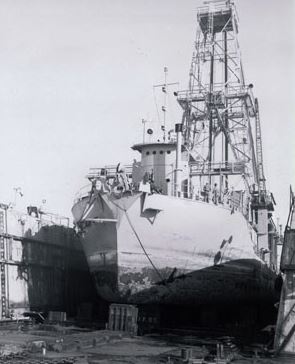
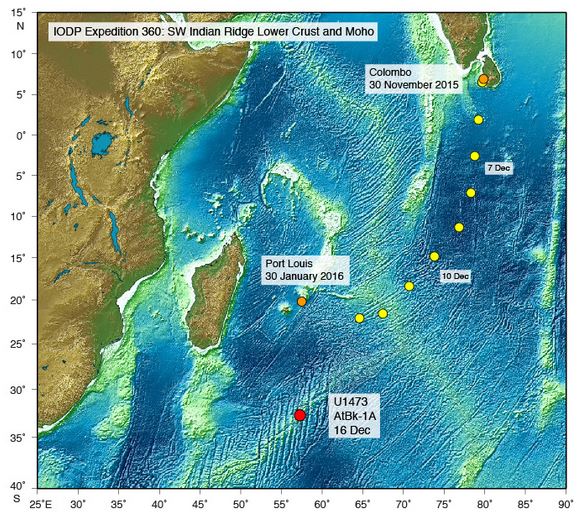
On the other side of the world, the JOIDES Resolution has just set out from Sri Lanka to the Atlantis Bank southeast of Madagascar in the Indian Ocean. They will reach their chosen target site tomorrow, then hover in the sea above some of the thinnest ocean crust in the world. This project seems promising. Or at least as promising as all the other attempts we’ve just discussed.

Area map for the latest best hope to drill into the mantle.

Area map for the latest best hope to drill into the mantle.

The ship, launched in 1978 from the Halifax Shipyard in Nova Scotia, Canada, is being operated by International Ocean Discovery Program. The goal, once again, is to osculate the hot skin of the Earth’s mantle with a tungsten carbide drill bit. I don’t want to predict the results of this latest great affair. If a commitment is made to stay with the job and push deeper regardless the costs or misadventures, I have no doubt it will be successful. But it will take single-minded persistent stubbornness. I’ll come back to the Atlantis Massif Moho Project in a few weeks when there is actually something to write about. For now, you may follow the expedition’s daily science reports by going to this site.

Why do we want to touch the mantle? This is pure science research. For the incorrigibly practical, there are some potentially useful outcomes. Understanding the rocks may eventually lead to earthquake prediction. This is the prime motivator for decades of research by scientists in Japan.  Knowing the actual chemical composition of the mantle will help us understand the material that makes up over half of our planet and may lead to new industrial and construction materials. But mostly, for now, it’s pure science and the opportunity to cross the Moho.

Tomorrow I’ll wrap up this overview of the efforts to drill to the mantle with another look at the deepest hole ever punched into the Earth – the Kola Peninsula project. And I’ll look at why some people think that the Russian drillers encountered Hell at the end of their drill bit. 

Posted in Culture, Engineering, Exploration, Geology, Oceans | Tagged , , , , , , , | 6 Comments

Drilling into Hell

Dore's etching of Styx

Gustave Doré’s etching of the River Styx, 1861

They’re going to drill into the Earth’s mantle. This has been an unachieved goal of Earth scientists for decades. This time they really mean it. No stopping before they get the job done. Over the next three days, I’ll look at the history of our view of the Earth’s hot interior,  how the task of deep Earth exploration has ruined some dreams, and why we expect to find Hell once we get below our planet’s crust

Around the world, various gurus have taught that Heaven awaits above, Hell beckons below. For the Greeks, all souls crossed the River Styx and then resided in the caverns ruled by Hades, the brother of Zeus. The idea of a hot underworld wasn’t ingrained in the mythology of the Greeks the way it later was with the Christians. However, Greek naturalists, observing volcanoes, did speculate that the inside of the Earth was ablaze.  Anaxagoras guessed that the Earth’s interior held hot windy gas that simply needed occasional relief – a flatulent Earth, if you will.

Naraka

Welcome to Naraka

3,000 years ago, the Hindu Vedas claimed that errant souls enter a scorching underworld. They called the place Naraka, and the souls of the dead were roped and dragged into Hindu Hell by devilish creatures called Yamadutas. Depending on the sinfulness of the human, hell could be eternal, or not, and might range from the soul being cooked in burning oil to being torn apart by red-hot tongs while standing on melting copper. Hindu Hell was as nasty as the Christian variety and was bordered by a river of nasty slime, puke, and puss which you would have been forced to swim if your earthly sins included destroying either a village or a beehive.

These fascinating faith traditions (probably still followed by some people) correctly acknowledge that the interior of our planet is hot and would be a dreadful place to spend eternity. The interior is inaccessible, at least to us still in our mortal clothing. But a grand scheme is afoot, hoping to drill a hole down to the mantle. Although past efforts have consumed billions of dollars in a half dozen major projects, no team has yet claimed to have actually punctured our planet’s skin.

Drilling deeply into the Earth becomes progressively harder – the interior of the planet becomes warmer and warmer as one goes deeper and deeper. At some point, drill bits and pipe stems melt. This heat is partly residual energy from Earth’s fiery formation and it is partly the result of radioactive decay of potassium, argon, uranium, and other hot elements trapped inside our planet. But all that heat hasn’t stopped a few ambitious explorers from digging down.

Chinese, African, European miners in South African gold mine around 1910

Chinese, African, and European miners
in a South African gold mine around 1910

The deepest accessible holes in the ground are South African gold mines near Boksburg and Carleton. These extend nearly 3,900 metres below the surface. The lift that carries up workers from the pit takes about an hour to bring the men to surface. The temperature of the rocks at that depth is a scorching 60° Celsius (140° F) , the air is 55°, but air-conditioned to 30°C by pumping an ice slurry into the zones being burrowed. Humidity, however, hovers close to 100 percent. If miners continue following the descending seams of gold, unmanageable temperatures will be reached. At this depth in the mine, the temperature rises one degree for every 50 metres.  Digging a bit deeper will result in air temperatures that pass the boiling point, at which point the miners will arrive in their own special hell.

The effort to drill to the mantle requires impressive engineering skills to withstand the enormous heat and pressure at even relatively shallow depths. Oil wells have been successfully completed to depths of 10,000 metres. But such wells are drilled into softer sedimentary rocks – drilling to the mantle will require boring through either tough granite or tougher basalt. Oil explorers drill easier rocks, but not safer strata. Hydrocarbons in their deep wells make their work more dangerous. The deepest oil well ever spudded was drilled by a South Korean rig called the Deepwater Horizon. In September 2009, the rig set a world record for the deepest oil well in history at a vertical depth of 10,683 metres (35,050 ft). A few months later, drilling a different well, the Deepwater Horizon was back in the news. An over-pressured pocket of oil and gas flashed up the drilling pipe to the surface. The blowout ignited and killed 11 workers. The rig sank. At the seabed, the well gushed for three months – causing the largest oil spill ever in U.S. waters.

Deepwater Horizon in better days - US Coast Guard photo

Deepwater Horizon in better days – US Coast Guard photo

Don’t expect such a disaster with the experimental wells that are attempting to drill to the mantle. These wells are being drilled into rock that lack dangerous amounts of hydrocarbons. They are purposefully being sunk into crust which is non-hydrocarbon-bearing. The most promising of these efforts will be in areas where the crust is thinnest – and that usually means oceanic basalt.

Tomorrow, I will continue this story with a look at four efforts to pierce the mantle – Russian, American, European, and Japanese. Then, on my third posting in this series, I’ll look at how the Soviets plugged a hole that some believe tapped right into Hell itself.

Posted in Culture, Engineering, Exploration, Geology, History, Oceans, Religion | Tagged , , , , , | 2 Comments

All the Grains of Sand

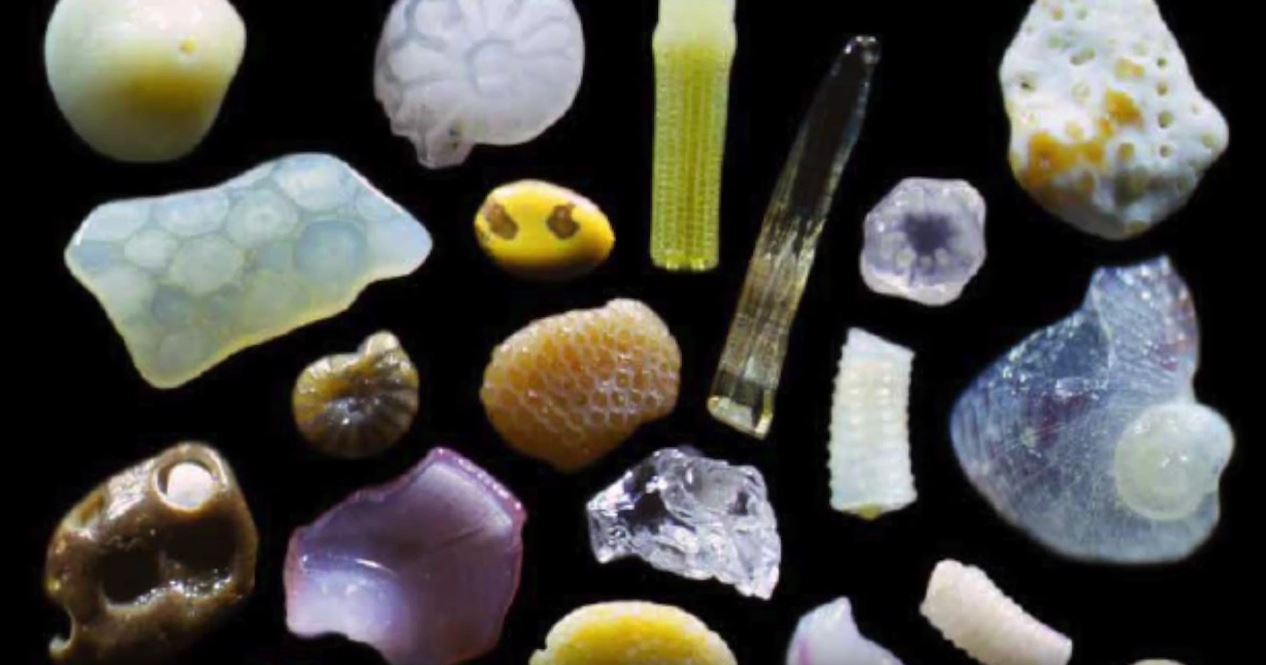
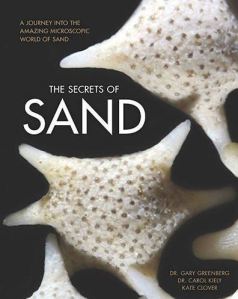
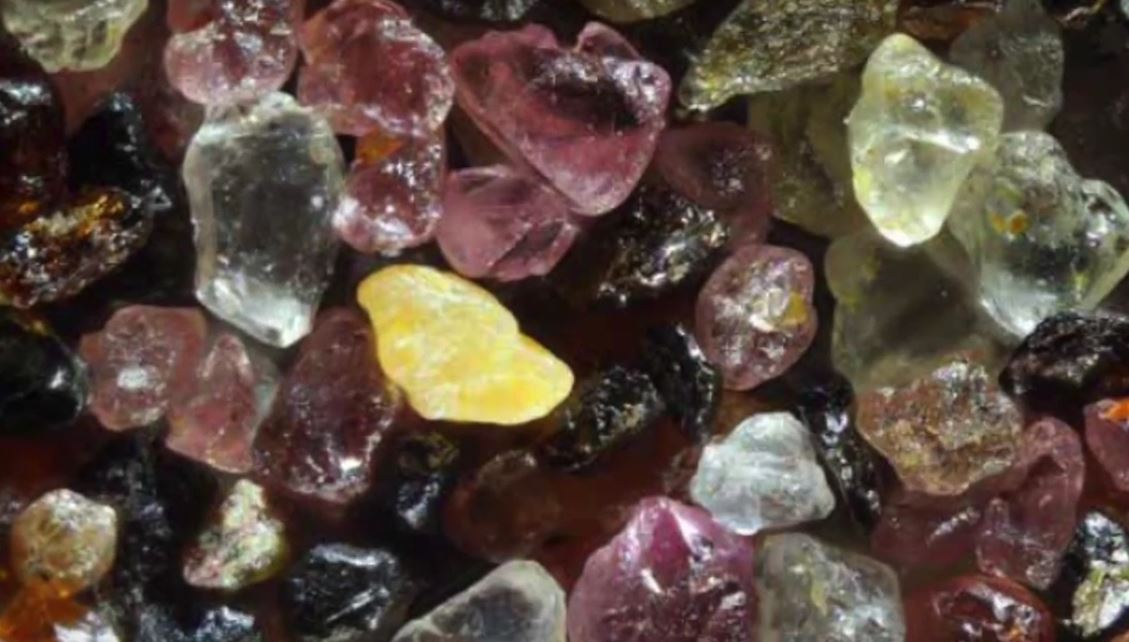
ex-living sandSecret Sand CoverUntil today, I hadn’t written much in this blog about sand.  I don’t know why I’ve neglected the grainy little bits of rock, but it’s about time that sand had it’s day.  I’m doing sand because I just finished a lovely book about sandThe Secrets of Sand: A Journey into the Amazing Microscopic World of Sand is mostly a picture book – but there is also some good reading, inspiring a lot of thinking.

We don’t think much about sand until it gets kicked in our eyes. But it would be hard to construct today’s concrete cities without it. And beaches are softer with sand, though I have seen some pleasant pebble beaches (chunky sand?). Sand is almost ubiquitous – found on desert dunes, island bars, volcanic pyroclastics, and river, lake, and seaside beaches. Under the scope it can be startling – smoothly polished by wave action or jagged and edgy from freshly shattered stones. Some of it is otherworldly – The Secrets of Sand has a whole chapter on lunar sand, carried home by the bucketful by Apollo missionaries.

The geological definition of sand, “a naturally occurring granular material composed of rock and mineral particles, finer than gravel but coarser than silt,” does scant justice to the beauty found among these tiny rocks. But geology is important to really appreciate the story of sand. The authors recognize this, so the book begins with an overview of sand’s natural history, as well as details about how the stunning photographs were made.

colourful sandBeach sand at Marconi Beach, Cape Cod, Massachusetts

This book has three outstanding authors. Dr. Gary Greenberg earned his doctorate in developmental biology from University College London and then taught at UCLA. He developed high-definition 3D microscopes, and is the co-founder of Edge Scientific Instrument Corporation. Presently, he is working at the University of Hawaii Institute for Astronomy.  Carol Kiely is Adjunct Professor at Lehigh University and focuses on the study and photography of lunar particles. Finally, Kate Clover is at the Science Museum of Minnesota and is the education advisor for the International Sand Collectors Society. Yes, the International Sand Collectors Society. Bet you didn’t know they even existed!

After introducing us to sand, the writers divided their subject into chapters based on the processes that went into forming the various types in this book and the representative locations where samples can be found. The chapters include Island Beaches, Rivers and Lakes, Continental Beaches, Dunes, and Lunar Dust.

lunar sandLunar volcanic sand: Collected by Apollo 17 astronauts at Shorty Crater

My favourite chapter is about the moon’s sand. Earth sand is mostly the product of erosion – wind, waves, glacial grinding, and weathering are among the forces that create terrestrial sand. The moon’s vacuity allows no such forces. Thus, some lunar sand was created by volcanoes, billions of years ago. It tends to be the progeny of basalt, so it is black. Spewed from volcanoes, it has a glassy, other worldly appearance. Other bits of moon sand were created when asteroids and other space rocks crashed into the moon, shattering the surface and making sand the way a hammer smashing a rock might produce sand-sized grains.

We tend to shake beach sand from our towels and dump it from our sandals, discarding it as a boring nuisance. But seen under the microscope, it is remarkably varied, sometimes colourful, and always interesting. The book can be ordered from Amazon, from the publisher, or found in bookshops. Could make a nice holiday gift for your favourite naturalist.

smooth pearly sandPearly ooids from Utah’s Great Salt Lake: Polished and layered by waves.


Posted in Book Review, Geology | Tagged , , , | Leave a comment

The Third Lucasian Professor

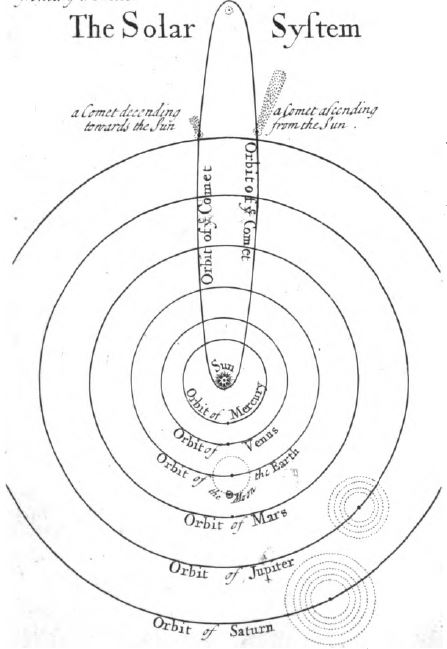
William Whiston (), holding a drawing of the solar system.

William Whiston (1667 – 1752),
holding his drawing of the solar system.

Newton was the second Lucasian Professor, holding the position founded by Henry Lucas, Cambridge’s Member of Parliament. Newton clung to the job for 33 years despite his obnoxious manners and his heretical ideas about religion. He succeeded by hiding his personal convictions and by being relatively reclusive. Not so his successor, William Whiston, who was fired after nine years.

Born December 9, 1667, today is Whiston’s birth anniversary. I met William Whiston’s shadow while researching ideas about the Earth’s geological evolution. I read a bit of his 1696 book, A New Theory of the Earth: From its Origin to the Consummation of all Things wherein The Creation of the World in Six Days, The Universal Deluge, and the General Conflagration, as laid down in the Holy Scriptures, are shown to be perfectly Agreeable to Reason and Philosophy. The title alone almost stopped me before I started, but I’m glad I spent a couple of dreary days with A New Theory of the Earth.

By the year 1700, some of England’s scientists were slipping away from the Church of England’s grasp. Deism (belief in an idle creator-god who plays no role in daily life) was ascending. Some contemporary scientists (notably astronomer Edmond Halley) were atheists. Others were mentally experimenting with variants of Christianity. Both Newton and Whiston fall into the latter group as they and many others tried to reconcile rapidly advancing science with rapidly fading faith.

William Whiston was a polymath, excelling at language, maths, and physics. He was also a wildly popular author. He produced an extraordinarily appealing translation of Josephus’s History of the Jews – after the Bible, Whiston’s version of Josephus was the most widely-owned book in England – his translation of the works of Josephus was second only to the King James Bible in sales in the 1700s.  A New Theory of the Earth was also a huge commercial success. His book, with its nod to a world designed by God, then set in motion and allowed to run on fixed laws, was well received by Isaac Newton, John Locke, and other notable contemporaries.

Whiston's 1696 drawing of the solar system - almost good enough to use today.

Whiston’s 1696 drawing of the solar system – almost good enough to use today.

It was Whiston’s mission to reconcile science and scripture. This included the universe’s creation and its ultimate demise. For Noah’s Flood, Whiston had the necessary water delivered on the tail of a comet – on the evening of November 28, 2349 BC. Whiston correctly identified that comets contain water and his 1696 drawing of a comet’s orbit is among the earliest printed diagrams showing the Earth revolving around the Sun. Except for perfect circles, rather than ellipses for the planets’ paths, his sketch of the solar system could almost sneak into a modern Kansas high school textbook.

Among his theories that were intended to unite science and scripture, Whiston preached that the Earth was motionless until the Fall of Man, after which it began to spin on its axis. He had other interesting ways of bending science to show there are answers in Genesis – much as many accomodationists do today..

Whiston also maintained that the Earth originated from the atmosphere of a comet and most changes in Earth’s geological history could be attributed to the action of comets. God created the Earth out of the atmosphere of a comet, and then engulfed it in a Great Flood with the tail of another.   Comets enamoured Whiston so much that he caused a bit of a panic in London when he predicted that one of those comets would collide with the Earth on October 16, 1736, and bring an end to life on the planet. It didn’t.

William Whiston was an English priest and a distinguished mathematician. His popularity and an endorsement from Newton helped Whiston land his job as the Cambridge math professor (and third Lucasian professor). Although he was extremely religious and spent years working out scientific explanations for biblical stories, he ran into trouble when he reduced Jesus to the status of a lesser god in the Trinity. His heresy was his embrace of Arianism.

Arius, a third-century Christian priest in Alexandria, Egypt, promoted the idea that God is the distinct and superior father of Jesus. Arius found the theory of the Trinity incomprehensible. In place of three gods who are one god, he offered a single deity. In the ensuing political battle, the philosophy of Arius fell from favour. Soon advocates of Arianism were deemed heretics.

In 18th century England, Whiston didn’t have to fear a fiery death by religious purists, but his unyielding and outspoken adherence to Arianism eventually contributed to his loss of the Lucasian professorship. Whiston, unlike Newton who concealed his unorthodox beliefs, was a popular preacher. His vision of the universe saw Jesus as something of a messenger of the god who had created everything and had nudged it all into action. If Jesus had the message and God was letting natural scientific laws drive divine destiny, there was little need for the Church and its thousands of priests. Perhaps Whiston never said exactly those words, but the implication of his message was clear.

Despite his considerable efforts, Whiston’s contributions to geology were slim. Today he is better known by students of religion than students of earth science. However, Whiston had suggested a geological history that lasted much longer than six thousand years, and he agreed that all geological changes were due to natural processes. On the other hand, many of the theories he created to bridge religion and scripture were so ridiculous that even today they serve as reminders of the futility of such an effort.


Posted in Biography, Culture, History, Religion | Tagged , , | Leave a comment