Oblated Spheroids, anyone?

Who cares if the world is not a perfect ball?  You should, for one. Knowing the exact shape of the Earth keeps satellites in place, keeps your GPS navigator working, and keeps you from the dehumanizing torture of asking someone for directions. And the knowledge that the planet lacks a perfect shape… well, maybe that excuses a person’s own lack of physical perfection. But that metaphysical implication was much more serious centuries ago. The lack of perfection in the shape of our planet became an item of debate when Sir Isaac thrust a needle into our ancestors’ collective ego balloon. Society was no longer free to imagine the world as a blob of perfection.

Newton offered mathematical proof (in Principia, 1687) that a spinning ball can oblate. Especially if it has some squishy fluid parts inside. Sir Isaac calculated that the Earth’s flattening, due to centrifugal forces, should be 1/230. In other words, the distance pole to pole, he thought, was about half a percent shorter than a diameter drawn through the equator. Newton’s number was almost right. Today, we have data Newton couldn’t dream of possessing. The actual Continue reading

Posted in History | Tagged , | Leave a comment

Earthquake Prophets

South Carolina. Earthquake.  Yes, according to the US Geological Survey, you need to link these two together in your mind. The government has issued a warning to folks in that southeast American state that it’s time to anchor the foundation. Last week, the government geophysicists issued an update (for the first time in 6 years), warning about the shaking bits in America. South Carolina ranked among the top. They, of course, are not offering any time or date or exact location for the impending earthquake. But if there is a devastating Charleston earthquake, it won’t be the first one. Continue reading

Posted in History, Religion | Tagged , , | Leave a comment

Conspiracies are Everywhere

Bison, anticipating a massive volcanic eruption, seen fleeing Yellowstone.

Yellowstone National Park sits atop the world’s largest supervolcano.  The accompanying caldera will one day tip its hat and obliterate half of the American states. Or maybe not. This blog entry isn’t going to address the date of the park’s extinction (October 22, 2014, around 6 pm, is as good a guess as any), but instead I will write a bit about the human condition. The tendency to assume some group somewhere has secret information  – in other words, conspiratorial thinking – is rife among people who don’t have the energy or desire to engage in a little critical thinking. Among other stories lately surfacing about Yellowstone, there is this news item: Continue reading

Posted in Science Education | Tagged , | Leave a comment

Alaska knows something


4th Avenue, Anchorage

4th Avenue, Anchorage

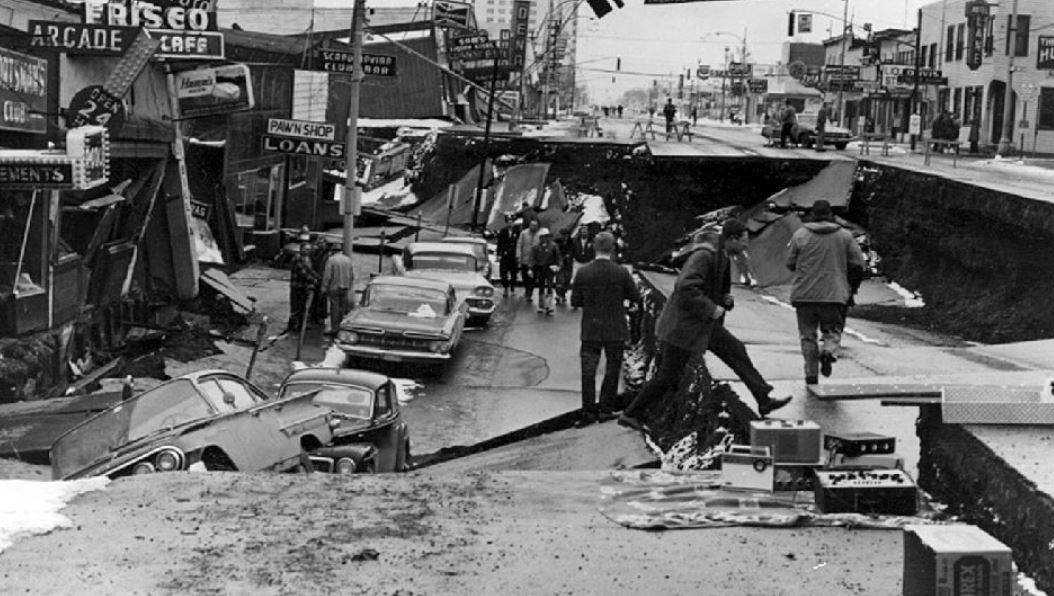
Alaska is taking credit for proving plate tectonics.  OK, that’s an exaggeration. 50 years ago, in March 1964, an incredibly powerful 9.2 Magnitude earthquake shook Alaska.  We are being told that “the quake proved a theory that was just then surfacing in seismology Continue reading

Posted in Engineering, History | Tagged , , | Leave a comment

SWARM of Magnetism

Earth's Magnetic Field (ESA/ATG Medialab image)

Earth’s Magnetic Field
(ESA/ATG Medialab image)

The popular press has been fretting about the impending demise of our protective magnetic field.  Rightly so. We can expect all sorts of nasties when the field fails.

The European Space Agency recently placed a “swarm” of magnetism-sensing satellites in orbit. Well, three in-tandem satellites is hardly a swarm, but the project is called SWARM and its mission is lofty. Since November 2013, this new enterprise has been measuring Continue reading

Posted in History, Space, The Book | Tagged , , | Leave a comment

Boring Mountains

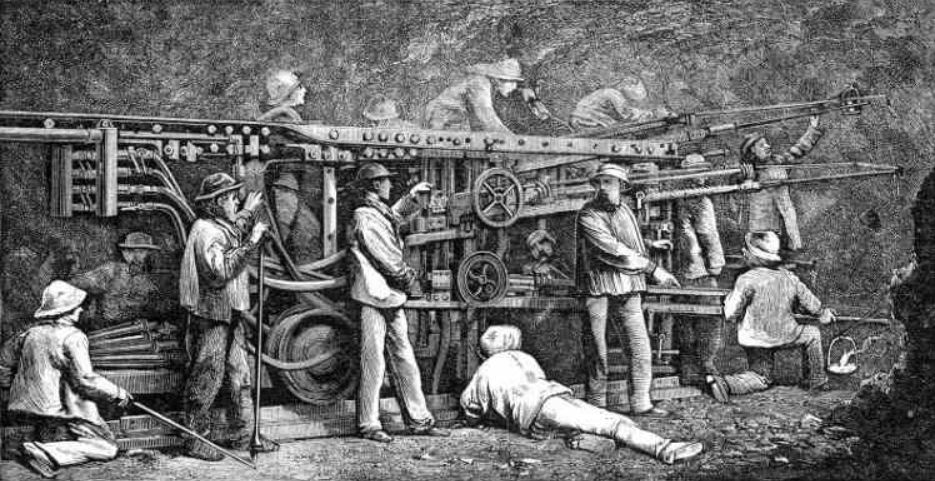
The Sommeiller Mountain-Boring Machine

The Sommeiller Mountain-Boring Machine

You might think that “boring mountains” is an odd title for a blog that promotes the study of mountains.  But today marks the anniversary of the death of an engineer who supervised the first major boring of a mountain anywhere on Earth when he drilled an 8-mile-long (13-km) 2-track railway tunnel through the Alps. In 1871, the tunnel that Gemain Sommeiller created was completed – after 13 years of digging.

When the tunnel linking Italy and France was started, only 8 inches (20 cm) of mountain was gnawed away each day. But Sommeiller soon replaced the men with picks with the tunnel-making machine you see in the photo above. (Even in 1871 some sort of hard hat was part of adigger’s attire.) Sommeiller built a water reservoir high in the mountains to generate the pressure needed to charge a pneumatic system he designed. Boring was suddenly 20 times faster. During the decade of machine-drilling, dynamite had been invented and the project put the stuff to good use, even using some of the first electic charging to ignite the sticks.

The Mount Cenus Fréjus Rail Tunnel  was an engineering marvel when it opened in the fall of 1871. (I guess it still is, actually.) It was twice the length of any previous tunnel. When diggers met (the Italian team punctured a hole through to the French side in December, 1870), their floor was just 2 feet higher than the other side – but horizontally, it was a perfect match. Quite brilliant surveying.

There was likely a ribbon-cutting ceremony when the first train used the tunnel.  Unfortunately, Germain Sommellier was not the one with the scissors. He died July 11, 1871, aged 56. He lived long enough to see the tunnel completed, but the last rail spike wasn’t driven until a couple of months after his death.

Read the book, The Mountain Mystery.

Posted in Biography, Engineering, History | Tagged | Leave a comment

Goddess Pele is stirring

Godess making mountains.

Godess making mountains.

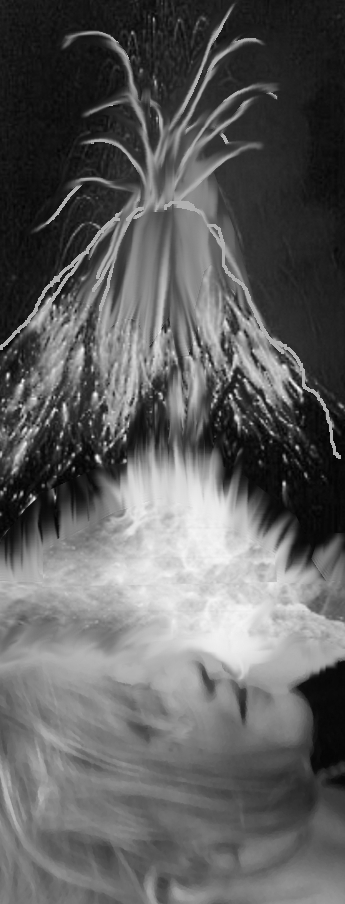
The goddess Pele may be restless again.  It seems that the legendary fire-woman, believed by early Hawaiian islanders to live under the sea and breathe lava into the throats of mountains, may be stirring. According to the ancient legends, the chain of Hawaiian islands grew from the northwest to the southeast as Pele episodically pushed through the seas, causing the series of volcanic islands to erupt. Like many myths, this one has some bits of fact – the oldest, extinct, and most eroded volcanoes are in the northwest, right where the legend says Pele began her work. Today, they say, she is busy under the world’s largest mountain, Mauna Loa, on the big island, which is also the world’s most active volcano.

Canadian geophysicist Tuzo Wilson saw things in a similar way. Back in the mid-1960s, when plate tectonics was finally taken seriously, it was apparent that volcanoes could occur at plate boundaries – the crust was fragmented and friction from the rubbing plates was heating things up, said advocates of the nascent theory. But there were too many examples of volcanic activity far from plate edges. This cast some doubt on plate tectonics, as opponents to drift quickly pointed out. Tuzo Wilson then revealed his dream (I would call it a nightmare.) of the goddess Pele on the bottom of a river, staring up, blowing bubbles from her mouth. The bubbles rose to the surface and, according to Tuzo’s vision, left a trail on the water’s surface. Professor Wilson said this image made him think of a mechanism for volcanoes that occur far from tectonic plate edges. The river is the ocean’s moving crust, Pele is a hot spot, and her exhaust is a mantle plume. Thus plume theory, an auxiliary to plate tectonics was born.

Tuzo Wilson tried, unsuccessfully, to publish his idea in “the leading American geophysics journal.” His revolutionary idea was rejected by the reviewers. Silly and daffy, they must have thought. Wilson quickly submitted his paper to a Canadian physics magazine. The Canadian Journal of Physics published “A Possible Origin of the the Hawaiian Islands” in March 1963. The paper’s editors accepted it because “they didn’t realize it was controversial” said Wilson. Perhaps. But they likely published Wilson’s work because the 55-year-old scientist (known to his friends as the cyclone) had a formidable reputation for clever insights in geology. He was a mountain climber, a travel writer, and one of the first to pilot an aircraft over the north pole. He pretty much invented aerial geology and was well-known as man who seldom got things wrong. He was not the first to support plate tectonics, but he was an early and fervent proponent – once he recognized the bulk of evidence sided with the theory. He was in his mid-50s when he abandoned stationary continents in favour of mobile ones. Very few scientists can make such a leap in ideology and embrace a new theory – and then make major contributions to the hypothesis. (In another posting, I’ll come back to Tuzo Wilson and describe his invention of transform faults and his creation of the idea of a repeatedly opening and closing Atlantic Ocean, now called Wilson Cycles. Plumes, Transform Faults, and Wilson Cycles are integral to plate tectonics.)

Mauna Loa is quite a structure. Pele has constructed a mountain that rises almost 4200 metres above the sea. From the Pacific seafloor to its snowy peak, the mammoth mountain is actually over 9200 metres – making it somewhat taller than Everest. A broad shield volcano, the mountain is 60 miles long and 30 miles wide. It is huge. And formerly, quite active – spewing lava every few years for thousands of years. However, the volcano has been quiet for the last 30 years. Until this spring. Earthquakes are waking cobwebbed seismometers, foretelling the next blast. Volcanologists believe it may be imminent.

Read the book, The Mountain Mystery.
Posted in History, How Geophysics Works | Tagged , , , , , | Leave a comment

The Death of Heezen

Bruce Heezen, 1975

Bruce Heezen, 1975

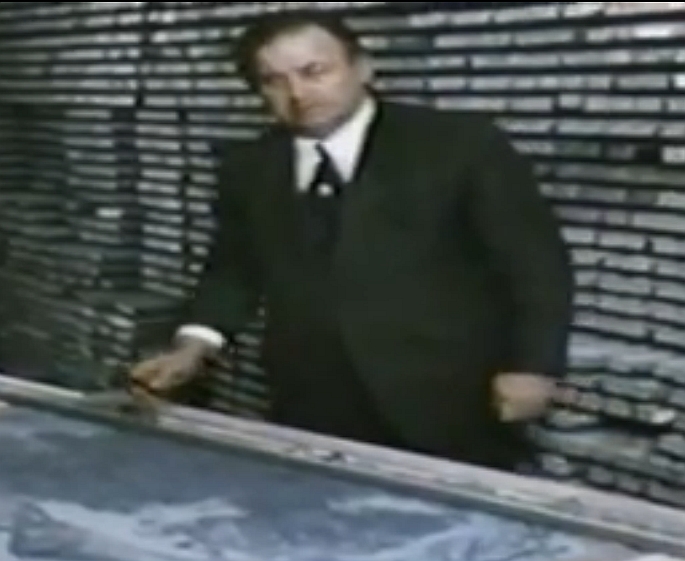
The Des Moines Register described Bruce Heezen as a large man. This, they said, contributed to his early death at age 53, on this day in 1977. But when we look at photographs of Bruce Heezen, he doesn’t appear to loom so large. Husky, they called that shape back in the 1970s. Normal, we call it today. We will get to his untimely death and its unusual circumstance in a few moments.

The native Iowan – a farm boy who grew up raising turkeys – played an important role in plate tectonics theory. But Continue reading

Posted in Biography, History, Oceans, The Book | Tagged , , , , , | 2 Comments

Mountains by Destruction

The Blade - vertical beds of sandstone

The Blade – vertical beds of sandstone

Gustave-Émile Haug. Now, there’s a name you don’t hear everyday. Unless you specialize in the obscure. But everyone has a birthday, today would have been Haug’s, so let us remember the French geologist for his role in helping to develop the failed geosynclinal theory of mountain building. Born in 1861, his 1907 Traité de géologie was “an invaluable reference” to those who valued it. It spoke of the way seaside synclines – actually massive trenches – fill with continental sedimentary runoff, then mysteriously rebound as mountain ranges. Haug’s playground was Continue reading

Posted in History, Non-drift Theories | Tagged , | Leave a comment

Earth’s Mid-life Crisis

maninhammockSome researchers think the Earth went through a mid-age doldrum, a sleepy period of listless ennui. Its plates slowed down, they claim. Or maybe stopped churning completely. For about a billion years, (1.7-.75 bya) the planet was boring. No serious tectonic excitement. Instead, supercontinent Roodinia assembled and then sat like an old frog on an old log on the ocean, doin’ nothin’.

Professor Kent Condie (New Mexico Institute of Mining and Technology) says that crustal movement may be speeding up since those days of yore. He wasn’t there in the old days, so we assume he has used some geo-magic to learn this. And he apparently has. Geomag signatures in old rock indicate to Condie that the plates  (previously usually thought to move at a stable pace) are picking up speed. It is not Continue reading

Posted in How Geophysics Works | Tagged , , , | Leave a comment