Ben Franklin: Geophysicist

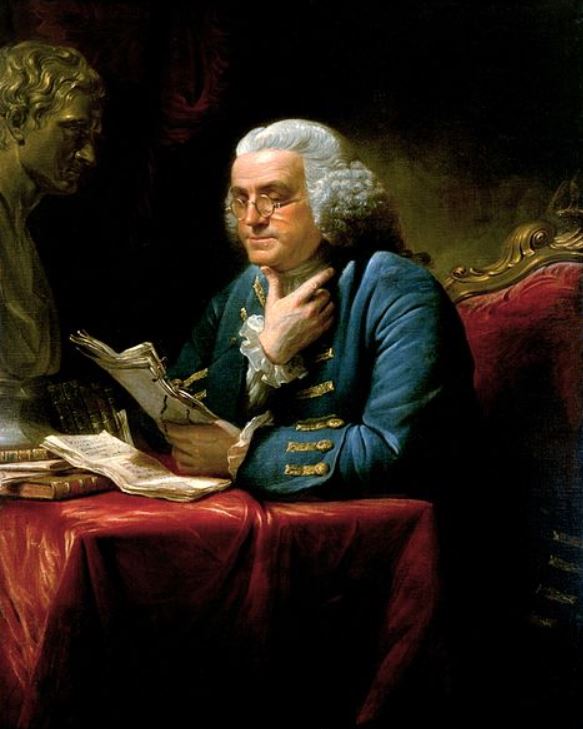
Franklin, painted in 1757 by D Martin.

Franklin, painted in 1757 by D Martin.

It’s a stretch to claim Benjamin Franklin as a fellow geophysicist. But I think we have more claim to him than the optometrists who consider Franklin a fellow glasses-maker. (Franklin invented bifocals.) Franklin, whose birthday is today, studied lightning and ocean currents and had ideas about plate tectonics. Earth physics. He also had a few things to say about science and religion – we’ll get to that in a moment.

Most of the readers of this blog (about 60% of you) live in the USA. So you know this great American hero of The Revolution. For the rest of the readers, I’ll recap just a few of the many highlights of Franklin’s life.

tallow chandler

New England tallow maker, 1730.

Ben Franklin was born on this day (January 17) in 1706. His father was a rather ineffective merchant of soaps and candles and Ben was the youngest son in the family of 17 children – the family had little money, so Ben had a very short formal education. About two years, actually. At age 10, he was pulled from school to help his father make soaps and tallow candles. As a teenager, Ben Franklin apprenticed as a newspaper printer for his older brother. His brother wouldn’t let him write for the paper, so Ben discreetly submitted tidbits of gossip and news under the pseudonym Mrs Silence Dogood. James Franklin was outraged when he discovered he’d been duped into printing his little brother’s gossip. So at age 17, Ben Franklin became a fugitive – he broke the law by running away from his apprenticeship. He left Boston and went to Philadelphia.

Ben Franklin opened his own publishing shop in Philadelphia, perhaps a risky move for a fugitive. He published Poor Richard’s Almanac which became a wellspring of wholesome adages. These included didactic witticisms like “Time is money“, and “Success has ruined many a man.” The sort of profundities that modern philosophers such as Deepak Chopra and Eckhart Tolle now make millions publishing.  Banalities paid well in those days, too. With the cash, Franklin cobbled together a chain of newspapers that extended from Charleston, South Carolina, up to the New England states. Franklin made most of his money as a publisher and author.

The uneducated fugitive founded the American Philosophical Society (1743) and the first hospital in America (1751). Multi-talented Franklin is the first American chess player known by name – he wrote an essay, The Morals of Chess, in which he expounded upon attributes a good chess player employs: Foresight, Circumspection, and Caution. The man also loved music: he played the violin and harp, and wrote a notable string quartet. (Follow this link to hear it performed with a full orchestra and with the glass harmonica he invented.)

Ben Franklin always had a revolutionary spirit and his writings were filled with liberal sentiments of American independence and republicanism. He was imprisoned (briefly) for publicly airing his thoughts about England’s king and the king’s intentions for America. Eventually Franklin helped write the Declaration of Independence. When Thomas Jefferson sent Ben Franklin a copy to be edited, Franklin changed an important line. “We hold these truths to be sacred and undeniable…”  became instead an assertion of rationality: “We hold these truths to be self-evident…” The use of the word sacred, said Franklin, inserted a sense of religiosity that he wanted kept out of government documents. Benjamin Franklin was a deist – a person who accepts that a god of some sort likely exists, but who rejects prayer and numinous texts and sees no role for divinity in the affairs of humans or natural events. And like many deists of his day, Franklin also had a strong scientific curiosity.
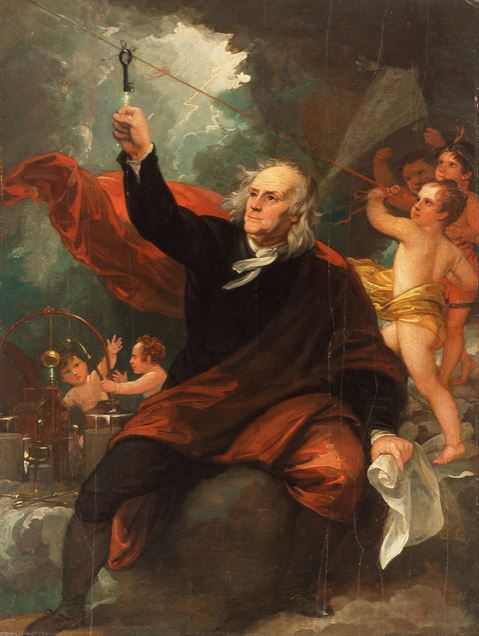
Franklin's science experiment chases cheribs away.

Franklin’s science experiment chases cherubs away.

Franklin famously flew a kite to investigate lightning – it was an electrifying experience. With proof that lightning is electricity, he invented lightning rods – iron spires that can attract bolts of lightning and transfer their power safely to the ground. This invention prevented house and barn fires and saved thousands of lives.

In a totally different scientific endeavour, Franklin figured out and named the Gulf Stream – he had mariners take temperature and flow measurements in the Atlantic, then he put together all the data into the first map of the warming current, in 1768.

It is not surprising that Benjamin Franklin also had clever geological insights. He observed that the horrific Icelandic volcano Laki, which erupted in 1783 while he was living in Europe, had caused the dreadful winter weather felt on the continent in 1784. Franklin noted the season began with heavy smoke and fog, which he speculated were caused by volcanic ash. Franklin was the first scientist to grasp the volcano-weather relationship.

On the Theory of the Earth, a 1782 message to French geologist Abbé Giraud-Soulavie, Franklin described the way islands and continents might move about on the Earth’s surface. In his letter, he construes how an island he observed might have obtained its twisted, convoluted layers of rock:

“Some part of it having been depressed under the sea, and other parts, which had been under it, raised up. Such changes in the surface parts of the globe seem to me unlikely to happen if the Earth were solid to the centre. I therefore imagine that the internal parts might be a fluid more dense than any of the solids we are acquainted with, which therefore might swim in and upon that fluid. Thus the surface of the Earth would be a shell, capable of being broken and disordered by the violent movements of the fluid on which it rested.”

Benjamin Franklin described an Earth with thick, dense fluid inside which causes the surface crust to be violently broken and mobile – no one else would come closer to describing the modern theory of plate tectonics for almost two hundred years. But his comment, a mere speculation, was not noticed by geologists. And if it had been, they had no way to test its validity. However, this letter further panegyrizes the brilliance of the man with a brain that seemed to think about everything. So we celebrate Ben Franklin today, on the 309th anniversary of his birth. And perhaps imbue ourselves with this pithy poem:

“If you would not be forgotten
As soon as you are dead and rotten,
Either write things worth reading,
Or do things worth the writing.”    – Ben Franklin, 1738

Posted in Biography, Culture, History, Plate Tectonics | Tagged , , , , | Leave a comment

Tonga Shakes. Again.

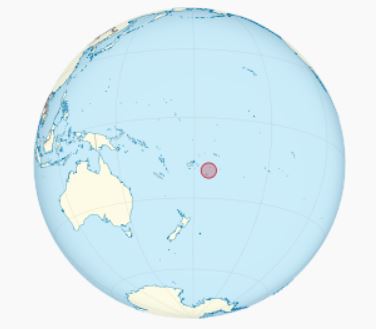
Tonga. The most active seismic area in the world.

Tonga. The most active seismic area in the world. (photo credit – Stefan Heinrich)

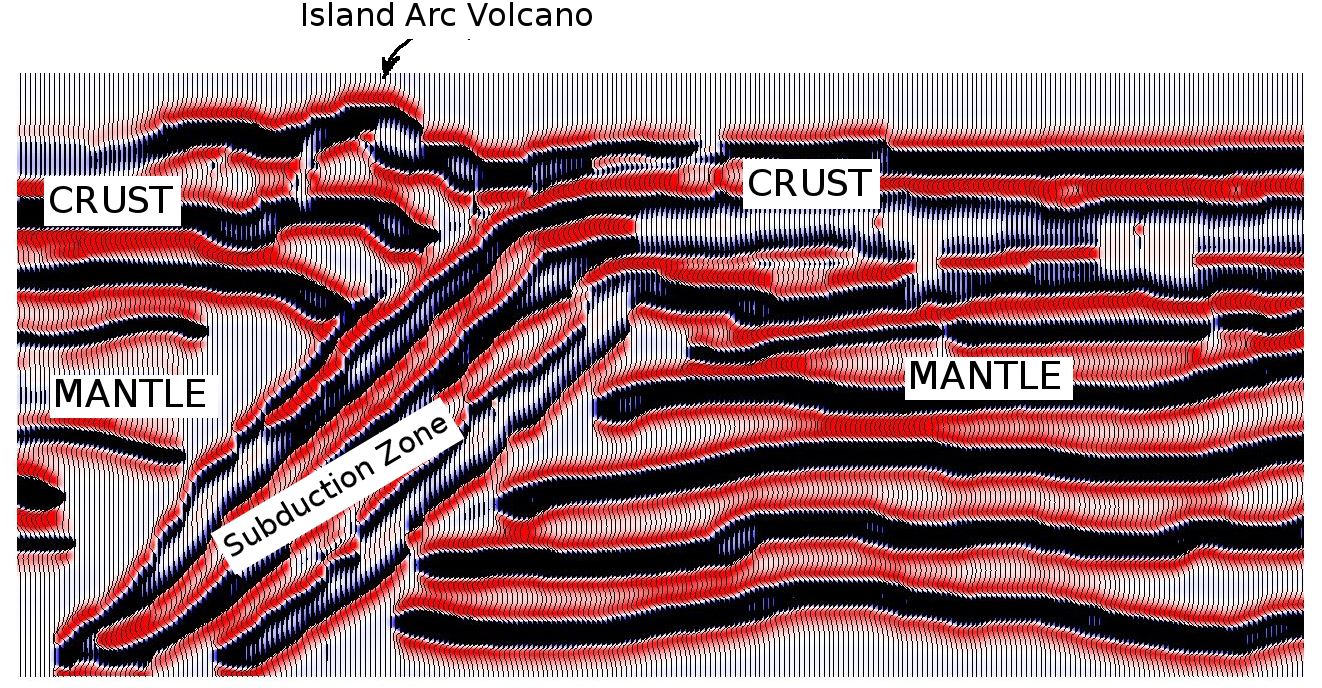
Tonga. It’s an archipelago for the seismic history books. Tonga is in the news again, this time the submarine volcano Hunga Tonga-Hunga Ha’apai was spotted by NASA satellites because the eruptions discoloured the Pacific waters amidst the island kingdom’s 176 islands. Locally, the area with the latest volcanics is known as “the place where islands jump back and forth”. The Tongans gave the region that name a long time ago. The jumping is seismic and that’s related to the volcanoes. The volcanoes are related to a deep subduction zone, a place where ocean crust is devoured in the Earth’s mantle.

Tonga - rather remote

Tonga – rather remote

Tongans are proud that they have never been colonized – they’ve never been anybody’s property. Considering the record of western domination, this is indeed something to take pride in – although part of the reason Tonga was never conquered may be that the thinly populated islands offered little more than subsistence farming and volcanic ash. There really wasn’t much reason for the French, Dutch, British, Portuguese, Spanish, or Americans to conquer and hold these dots of land. Nor would there have been much interest in a handful of islands that constantly shake.

Tonga and nearby Fiji are isolated but seismic geophysicists have been finding their way there since the 1950s. The area is a living laboratory of earthshattering activity. It was in this part of the Pacific that American scientists first got a clear glimpse of a subduction zone in action. Until then, the idea that the Earth consumes oceanic crust was an unproven scientific conjecture. But then Bryan Isacks and Jack Oliver showed up on the islands with their seismometers.

Serious worldwide seismic monitoring began with funding from the American defence department. In 1954, Jack Oliver, a young post-doc in New York City, accidentally monitored Nevada nuclear detonations on his east coast seismographs. It was immediately realized that such graphs could be used to keep an eye on Soviet nuclear tests. So the American government paid for installation of seismic recorders all over the world. Scientists jumped on the idea – perhaps they were saving the world from nuclear annihilation, but more importantly, they were gathering data about the Earth’s interior.

One use for all the new seismic data was mapping the Earth’s deep crust. In 1957, during the International Geophysical Year, the king of Fiji asked geophysicists to set up seismometers and to listen to the rumblings under his restless island. Recently, employing modern GPS equipment, scientists have learned that the spot Oliver and Isacks selected for their 1960s seismic study has the fastest plate movement on the planet – a rate of 24 centimetres per year, ten times faster than the global average of less than 3 centimetres. Movement of ocean crust at the Tonga Trench makes it the planet’s most energetic zone of seismicity. As Jack Oliver noted, in order to make an important discovery in science, be at the right place at the right time. He certainly picked the right place for seismic action.

For some great scientific breakthroughs, a measure of luck is involved. As Oliver writes in his book, Shocks and Rocks, plate tectonics was proven because “serendipity prevailed.” Serendipity, discovery by accident. Repeatedly, scientists have made accidental discoveries, often by gleaning data originally gathered for military use. Jack Oliver pointed out that the worldwide grid of seismic stations was not built for him to find slabs of ocean crust descending into the Tonga Trench, but scientists used the data for that purpose.

To investigate the deep-seated earthquakes revealed by military data, Bryan Isacks spent 15 months on various tropical islands, tinkering with seismometers and recording seismic stirrings within the deep crust and mantle. With his strategically located gadgets, Isacks found himself eavesdropping on the death groans of a gigantic slab of ocean crust sinking far below the geological structures that had created Tonga. The seismic noise was originating at least 600 kilometres below the Pacific’s calm surface. Scientists know that earthquakes result from violent shattering of brittle slabs of rock. Material six hundred kilometres below surface should be very hot and soft and pliable – bendable, not breakable, and not able to generate earthquakes. Enormous heat and pressure make such rock malleable. Nevertheless, they recorded deep earthquakes. The researchers concluded that a thick slab of cold ocean crust was being thrust deeply into the planet’s interior. But this was not a simple and direct conclusion. The idea contravened accepted wisdom – everything in the mantle should flow like cold molasses, not break like glass.

Seismic of an oceanic subduction zone - image modelled by Ron Miksha

Seismic of an oceanic subduction zone – image modelled by Miksha

Although several geophysicists had speculated about subduction zones, it was not until Isacks, Oliver, and Lynn Sykes published “Seismology and the New Global Tectonics” in the Journal of Geophysical Research, that subduction zones were proven. Their paper was the first to document how the Earth recycles crust in ocean trenches. For such an important paper, it is an easy read and a good review of the development of plate tectonics up to late summer, 1968.

Their article acknowledges Alfred Wegener’s continental drift, Harry Hess’s seafloor spreading, and Tuzo Wilson’s transform faults. After that preamble is a nod to mid-oceanic ridges, the nursery of the Earth’s crust. They show that the spreading seafloor is revealed by seismicity, earthquake swarms, and the “young ages measured by radioactive and palaeontological dating and the general absence of sediment.” Thus the authors acknowledged the birthplace of the planet’s rocky crust. Logically, if the crust is spreading from mid-ocean rifts, and not surviving to an extremely old age, it follows there must be places where the (comparatively) youthful rock is being destroyed. Their seismic proof of the crust descending into deep trenches was the fundamental contribution of their paper. Their seismic observation of the digestion of ocean crust was as convincingly clear as an X-ray image of a python swallowing a gerbil.

The scientists concluded that island arcs are zones of destruction, rather like downward escalators carrying ocean crust into a deep dark recycling depot. As proof, Isacks had captured those seismic earthquake signals – noises not dulled by soft, pliable rock but instead the crisp sounds of rigid surface crust cracking within the abyssal trench. The low-frequency seismic rumblings recorded in the south Pacific were the cacophonous crushing of ocean crust within the Earth’s mantle. This discovery was one of the final proofs of the plate tectonics system.

Until the work of  Isacks, Oliver, and Sykes in the South Pacific, the theory of tectonics was floating on thin crustal plates. Underlying dungeons were not much considered. Oliver himself said, “As far as I know, no one before us had thought in terms of such a large-scale thrusting phenomenon that moved a 100-kilometer-thick slab of lithosphere from near the surface to depths of at least 720 kilometers, or had even brought the lithosphere-asthenosphere structure into the picture.”

Oliver's "well-known sketch of a subduction plate."

Oliver’s “well-known picture” of a subduction plate

Oliver summed up the moment when he and Bryan Isacks first realized they had proof that trenches were swallowing ocean crust. “In retrospect, the final interpretation of the data seems obvious, but we pondered the data for months,” said Oliver. Then, one day, the team compared their records from Fiji to data from the Caribbean and “almost immediately, the well-known picture of the down-going slab beneath island arcs appeared on the blackboard.”

The current bit of Tongan volcanism and seismic shaking has wiped out wildlife on part of the island nearest the eruption, but the volcano has added a few hundred square metres of land to the kingdom. That new land, an upwelling of volcanic rock, is a by- product of the subduction zone gobbling up an incredibly huge swath of ocean seafloor. The bit of lava at Hunga Tonga-Hunga Ha’apai is but a small gift, an enlargement of the Tongan archipelago, given in exchange for seafloor crust – and given with much smoke and shaking to the little nation.

Posted in Geology, History, How Geophysics Works, Oceans, Plate Tectonics | Tagged , , , , , , , | Leave a comment

Ethical De-extinction

Mammoth

Buttercup, as she may have appeared 40,000 years ago. (Credit: WolfmanSF)

A South Korean biotech firm pulled blood from a frozen female Siberian wooly mammoth. Found on an arctic island in the East Siberian Sea, the creature is the best preserved mammoth ever discovered. When she was dug out of the thawing permafrost in May 2013, blood oozed from her body. Palaeobiologists performed an autopsy. They concluded that she was a 50-year-old who had mothered at least 5 calves. (They deduced that from growth rings in her tusk.) Buttercup the Mammoth, named after the flowers discovered fermenting in her stomach, apparently died when she became stuck in a peat bog and then was killed and partially eaten by predators. This could be one reason she was found with only three legs.

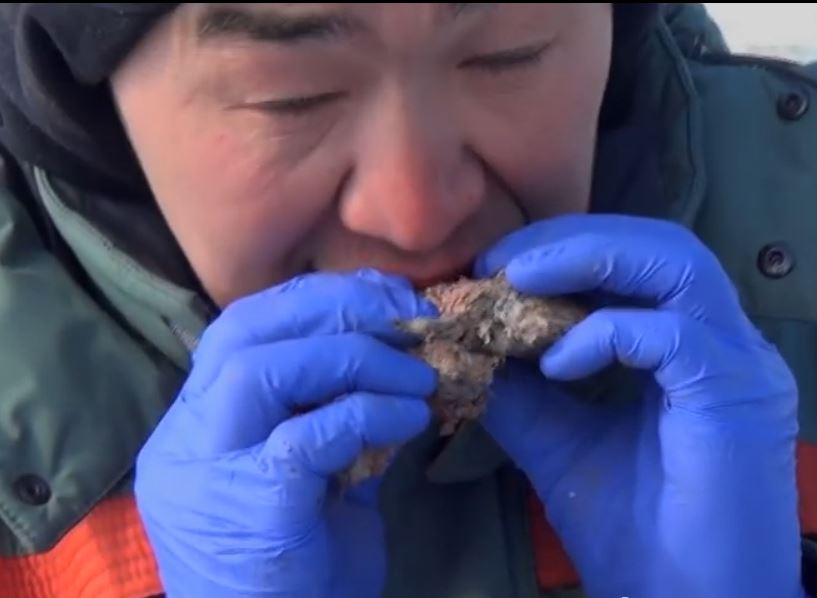
The mammoth had been frozen a long time. When she was discovered, the first scientists on the scene wondered how fresh the preserved body was, so one of the gentlemen took a bite of the mammoth meat, following up on the work other carnivores had begun just 40,000 years earlier. You might question the safety of eating a 40,000 year old steak, but locals had long fed similar finds to their hunting dogs. And, as they say,”if it’s good enough for a hunting dog, it’s good enough for a scientist.”

Eating mammoth meat.

Scientist eating mammoth meat.  (Credit)

From an experimental perspective, I guess it’s OK to have a bite. As Tori Herridge of London’s Natural History Museum explained, “it was just a wee nibble” and allowed the scientist to determine how well preserved Buttercup might be.  “I’m a paleontologist, I work on fossils normally . . . so to have the opportunity to get up close and very, very interactive with flesh that was quite bloody and sort of gory…” her voice trailed off. I don’t know if Dr Herridge tasted the meat herself, but she did have the chance to pet the dead mammoth’s hairy trunk. You can see more by watching this Russell Howard interview with Dr Herridge:

With all the blood and fleshy bits, it should be possible for the South Korean firm Sooam Biotech Research Foundation to clone Buttercup the Mammoth. Sooam Biotech has plenty of experience – they have cloned over 400 pet dogs. They will resurrect your favourite pooch for $100,000. For that price they also add a proof of purchase token – the cloned animal will be built with glow-in-the-dark toenails. Not only will you have a copy of your pet but it is less likely to get hit by a truck next time it crosses the street in the dark.

Sooam Biotech may be the perfect company for cloning a Buttercup. They have the experience. Apparently they also have the thick skin it may take to ward off ethical criticism arising from the venture. The firm’s founder is the daring and talented Woo-suk Hwang. The former veterinarian cloned the world’s first dog, Snuppy, in 2005. But you may also remember Hwang as being publicly disgraced for falsifying human embryo cloning research at Seoul National University, which expelled him. Even after the scandal, Hwang’s supporters raised nearly 4 million dollars and started Sooam Biotech in order to pursue commercial cloning. Hwang works there today, in a low-profile role. Woo-suk Hwang is apparently not directly involved in the company’s high-profile Buttercup project.

The question remains: should the cloning of a mammoth proceed? I doubt anyone will stop the project, so it’s likely a mote query. Nevertheless, there are ethical questions. At first these will involve the welfare of the elephants forced to act as surrogate mothers while the future mammoth is grown in the breeder’s womb. I suspect a few Indian elephants will unintentionally die in this pursuit. Then there are the offspring. Scientists believe that mammoths were gregarious band members. New creatures may be pretty lonely, unless the procedure is safe and inexpensive enough to allow a herd of clones. All of whom, presumably, will be female, if the only cloning stock is Buttercup.

Dodo, painted by F W Frohawk, 1905

Dodo, painted by FW Frohawk, 1905

Aside from the ethical questions regarding these science experi- ments on sentient elephants and mammoths, how does the successful cloning of a giant extinct mammal affect our perspective on the glaring reality of everyday extinction – much of it due to our own actions and manipulation of the environment? Shall we feel less guilty about the demise of the dodo bird, passenger pigeon, and polar bear? Knowing we can resurrect creatures we have killed, will we allow ourselves to become callous? (That is, even more callous than we already are?)

Whether or not we can make spare clones, we will continue to butcher our fellow creatures at an accelerating rate. We will lose the Earth’s genome diversity, one species at a time. Cloning – ugly as it is for the animals involved – is perhaps a debt we owe to those creatures succumbing to our bad habits. We are living in a new age – the Anthropocene, or Age of Man – and it is named for human-inflicted extinctions. Geologists define epochs on the basis of extinctions in the fossil record. Presently, more species are becoming extinct today (several dozen species disappear each day) than died off at any other time in the past 60 million years. We won’t reverse the Anthropocene, but like a desperate ex-lover, we may pull a few scorched letters from the fire we started. These letters may be simply C,G,A, and T, but they might remind us of the way things once were.

Besides the suffering endured by the resurrected animals and their surrogate mothers, a second ethical question arises with respect to the clone’s impact on the environment. In the case of the mammoth, that should be negligible as the environment of 10,000 years ago (when the last mammoth became extinct) is not much different today than it was in the day of Buttercup and her calves. Nearly identical flora, fauna, and even temperatures can be found among some of the world’s preserves. In this sense, at least, the mammoth will feel at home.

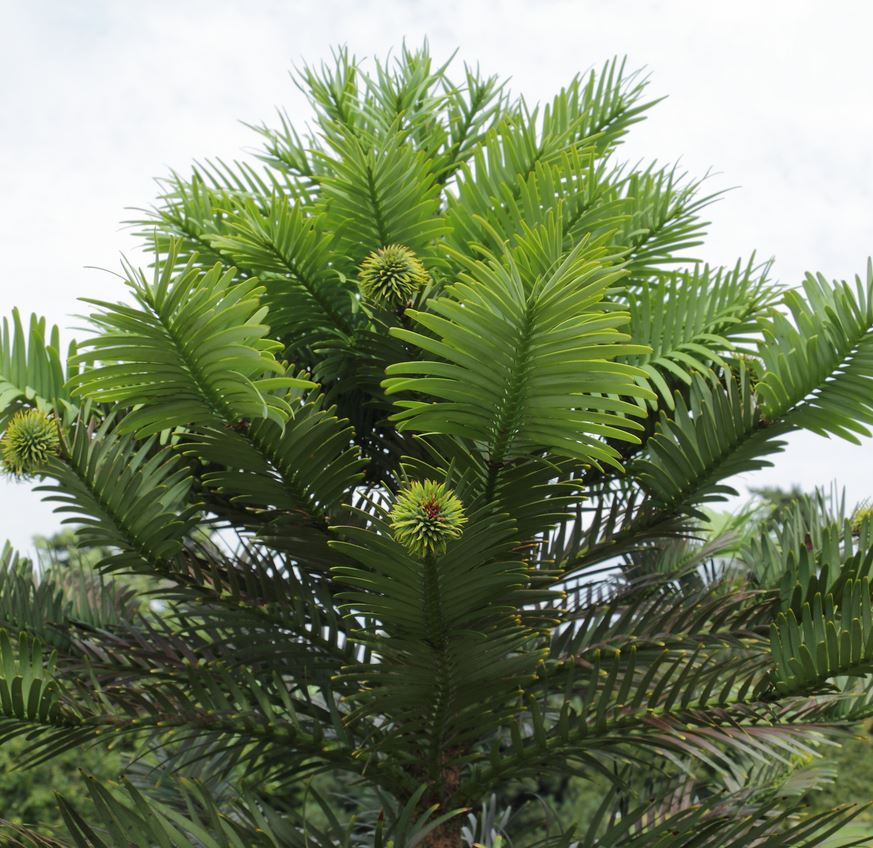
Woolemia nobilis, photo by

Woolemia nobilis  (photo by CT Johansson)

In a way, the ethics of de-extinction has already been answered. We have already resurrected an extinct species – and we have spread it around the world. Wollemia nobilis is a magnificent tree that flourished 80 million years ago, then slowly abandoned the fossil record everywhere in the world. Paleobotanists lost all trace of it in rocks younger than 2 million years, thus believing Wollemia nobilis became extinct 2 million years ago. But in 1994, a few living specimens were discovered in three small isolated ravines 150 kilometres northwest of Sydney, Australia. Since 2006, copies of the dramatic coniferous tree have been transplanted around the world. Botanical gardens are fond of Wollemia. It can tolerate a wide range of temperatures and soils – a grove of the Australian tree has been planted as far north as Scotland. If the Wollemia Pine had become extinct and was revived, would that be considered more ethically dubious than spreading this living fossil from its tiny reserve of isolated trees? If nature had run her course, a funeral for the last of the Wollemias would have been held later this century, a private ceremony attended by frogs and wallabies in that distant gorge. Instead, we can study this lone species, the sole representative of its genus. It is in many ways a unique tree.

Considered a Lazarus taxon, all known specimens of the Wollemia Pine are genetically identical, indicating the near extinction of the tree. It grows to 40 metres, has a fascinating brown knobbly bark, and resembles a monkey puzzle tree. Despite its common name, it is not really a pine – it has flat leaves rather than needles. But it is coniferous. Male and female cones occur on the same plant, and when the cones mature, the branch holding the cones dies. New branches grow from dormant nubs on the trunk and, in turn, produce more cones. We don’t yet know what we may learn from this fossil tree and its unique biology. And so it will be when we encounter a herd of resurrected mammoths grazing on arctic tundra a few decades from now.

Posted in Climate, Culture, Philosophy | Tagged , , , , , , | 2 Comments

2014 as we saw it…

The Earth and all her sciences were a big deal in 2014. Although this blog – the Mountain Mystery Blog – started in May 2014, it still caught some of the best stories of the year. In chronological order, here are links to some of this blogger’s favourites:

Posted in Culture, History | Tagged | Leave a comment

Has Cuba Got Oil?

Havana lawyer, Dr Fidel Castro, in Washington DC, 1959.

Havana lawyer, Dr Fidel Castro, visiting Washington DC in 1959.

Besides sunshine and sugar cane, what has Cuba got? It looks like the USA is serious about letting Americans party along Havana’s beaches and carry home a cigar or two. It has long bemused me that two of the continent’s closest neighbours have been isolated for two generations, with nary a neighbourly howdy between them. I can understand the American disdain when Castro turned to Russia for help and converted his island into a Communist dictatorship instead of a socialist democracy. But I can also see the point that others have made – sometimes an obstreperous foe’s behaviour changes more quickly by talking rather than isolating.

Let's concentrate on geology

Let’s concentrate on geology

This geology blog tends to steer clear of politics, so instead of pitching my three cents worth of non-expert opinion about embargoes vs free trade, I thought I’d write a few words about Cuba’s major oil fields. There really aren’t any elephants – not yet. Some readers may be surprised by the fact that the politics of oil exploration seems to play no role at all in the new American-Cuban detente.

Cuban village

Cuban village life south of Havana

Three geologists whom I know – Canadians working for three different companies – have spent time exploring Cuba’s subterranean oily treasures. They discovered very little oil, though one found a wife and settled into village life south of Havana. Nevertheless, there is oil within Cuba’s domain – the US Geological Survey estimates billions of (mostly offshore) barrels are awaiting discovery. Unfortunately, after drilling deeply in 2012 just off the north Cuban coast, hopes for the discovery of big oil fields were dashed. At least for now.

Things that make an oil field include source rock (usually oily shale), porosity (fractures and cracks that deliver hydrocarbons to the well), and traps (which can be ancient buried reefs, sand bars, pinched thrust sheets, or a bunch of other structures). There’s much more to an oil field than this, of course, but without a source, porosity, and trap, you’d better keep your derrick stashed in the shed at home. The things that make an oil field economical are the cost of production (depth of well, rock type, existing infrastructure), nearness to market, and the rule of law within the jurisdiction. How does Cuba stack up among these?

Well, all the elements that could create a profitable oil field actually exist in Cuba. The country itself has amazingly varied geology with plenty of source rock and plenty of traps buried in its highly structured geology, although the porosity element is sometimes problematic. Oil seeps were discovered centuries ago – strangely, though, the oil drips from igneous rocks, not the typical sedimentary limestones and sandstones that usually host hydrocarbons. An American Association of Petroleum Geologists’ 1932 paper, Occurrence of Oil in Igneous Rocks of Cuba, estimated that over 200 million barrels of “asphalt grade” oil was locked in rock along the north-central Cuban coast. In places, the heavy oil seeps from intrusive diorite dikes which have cut through 1,500 feet (500 metres) of oily Jurassic limestone and shale. All of this bode poorly for the explorers of the 1930s and it still does today. It means the hydrocarbon setting is complicated and unpredictable – and much of the oil itself is not much better than low-grade tar.

Regardless the US Geological Survey’s prediction of massive potential, Cuba has been energy-starved for a century. To fix this, Cuba famously entered into a deal with Venezuela, shipping well-regarded Havana-trained doctors south in exchange for South American oil. This worked well enough as long as Hugo Chavez was alive, but the flow may be stanched. Cuba needs to pump its own oil. Consumption has been around 155,000 barrels per day; production is one-third that. The shortfall has been purchased or bartered from Russia and Venezuela, but this creates a foreign expense of $5 million dollars a day – about $0.50/person in a country where daily income (GDP/pop) is a dismal $6. Both Russia and Venezuela are former big-bucks oil-ogarchies and were generous benefactors when oil prices were high. But things have changed. Those former sugar daddies have turned into sugar duds.

A Dog's Breakfast of geological puzzlement - USGS Cuba Structure Schematic

Dog’s Breakfast of Geology – USGS Cuba Structure Schematic

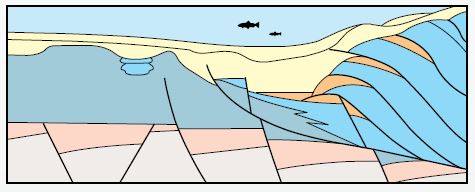
With the help of seasoned foreign geologists, Cuba has tried to produce its own oil. A very capable Canadian company – mining giant Sherritt International – explores and develops much of the country’s onshore oil. Sherritt is the largest independent oil producer in Cuba. But there is not an enormous amount of onshore oil. The real prize is waiting off the north coast – that’s where the USGS estimates 4.6 billion barrels of oil will eventually be produced. (The Cuban government claims the number is 20 billion barrels – but they are looking for investment partners.) Deep sea oil is not seeping to the surface – it is locked in rock deep below the ocean floor. Even though Cuba is near huge deep-water oil fields in the Gulf of Mexico, the geology under Cuba’s waters is remarkably different. The sticky prize is under 300 metres of seawater, then beneath 8,000 metres (25,000 feet) of twisted, faulted, thrusted rock. Geologists have a technical name for the jumbled thrust sheets that hold Cuba’s submarine oil – they call such formations a dog’s breakfast. It’s not pretty.

Not far from Cuba’s bit of the Caribbean are Gulf of Mexico oil platforms – some of which each produce 200,000 barrels a day. That’s more than the entire country uses. Large reserves are also under Cuba’s water, but so far none of it has been pumped to the surface. A recent casualty in the deep drilling effort was the Spanish oil company Repsol. After years of seismic exploration and testing under the tropical waters, Repsol gave up in 2012. Others have been poking holes in the Cuban exploration blocks – Brazil’s Petrobras (sometimes considered the world’s expert at deep marine exploration), Russian companies Rosneft and Zarubezhneft, as well as Norwegian, Indian, and Malaysian companies. All have given up on their offshore projects. Venezuela’s national oil company continues to be supportive, but can’t afford to drill the deep tricky wells off Cuba’s coast. Because of the 50-year embargo, American firms have not been involved at all – even though the huge Florida market for the offshore hydrocarbons is only a hundred kilometres to the north.

Greatly complicating things for Cuba, the drop in oil prices has further driven deep sea exploration projects from the stage. Low prices force drillers away from risky targets because the potential for a big financial return is too small. It must be frustrating for the Cuban people to own a non-recoverable resource that even the Americans assess at a $250 billion value. Because of the stubbornly unyielding deep sea reserves, Cuban leaders have refocused their efforts to the original fields – the proven onshore resources that already supply a chunk of the country’s oil. The Cubans have also begun focussing on solar, wind, and biomass energy (garnered from sugar mill waste) in earnest. Cuba’s vice president, Marino Murillo, recently told his parliament that Cuba plans to invest $3.6 billion over the next 15 years to develop alternative energy.

Oil well on Cuban beach

A safe oil well on a Cuban beach

This might be good news for Cuba’s growing tourist industry – oil production lies very near Havana and Varadero and is found on beaches popular with Canadian and European winter holidayers. The threat of leaks and spills worries Cuban residents as well as foreign resort developers. Cuba’s inadvertent switch away from deep sea oil exploration towards other energy schemes reduces their anxiety a bit.

The bottom line to this story is that Cuba and the States may become friendly neighbours but oil is not the reason. Someday the potential offshore Cuban oil reserves may be drilled, but with the current low price of oil and with the difficult geology of Cuba’s thrust and fold belt, development is decades into the future. By then the other elements that make an oil field – including lower cost of production and rule of law – will hopefully be ingrained features of the Cuban business environment.

Posted in Exploration, Geology | Tagged , | 1 Comment

Ghosts of Christmas Cold

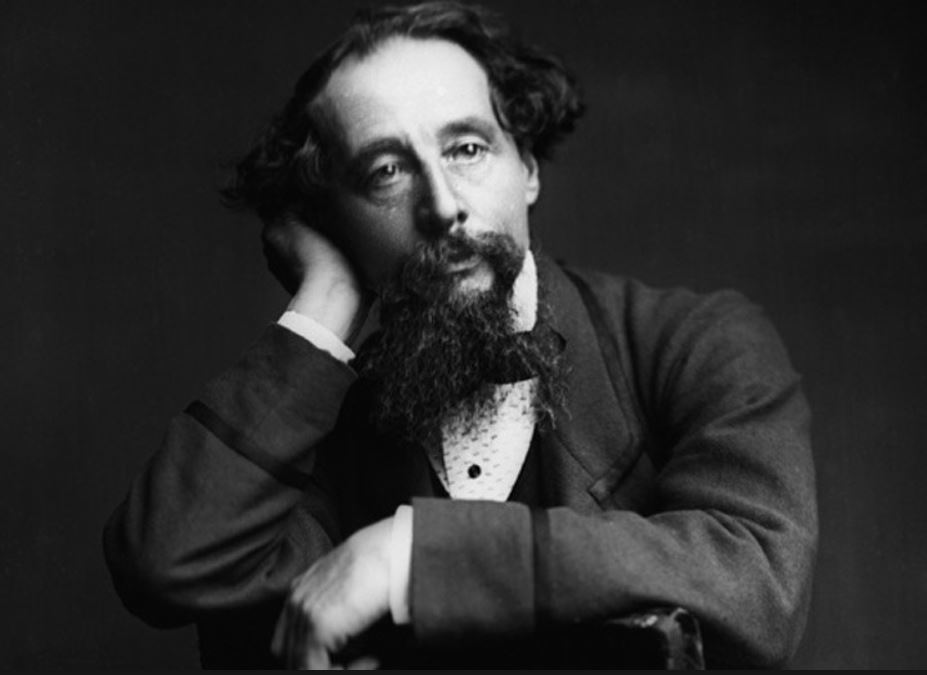
Dickens at age 49, photo by George Herbert Watkins

Charles Dickens at age 49, photographed by George Herbert Watkins in 1861

What would a modern Christmas be without Charles Dickens? For a lot of Canadians, Americans, and Brits, Dickens’ Christmas Carol is nearly the apex of Christmas culture: the story of a greedy bitter miserly capitalist whose nightmares awaken the spirit of Christmas within him. Dickens wrote his novella in 1843, a time when several of our modern holiday customs were emerging – Christmas cards, Christmas trees, and Christmas carols derived from boisterous bawdy pub songs rather than church hymns. Oh, and snow. Snow is a huge part of the Christmas image for many of us.

Geo-geeks over at the blog Letters from Gondwana inspired me to look at the Dickens-snow-Christmas connection. They analyzed The Little Ice Age and the 1815 Tambora volcano (which caused “the year without a summer”) and they explained how these events caused a period of cold weather that became part of our Christmas stories. Dickens described Scrooge with wintery symbolism: “No wind that blew was bitterer than he, no falling snow was more intent upon its purpose…” He likewise described London: “[on] the city streets on Christmas morning, where the weather was severe, the people made a rough, but brisk and not unpleasant kind of music in scraping the snow from the pavement in front of their dwellings, and from the tops of their houses, whence it was mad delight to the boys to see it come plumping down into the road below, and splitting into artificial little snow-storms.” Then the Ghost of Christmas Past took Scrooge upon the streets of his childhood: “The darkness and the mist had vanished with it, for it was a clear, cold, winter day, with snow upon the ground.” Dickens goes on and on, inconveniently dumping snow everywhere.

Dickens was only 31 when he wrote the Christmas Carol. The knee-deep snow of his childhood’s knees was still fresh in his memory. His story was an instant literary and commercial success. People loved the theme and identified with the snow drifts. They and their immediate ancestors had also witnessed the gripping cold of the receding Little Ice Age. Temperatures were cold for over 400 years (1400-1820), especially in northern Europe where entire communities became climate refugees.

Hunters in the Snow by Brueghel, 1565

Hunters in the Snow by Bruegel, 1565

Strange as it may seem, even today there are living tales of that cold time in Europe’s past. I have met two people who told me their family stories that include the Little Ice Age. One friend from Hungary, now living in Canada, has the unlikely surname Larsson. “Swedish,” he told me. “My great-great-grandfather left Sweden because the crops kept freezing. He settled along the Balaton in Hungary.” Another family friend, Helga Dorfi, was born a German-speaking Romanian. Her ancestors had left the Hamburg area “because the crops kept freezing” and had settled near the Black Sea. They kept their language and traditions for 300 years, she said. Then they emigrated to Pennsylvania.

The theory that a period of unusually cold weather before 1820 inspired our expectations of snow at Christmas seems probable. It also points to a full subversion of the Christmas story and its adaptation to a European audience. We ignore the probable spring-time birth of Christ, opting to fuse the Christian celebration with the Roman Empire’s wintertime Saturnalia Ceremony. We also ignore the palms and dusty desert manger, replacing the messy childbirth scene with clean white holiday snow. But I wonder if this will change?

In a typical winter, fewer than 10% of Americans are certain to have a white Christmas. Those folks live in northern Maine, Minnesota, Idaho, and the higher elevations of the Rockies. For everyone else, the probability diminishes quickly as one heads southward. I’ve included the US government’s NOAA Map of Snow-cover Probability, below. For over half of all Americans, there is little chance of sleigh rides and skating on open ponds. And if the climate continues its current trend, more and more of us will be dreaming of a white Christmas only after reading Dickens – in our shorts while lounging on the patio.

Probability of snow in the lower states - NOAA's National Climatic Data Center

Probability of snow in the lower states – NOAA’s National Climatic Data Center


Posted in Climate, Culture | Tagged , , , , | Leave a comment

Catastrophic Floods

Gustave Doré - The Deluge

Gustave Doré – The Deluge

An interesting blog posting, Catastrophic History, produced on the website The Not So Solid Earth, makes the point that much of future archeology will be marine archeology. During the last ice age, a lot of sea water was captured in ice sheets and was not topping up the oceans, so coasts were more exposed. Those mild, moist shorelines – now flooded – would have been ideal settings for villages older than eight or ten thousand years. In today’s blog, we’ll look at the conditions that followed those days and re-exam the status of Noah’s Flood – from a scientific perspective. Continue reading

Posted in Climate, Culture, History, Oceans, The Book | Tagged , , , , , , , , , | 2 Comments

Fat Cops; Skinny Scientists

Skinny cop

Cop.

What makes cops fat and scientists skinny? Before I go any further, let me say that I am quoting an American Journal of Preventive Medicine study and the statement reflects an average. There are outliers. I know a few overweight scientists and I know that there are skinny cops – including the one who will ask for my ID tomorrow morning while I am idling at a stop sign. He won’t be fat and I’ll tell him so, if I get a chance.

Yet it remains that the trend is there – 40.7% of police, firefighters and security guards are obese, according to the Wall Street Journal. Obesity is also over-represented among clergy, social workers, and counselors. Meanwhile the lightweights are economists, scientists, and psychologists – this group has just a 14.2% obesity rate. The contrast – 40.7% vs 14.2% – is significant. These figures are for the States – a place where over 60 billion dollars a year is spent trying to burn excess weight. The battle is not going well.

Fat scientist

Scientist.

What makes fat cops and skinny scientists? This is complicated. Data interpretation can be tough. Causation may be stubborn to tease out of facts. Picturing a chubby cop in his car at a donut shop might miss the story. Let’s look at a few reasons that the facts may be what they are, assuming the facts (based on a 375,091 sample set) are correct.

Lifestyle. Perhaps cops actually do sit too much and don’t walk/run/move as much as geologists, anthropologists, or botanists. A police officer may occasionally bound down a back alley with shoes flying, but an awful lot of time is spend in the cruiser. On the other hand, scientists may be on their feet more – hiking the hills for facts. My hunch is that this contributes to the contrast, but it may be a generalization.

Income. The Preventive Medicine journal indicated that folks with higher incomes have fewer obesity problems.  Police are underpaid. People with more money have more options for healthy eating and exercising. The study found that people with an income over $50,000/year had an obesity rate just 72% of those with an income of $25,000/year.

Genetics. This could be a touchy subject. The vocational choice between peace officer or scientist is not genetically determined, but it is likely that certain ethnic groups with particular genetically-determined body shapes (or inherited weight-related conditions) gravitate towards one or the other occupation.

Intelligence. I know a few overweight know-it-alls. And some very bright law enforcement officers. Especially among Canada’s mounties – who almost always get their man. However, in general, scientists may have brains developed in ways that avail themselves to both mathematical/scientific endeavours and to awareness of nutrition. So there might be some correlation. The charts on the pages of Preventive Medicine show a strong negative correlation between obesity and years of education – people who finished college had only 68% the obesity rate of people with “some college“. This, of course, could reflect personality types more than intelligence.

Lifestyle, again. An inordinate number of geeks are just too busy to eat. As a group, they seem to prefer problem solving to face stuffing. You likely know such people – skipping meals or nibbling on carrots while filtrating lab chemicals. Meanwhile, the stress of law enforcement and shift work may lead to mindlessly foraging upon the typical American fare of sweet sodas, salty chips, cheesy pizzas, and fatty hamburgers.

This fat/skinny cop/geek dichotomy should make us aware of some of the issues that complicate the understanding of any ‘facts’ we encounter. An emaciated version of this same story is given on Time magazine’s Health News webpage (Law Enforcement Is the Fattest Profession, Study Finds), but it is published there without even an inkling of qualification or explanation. Entirely too much science trivia is presented in popular media in this way – without the feeblest effort to encourage introspection. Lacking critical-thinking tools, we may be able to regurgitate facts – but without insight and skepticism, coughing facts into the air does little to foster understanding. This should be the most important role for the science educator. Sure, give the fun facts that attract an audience, but also instill debate and thought into the background and causation of those facts. That’s where the science really is.

Posted in Culture, Science Education | Tagged , , | Leave a comment

A Wonderful Life

Sir isaac Newton December 25-1642 - March 31, 1727

          Sir Isaac Newton, born December 25, 1642

Are you ready? Just 7 more shopping days until December 25th – Newton’s birthday.* People celebrate Sir Isaac Newton’s birthdate in interesting ways. In this part of the world, there are a lot of coloured lights, decorated trees, and shiny tinsel. Stores all over our city are running specials (although the best sales are on Newtonian Boxing Day, December 26). All in all, it’s a festive occasion and a great way to remember the man who brought us gravity, optics, calculus, and all those laws of motion. Newton would be 372 years old next week, had he not been stricken by the infirmities of elderliness. But I wonder what the world would be like if he had never been born? Would gravity work the same as it does today? Probably, but we should still celebrate the great man of physics.

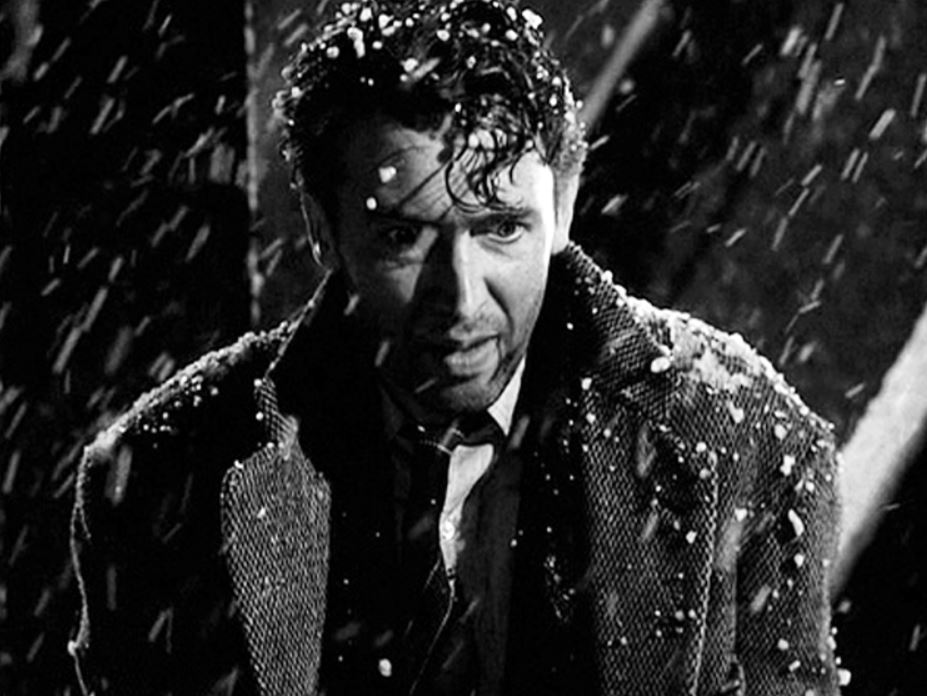
George

George

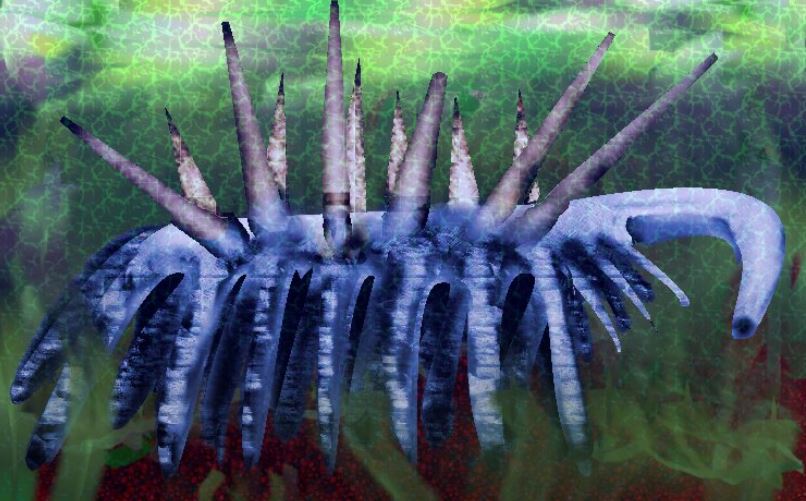
There are a lot of fun ways to commemorate Newton’s birthday – each year one of our local TV stations broadcasts the great science fiction classic, It’s a Wonderful Life, in honour of Newton. The movie probes the idea of how vastly different the world might be if one person – let’s call him George – had never been born. In the absence of George, the Earth suffers a devastating dystopia as gambling, jazzy music, and boozing abound. Without George, the world is a far different place. It’s just a movie, of course, so we will never know the impact of just one George. However, Harvard paleontologist Stephen Jay Gould pursued the idea by investigating the evolution of life on Earth as it might have been, had the peculiar creatures of the Burgess Shale survived and had the Cambrian extinction not taken place.

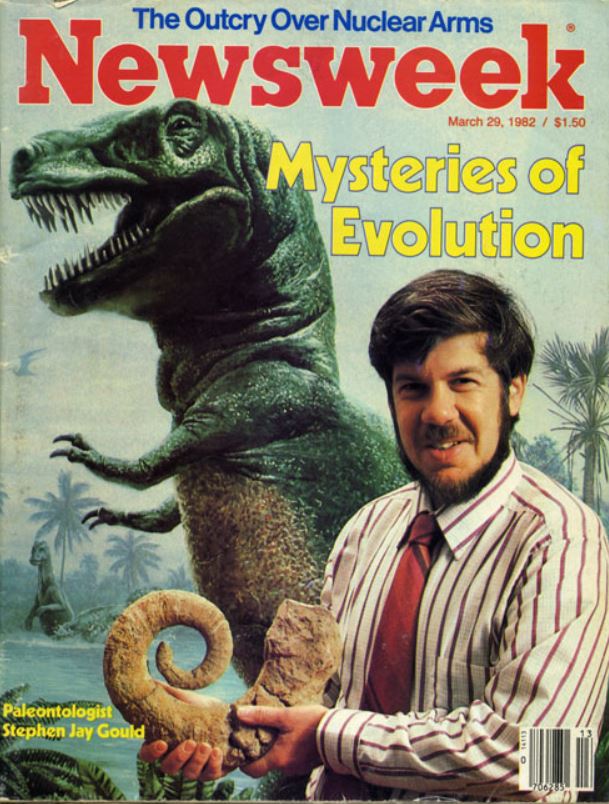
Stephen Jay Gould, cover of Newsweek, 1982

Stephen Jay Gould, cover of Newsweek, 1982

Gould’s thought experiment – what our planet would be like without that one single extinction event –  is part of his outstanding 1989 book, Wonderful Life. Catchy title, isn’t it? I have a signed copy of the book. Not signed by Professor Gould, but signed instead by my former co-workers who presented the book to me when I resigned from a big, big, big corporation (I think it is the world’s largest.) where I had briefly worked. The signatures of my co-workers mean more to me than Gould’s name inscribed in the book would have meant, though I liked Stephen Jay Gould and immensely enjoyed a talk he gave here in Calgary in 1991, the year Wonderful Life was a finalist for the Pulitzer Prize. Gould spoke about his book and the evolution of life. He was great.

Here is my three-paragraph recap of Gould’s Wonderful Life: The Burgess Shale and the Nature of History. Yes, the book has a subtitle. This narrows the scope of the book down to Canada’s Burgess Shale and the entire Nature of History. Gould is up to the task. Gould believed that chance was one of the crucial factors in the evolution of life on Earth and survival of the fittest might actually be survival of the luckiest. Controversially, Gould suggests that fitness for existing conditions does not guarantee long-term survival. If environmental conditions change abruptly, species survival may depend mostly on luck. It could also mean that the best adapted creatures for the present environment will be replaced by marginal creatures that have attributes unexpectedly suited to a suddenly changed environment. This certainly challenges “survival of the fittest” – those best adapted for the present environment might not win the longevity contest against some obscure maladapted creatures that were inadvertently prepared for some radically and abruptly changed future environment.

Hallucigenia - not your grandfather's ancestor.

Hallucigenia – not your grandfather’s ancestor.

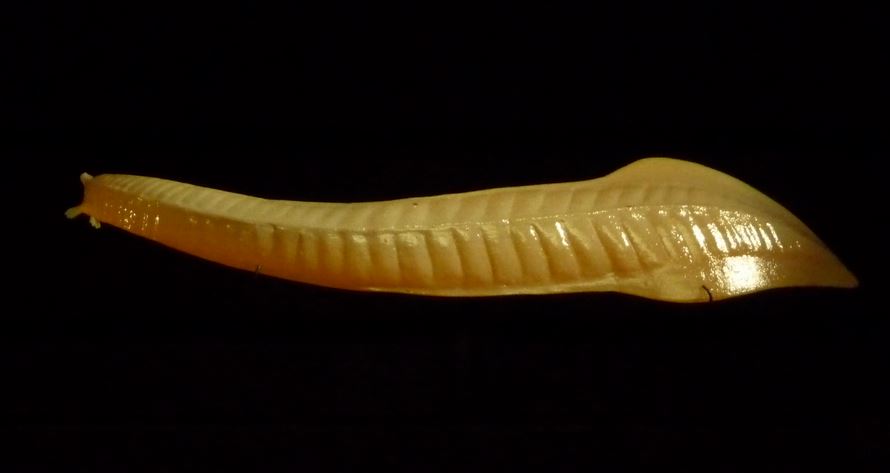
Pikaia, arguably your grandfather's ancestor

Pikaia – arguably, your grandfather’s ancestor

A large part of Gould’s argument is based on remarkably well-preserved fossils in British Columbia’s Burgess Shale. The type of animals that thrived just after the Cambrian explosion (around 505 million years ago) would not normally have left fossils, but the muddy conditions (now a shale formation in the Rockies) captured their soft bodies’ outlines in surprisingly clear relief. Gould argued that during the Cambrian the Burgess fauna were perfectly adapted to their environment, but most of them left no descendants because conditions changed. Most Burgessites became extinct.

Importantly for Gould’s thesis, surviving creatures did not seem better adapted than the ones that went extinct. Stephen Jay Gould invites us to consider what the world would be like if we could roll back time, change the happenstance of the extinction event, and imagine that the world is now populated by descendants of Hallucigenia rather than Pikaia. Would the distant offspring of Hallucigenia have evolved into bloggers who could ponder this question?

But here we are.  And now, with the big Newton holiday quickly approaching, you might consider lighting a candle to one of science’s most brilliant brains. Or perhaps buying a copy of Wonderful Life for the science geeks in your circle of friends. It is sure to be appreciated.  Maybe it can become an annual tradition.

*About Newton’s birthday on December 25th 1642 . . . Most references cite January 4, 1643, the date it falls upon with our Gregorian calendar. But it was a Julian calendar hanging on his mum’s cottage wall when he was born, and it said December 25, 1642. This gives you a chance to celebrate his birth twice each year.

Posted in Book Review, Culture, Geology | Tagged , , , , | Leave a comment

Dinos 101: Everything You Ever Wanted to Know

Greeter at Tyrrell Museum (photo - Miksha)

Greeter at Tyrrell Museum (photo – Miksha)

Want to know about dinosaurs? You’re in luck. The University of Alberta is offering a free 12-week course, a MOOC (Massive Online Open Course) starting January 3rd. I am thinking of signing up for it – the course is offered through Coursera, a giant MOOC-clearinghouse. I’ve taken advantage of Coursera before – I took their Philosophy of Science (University of Edinburgh),  A Brief History of Humankind (Hebrew University of Jerusalem), Origins – Formation of the Universe, Solar System, Life and Earth (University of Copenhagen). I haven’t studied any MOOCs that were taught via a Canadian school, so I am looking forward to Phil Currie’s lectures from the University of Alberta. Dr Currie ran the Royal Tyrrell Museum of Palaeontology here in southern Alberta and he is a smart and capable presenter.

If you have never taken a MOOC, maybe this is the time to give it a try. The Coursera program is free (although you can purchase “Verified Certificates of Completion” if you want – I haven’t done this myself).  Give Coursera’s MOOC a try. You can always drop out if the material or time commitment (about 3 – 5 hours/week) doesn’t work for you. The January 3rd course is called Dino 101: Dinosaur Paleobiology and it will cover topics in dino biology, as well as evolution, plate tectonics, and extinction. Course material claims it will also help you understand how science works. Go to this site to learn more.

As part of their promotion, the University of Alberta put together this fun page: Dinosaur Videos: 12 dinosaur myths that will blow your mind. I don’t know how these myths will actually “blow your mind” or even if that is something you want done to your mind. (I know, that silly title is just tedious click-bait.) But the webpage itself is not bad. Each myth is accompanied by a short video. If you aren’t jumping over to their site, here are three of the best of the U of A  blow-your-mind myths:

  1. Dinosaurs walked the earth, then mammals came. That’s a myth. Mammals actually evolved before dinos, but stayed in a repressed rat-like stage until the dinosaurs cleared out. Synapsids, of which mammals are the major modern representatives, arose 324 million years ago. They became rather large and dominant creatures until the Permian extinction, after which most were wiped out – except for the mammal branch. Those animals kept our bloodline alive, but were forced into cowering submission by the rising influence of the dinosaurs. Then, of course, most dinosaurs went extinct while others became birds, clearing the way for the rise of synapsids (as mammals) once again. 

  2. Some dinosaurs lived in water. That’s a myth, too. Even the super-big 100,000-pound fellows like Brachiosaurus and Apatosaurus were landed gentry. Somehow they had enough muscle to hold their bodies upright. (There is a theory that the Earth was smaller and gravity was weaker and that’s how the dinosaurs got so big. The Earth might be expanding, but I don’t think it was that much smaller during dino days.)

  3. Dinosaurs were slimey, featherless creatures. Another myth. According to the University of Alberta dino myth page, “Since the 1990s, paleontologists have discovered species after species of extinct dinosaurs that were covered in feathers. These were flightless theropods that may have used their feathery body coverings for insulation, protection from the elements and as displays for potential mates.

If this sounds like fun stuff to know, you will probably like Dino 101: Dinosaur Paleobiology. I suspect the actual course work will be more rigorous and challenging than this fun little introduction (and it might not blow your mind), but chances are it will teach you everything you ever wanted to know about dinos.

Posted in Science Education | Tagged , , , , , , | Leave a comment