Geosyncline Celebration

James Hall, American geologist and paleontologist. (1811-1898)

James Hall, American geologist and paleontologist. (1811-1898)

Today, September 12, commemorates the 1811 birth of James Hall, Jr., an American geologist (and one of the world’s first paleontologists). Hall was brilliant. But dangerous. And, as often happens in science, his most stunning idea was eventually proven wrong. But for a few decades, the geosyncline theory of mountain building was one of the best ideas in geology.

For at least 30 centuries, people had wondered about the origin of mountains. By the 1800s, a few reasonable ideas emerged. Some geologists guessed that mountain ranges were the result of the planet’s cooling, shrinking  skin. Mountains are Earth’s wrinkles, they figured. On the other hand, others believed that mountains rose because the planet is expanding. The correct answer is plate tectonics. But the idea of colliding continents was still a hundred years away when James Hall presented his novel geosyncline idea.
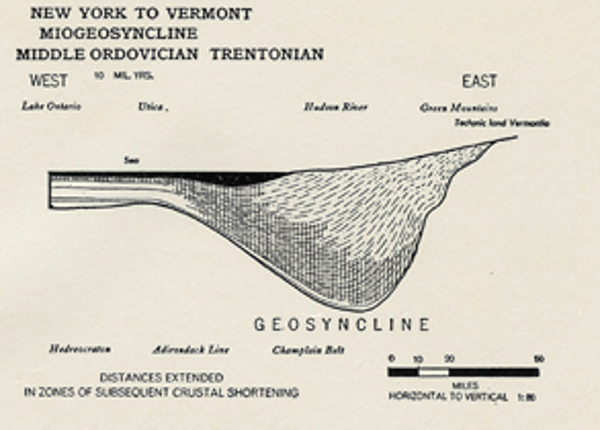
Cross-section of New York to Vermont (Mio)Geosyncline.

Early 20th-Century Cross-section of New York to Vermont (Mio)Geosyncline

Hall explained mountains in terms of regurgitated sediment becoming deposited in shallow basins (usually where continents and oceans met). They filled up, heated up, and bounced up after they underwent thermal expansion. Geothermal rebound in or near geosynclines (a word Hall invented) made sense.

It was supported, in a way, by Charles Lyell, the great Scottish geologist and friend of Charles Darwin. Lyell is sometimes credited with inventing modern geology. His words certainly carried a lot of weight. Lyell agreed that heat expands rocks and helps build mountain ranges. In his influential Principles of Geology, Lyell calculated that 500 metres (about 1600 feet) of a typical mountain’s height is simply due to heated, expanded rock. Not enough to make an Alp, but enough to cause geologists to consider the role played by thermal expansion.

The great Charles Lyell lent respectability to James Hall’s idea, but it was a short-term loan. Hall had a strong ego and an irascible personality that drove a  wedge between most geologists and Hall. It would be the same with Charles Lyell, as we will see.

Hall had been appointed New York state paleontologist in 1841. The reckless geologist reserved his sharpest attacks for his many enemies in the New York government, men in the legislature who were in a position to help him. His outbursts were infamous, making state assistance reluctant, which made Hall even more tempestuous. He kept a loaded shotgun next to his desk – he wasn’t known to have used it, but the intimidating weapon helped him win arguments.

Before detailing James Hall’s dispute with Charles Lyell, here is an example of Hall’s rash behaviour. Hall’s government office published geological outcrop maps. Hall had made several significant contributions to naming and defining geological eras and periods. He was an expert paleontologist and his fossils helped identify rock layers throughout New York. But the lofty style of his work was inaccessible to ordinary folks. That changed after James T. Foster, a New York school teacher, published a popular geological chart in 1849. The chart was rife with errors, but it was clever and popular. Hall was jealous and indignant, and set to kill.

He didn’t kill Foster. But in Albany, Hall slipped aboard a boat headed to New York City. The vessel was hauling Foster’s geological charts. Hall worried that if the prints reached New York and were released, European geologists would injure themselves laughing at the bucolic state of American science. During the night, Hall threw all the prints of Foster’s offensive chart into the Hudson River. Next, he and Harvard geologist Louis Agassiz published letters in the Albany papers, claiming that Foster’s work was a childish effort created by an amateur dabbling in science. The school teacher, James Foster, felt insulted. He sued Hall and Agassiz for the equivalent of a million dollars in today’s money. The subsequent libel suit entangled Hall, Agassiz, James Dana, and other geologists for two years but was finally dismissed by the judge. Meanwhile, America’s first ‘science’ trial brought favourable international attention to the callous Hall and to the other American geologists involved.
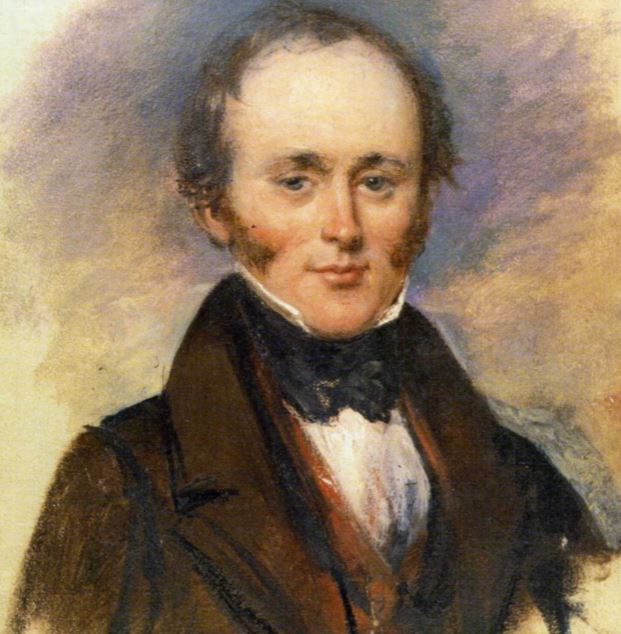
Charles Lyell in 1840.

Charles Lyell in 1840.

Hall’s volcanic temper also got him in trouble with Charles Lyell. Lyell was touring North America in 1841 and 1842. Lyell’s incessant questions and his habit of copying American geological maps began to irritate his hosts. They nicknamed Charles Lyell “The Pump” and stopped feeding him the maps and notes they had worked hard creating.

James Hall worried that Sir Charles Lyell would return to Britain and claim the Americans’ material as his own work.  In March 1842, a letter signed “Hamlet” appeared in a Boston newspaper. It charged Lyell with the scientific sin of geo-kleptomania. Hamlet was Hall and Hall was suddenly ashamed of himself for anonymously insulting such an esteemed guest. In his embarrassment, James Hall treated Charles Lyell with even more respect and deference than he deserved – Lyell had certainly exceeded the bounds of any visitor’s allotted indulgences. But Hall’s fresh attitude soothed the insult towards Lyell. In return, Charles Lyell was somewhat open to Hall’s account of mountain building.

In the geosyncline theory, mountain-building was counter-intuitively explained as a result of landslides that filled deep chasms. Layers of sedimentary sandstone, limestone, and shale found in mountains were due to massive accumulations of sediment that slid into huge near-shore chasms created by the weight of earlier eroded sediments,  buried deeper and deeper in geosyncline troughs. The accumulation of sediments became so thick they sank far down into the hot basement of the subsurface and melted. Eventually everything expanded because of heat, and rose high on the surface in the form of mountains.

The geosyncline theory was popular in North America. For one thing, it was a home-grown idea, invented and taught in America. The Europeans were stuck in a debate between a shrinking vs expanding Earth as the cause of mountains. In the USA, it was geosynclines that built mountains.

James Dana, at age 71

James Dana 1813-1895

Hall teamed up with James Dana, the popular head of Yale’s geology department, to flush out the details of the model.  Together, they concluded that erosion washes grains of rock off continents, dumping them into nearby seas where the weight of the grit depresses the sea floor. The amount of accumulated sediment becomes so enormous that the material pushes down thousands of metres. In the case of the Appalachians, Hall and Dana figured the depth of accumulation was about 12,000 metres just before those mountains rose from the depths. It is fairly easy to imagine huge depths of eroded materials. But finding a way to elevate these twisted hardened rocks back above sea level was problematic. The geologists assumed that the heat of the deep burial plus the pressure of the Earth expelled the geosyncline’s material, forming mountains – like toothpaste squeezed from a tube. It was a convincing theory, but unfortunately there were no existing active examples anywhere in the world that it actually happens.

Nevertheless, for lack of another way to explain mountains, the idea was accepted in the US for decades. The idea long outlasted James Hall, who lived 86 years, dying in 1898. It would take another 70 years before plate tectonics replaced geosyncline theory in America’s universities. By then, the idea had become so ingrained into the understanding of geology that it was hard to overturn it.

Posted in Biography, Geology, History, Non-drift Theories | Tagged , , , | 2 Comments

Finding Oil and Gas where God Dumps Them

palinWell, here’s a great idea. Sarah Palin has offered to head the Department of Energy when Donald Trump becomes president. “I think a lot about the Department of Energy, because energy is my baby: oil and gas and minerals, those things that God has dumped on this part of the Earth for mankind’s use…”

There’s a lot I could write about the suitability of Sarah Palin as director of the Free World’s energy. I’ll start with her colourful way of describing how oil, gas, and minerals form. In her interview, she said something about God taking a dump.

I guess when a politician thinks the world is just 7,000 years old, the polit may really think of geological deposits in terms of God’s dumpings. I can’t imagine her understanding traps, sources, migration, and reservoir rock with respect to hydrocarbons. Perhaps she doesn’t even care how God dumps natural resources.  Does it matter? Should we worry if the next person to run the American Department of Energy and command its 30.6 billion dollar budget, 13,000 federal employees and 93,000 contract workers doesn’t know how the firm’s widgets are made? It’s probably enough that the head of the department is a big-picture thinker. A leader with spunk and talent, people skills and leadership. Besides, what could be more amusing than having two reality TV stars running the USA – Trump (Apprentice) and Palin (Amazing America)?

Someone who really knows energy.

Someone who knows energy.

At the end of the CNN interview, Palin added “it would be great to have someone who knows energy” in charge of the department. Surprisingly, she was talking about herself. So, besides knowing that God has dumped energy upon America, what else does she know? Like most Americans, Sarah Palin knows that Alaska has a lot of energy. She should know this better than most – she was once a briefly-serving Alaska governor. As such she was responsible for a lot of energy.

“20% of America’s energy comes from Alaska,” she told us while she campaigned for vice-president. Well, the actual amount was 3.5%, an unfortunate error that she repeated for months. We expect a high-level big thinker to have a grasp for high-level numbers. So it makes us wonder what she meant when she told us that she knows energy.

It startled me when Palin commented yesterday morning on CNN that she would like to lead Trump’s energy department. But perhaps I worry too much. Although Trump responded by saying he could use her as his energy chief, I should remember that Sarah Palin doesn’t stay long on any of her jobs. And as the future energy secretary, she is already finding a way out. She’ll shut it down and move on, perhaps to a reality TV series called “How I Destroyed America”.

Palin tells us that her role as the national energy head would be short-term because all the energy operations and resources would be turned over to the states. (I wonder if that includes stateless offshore oil and gas.)  She would give the resources to the people of each state to manage. Perhaps there’s some logic to that. Or perhaps not. States have long had their own regulatory and oversight boards governing everything from well spacing, fracking rules, reclamation projects, and recovery rates from fields. But I guess the states could always do more and the federal government less. There might be 50 different competing bureaucracies – none with a national vision –  but what could possibly go wrong with that?

Speaking American

Speaking American

Although she would like to run the energy department, then quickly close it, Palin fortunately demurs on running anything dealing with culture and is unlikely to become Secretary of State. For example, in the recent Republican controversy about Jeb Bush campaigning in Spanish, she praised his effort to reach out to those nice Hispanic people who make up “a large and wonderful” part of the country. However, Sarah Palin added that in America, we should all “speak American.”  But I doubt that she meant real American – for example Navajo, Cree, or Cherokee.

However, Sarah Palin isn’t afraid of languages other than her own variety of American. She says that she studied both French and Spanish in high school, adding, “I shouldn’t have taken them both, because I got them all mixed up by the time I was graduating.”   I betcha she did.


Posted in Culture, Geology, People | Tagged , , , | 2 Comments

What do We Really Think about Plate Tectonics?

In mid-August, two experts on acid rain published a study. It’s about Wikipedia and how wiki edits reflect some of the social dynamics of the public’s view of science.  The researchers – Adam Wilson and Gene Likens – indicated that they were frustrated. Wikipedia’s acid rain entry had been repeatedly vandalized with obscenities and nonsense. The culprit(s) were likely editors who disagreed that precipitation can become contaminated with sulphuric acid and that such pollution can cause environmental damage. The vandals were apparently unable to express their opinions through reasonable logical arguments supported by facts. So the renegade editors deleted large sections of material and inserted vulgarities and wiki-graffiti. For example, the opening paragraph was once briefly replaced by “Acid rain is a popular term referring to the deposition of wet poo and cats.” Hilarious though this may be among 12-year-olds, it is annoying to people using Wikipedia for general study and it is disturbing when such vandalism is committed by 35-year-old libertarians intent on giving coal mine owners and anti-environmentalists failed reputations.

Wet poo was just the beginning of the vandalism crudely intercalated within the structure of the acid rain wiki page. If you read Wilson and Likens’ PLOS paper about wiki-graffiti, you will find some of the more vulgar comments that were inserted. As a result of their irritation with the ignorant science-bashers, Wilson and Likens decided to investigate the level of conflict played out on various other contentious science-related Wikipedia pages. These include global warming, evolution, and continental drift. I would have chosen plate tectonics instead of drift, but the phrase ‘continental drift’ attracts less science-worthy editors – which was perhaps helpful to Wilson and Likens’ study. They wanted to see how many nuisance (non-science) edits Wikipedia has been imbibing. Quite a few, it turns out.

In order to attempt to quantify the level of conflict among editors of Wiki pages, the researchers counted the size and number of edits on the potentially contentious pages for the period 2003 through 2012. We may assume that larger edits (over 100 words) likely represent disagreements or insertions of content while smaller edits (fewer than 50 words) probably reflect grammar and spelling corrections and minor additions such as details or references supporting or opposing existing theses. They found that evolution received an average of  9 edits per week with 142 words changed per day. Global warming was edited 13 times per week with 111 words changed daily, on average. Our favourite – continental drift – experienced just 2 edits per week with an average of 24 words changed per day.

Wiki Stats from Wilson & Likens - full description is here.

Wiki Stats from Wilson & Likens – full description is here.

What about plate tectonics? I have not run the exhaustive statistics that the PLOS paper’s authors employed. But I have taken a quick look and compared continental drift with plate tectonics. From January 1, 2015 until today, there have been just 21 non-robotic (and non-sequential edits by the same editor) changes to the plate tectonics wiki entry. Meanwhile, continental drift has seen 118 edits that were not conducted by robots or sequential editors during 2015.   [Wiki bots tend to fix grammar, formatting, vulgarity vandalism, and unsourced materials. Sequential editors are the same person, repeatedly changing and saving and changing and saving again. The bots were not counted as they likely don’t have personalities and are not engaged in flame wars while the sequential editors are counted as a single edit undergoing frequent revisions.]

Fixing the internet.(Credit: xkcd.com)

Fixing the internet.
(Credit: xkcd.com)

Plate tectonics, 21. Continental drift, 118. Those are the total number of actual human-invoked edits since January first.  I was intrigued by the big difference. One thing that immediately jumps out to me, a casual viewer, is that roughly half of the continental drift editors had IP identifiers – they were not editing under registered user names and had not logged onto real accounts. (On the other hand, none of the plate tectonics edits were made behind the guise of an IP ID.)

There may be many reasons edits are conducted without logging on, but such edits should be viewed with suspicion. One example is IP 186.119.52.216 (registered in Colombia, South America) which has been used only once for Wikipedia editing and includes the following vandalism on the continental drift page:  “ONE REASON THEY MOVE … the continents get boried of being in the same place so they move.” Well done, 186.119.52.216. Another user, IP 40.141.126.9 (registered in the USA) decided continental drift could use some porn references. These were undone within seconds by a computer algorithm named ClueBot.

I expected to find a number of tin-hat edits claiming that continental drift is a general fallacy and that such things as moving continents don’t happen on a flat Earth. I was happy to see that no such edits had been attempted among the several dozen entries I reviewed. My general conclusions are 1) topics with a more scientific-sounding title (plate tectonics as opposed to continental drift) receive more scholarly edits; and, 2) most irresponsible edits on the Earth science pages are easily recognized as vandalism.

I learned something else from the Wikipedia statistics compiled by Wilson and Likens: Continental drift is not very popular – and plate tectonics even less so. During the 9-year period researched, drift received about 1300 daily page views. The real action is evolution (6260 daily views) and global warming (15,550). My blog – the one you are reading right now – might be more popular if I had chosen to study and write about biology or the atmosphere instead of The Earth. Alas, I’ll continue my wayward path. And I appreciate your company on this journey.

Posted in Culture, Science Education | Tagged , , , , | Leave a comment

Florida’s Newest Sinkholes

Florida's new sinkhole. Engineers are filling it with water to stabilize it.

One of Florida’s new sinkholes.
Engineers are stabilizing it with water.

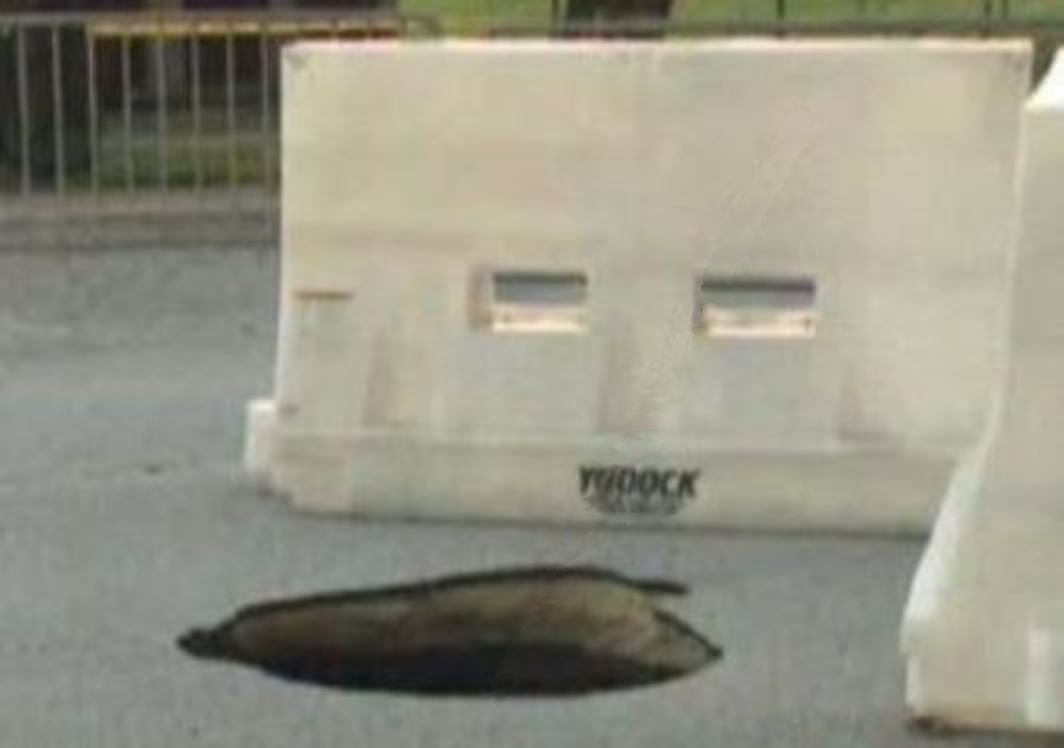
Smack-dab in the middle of Florida is a farming community called Groveland. It is hard to get more central than this central Florida town.  Groveland rides high on Florida’s limestone spine, a slight rise that puts the center of the state mildly above sea level. The limestone backbone, hidden under clay and sand, is riddled with caves and caverns. These aren’t usually visible from the surface, but they are vulnerable to collapse. On Sunday, three days ago, the lower than usual water table weakened the isostastic pressure holding up the roof of one such cave. The ceiling fell and a 20-metre-deep hole suddenly opened. Luckily, homes were spared, though part of a driveway was swallowed by the earth below.

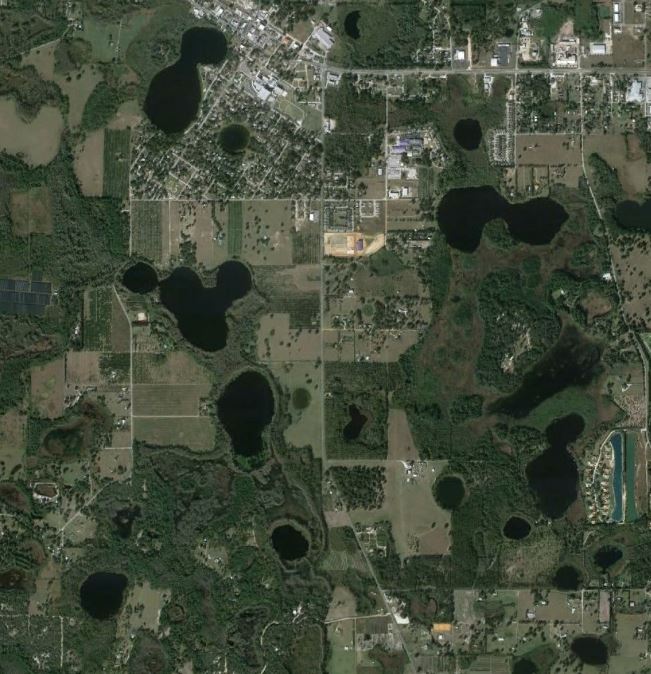
Sinkholes mar the landscape around Florida like chicken pox on an unvaccinated third-grader. This aerial view shows about 25 circular sinkholes that are over 100 metres in diameter. The largest approaches 500 metres. There are many more sinkholes which are smaller than 100 metres. (The one being celebrated at the corner of East Waldo Street and Iowa Avenue in Groveland is just 15 metres in diameter). Smaller sinkholes have largely been filled in by natural erosion – even in the aerial image below you can see circular swamps and depressions which were likely once small lakes.  By the way, this image covers about 12 square kilometres, of which ten percent is presently water-filled sinkholes.

South Lake County's circular lakes. Most likely were sinkholes that opened centuries ago. Groveland is the town near the top of the map.

South Lake County’s circular lakes. Most of them were likely sinkholes that opened centuries ago.
Groveland is the town near the top of the map.

I lived in this part of Florida for ten years. Groveland was my postal address, though my turf was seven kilometres south of town. It was the 1970s and early 80s. I knew about sinkholes, realized their danger, but spent almost no time thinking about them. Having a sinkhole suck up your home (and maybe your life) seemed less likely than being struck by a truck, a lightning bolt, or a water moccasin.

After a big one swallowed an Orlando house when I lived nearby, I asked a grove owner about the chances of his trees disappearing into a sinkhole one night. He looked at me as if I were speaking in tongues. “No, no chance,” he said. And I suspect people who are still living in the area are thinking about this Sunday’s sinkhole the same way. A grand nuisance, but no one was hurt, little damage was done, and school/work began pretty much as usual on Monday morning.

Monday's U of South Florida resident sinkhole

Monday’s University of South Florida campus sinkhole. Just a meter wide, but twenty metres deep.

The University of South Florida (USF) has a list of 101 sinkholes which opened in Lake County during the 30 years of 1976-2006. There were likely more, but the list gives a sense for the frequency of these events. The USF has similar lists for sinkholes across other parts of Florida, but on Monday they found they didn’t need to travel far to find a new one to examine. Florida’s latest sinkhole – a tiny metre across but 6 metres deep – appeared right on the Tampa campus.

Tampa's killer sinkhole that destroyed a home and swallowed a resident in 2013. It opened again last week.

Tampa’s killer sinkhole that destroyed a home and swallowed a resident in 2013. It opened again last week.

The Tampa area is a hotspot for sink- holes. In February 2013, one formed under the bedroom of Jeff Bush in Tampa’s Seffner suburb. Bush had just gone to bed. In a few minutes, he screamed for help. His brother Jeremy ran to see that Jeff Bush and most of his bedroom had disappeared.  The young man’s remains were never recovered.  Last week, on Wednesday, a 6-metre-wide sinkhole opened again at the same spot.  After the initial sinkhole formed two years ago, the county bought the property and a neighbouring home to prevent another disaster. It reopened, but the county does not expect it to grow larger.

To prevent deaths and dissuade developments atop potential sinkholes, predictive tools would be useful. You would be correct to place money on a sinkhole reopening where one might have existed in the past. As we’ve just seen, the killer in Tampa opened again last week. Even the Groveland sinkhole that led this story is a revival of a smaller one that struck the same spot 40 years ago.

Florida has more sinkholes than any other state and they can strike almost anywhere in the state. It just takes the right combination of near-surface carbonate rocks (which are fairly ubiquitous) and disturbances in those limestone and dolostones. Florida’s shallow ground water is usually slightly acidic. As it seeps below the surface, it eats away at the carbonates, forming water-filled caves. The resulting karst topography includes unexpected fresh-water springs, disappearing streams, caves, and sudden sinkholes. The underground erosion can be exacerbated by droughts followed by heavy rainfall or by excavation for buildings and pumping of irrigation water.

Pumping water can be especially problematic. Without Florida’s groundwater, a lot of farming wouldn’t see its next harvest. On the other hand, the shallow underground pores, vugs, and caves are sometimes depleted with unexpected consequences. For example, in the winter of 2011, a young lady living near Plant City left her back door and fell through a freshly opened sinkhole, a deep cavity less than a meter in diameter. She had her cell phone in her hand, called the emergency line and was rescued. The sinkhole developed because local farmers were pumping water to protect winter strawberries from frost. The water table fell fifteen metres and the aquifer couldn’t recover quickly enough – hundreds of private wells ran dry. Because the pumping suddenly made the subsurface cavities hollow, one hundred forty sinkholes appeared within days. In addition to farm irrigation and emergency anti-frost spraying, Florida’s growing population and domestic water consumption add to the problem of drained aquifers and resulting sinkholes.

Typical residual InSAR data showing deviation in elevation from previous recordings.

Typical residual InSAR data showing deviation in elevation from previous recordings.

The hope of predicting the next sinkhole now rests on NASA technology.   Satellites equipped with Interferometric Synthetic Aperture Radar (InSAR) may detect changes in ground elevations over time. Such changes may indicate an area’s vulnerability for sinkholes – sometimes a few centimetres of subsidence occurs before the ground collapses. InSAR can measure subtle deformations. This is done by comparing sequential radar surveys, searching for changes. At this moment, the technology is so new that these surveys are still in the planning stage. It might not even work as a predictor. Unfortunately, not every sinkhole is preceded by subsidence. Some simply pop open, swallowing the surface.

Not only are they sudden and (so far) unpredictable, you can’t be totally safe anywhere in the state, though some areas are riskier than others. If your retirement dream includes Florida, you can’t pick a safely non-sinkhole homestead. However, if we consider that about ten percent of the more active areas has been sunk sometime in the past 10,000 years, then you might assume that there is about a one percent chance that your property will experience a sinkhole in the next thousand years. So, you are reasonably safe – but you should probably avoid any real estate that has had a recently patched sinkhole.

Posted in Geology | Tagged , , , | Leave a comment

Hiding Rising Seas in Sunken Deserts

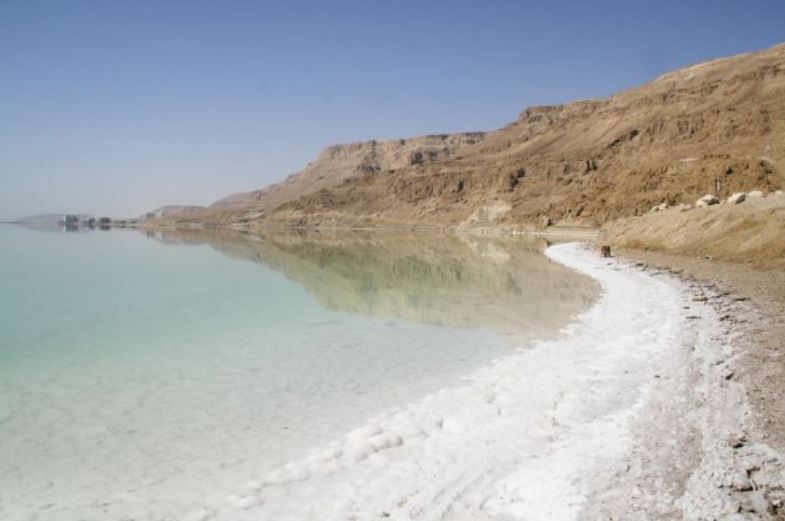
Dead Sea shoreline, 428 metres below sea level.

Dead Sea shoreline, 429 metres below sea level.

This weekend, a friend asked me if the rise in the oceans could be drained off into the world’s below-sea-level depressions. Could rising ocean waters be diverted to fill the Dead Sea and Death Valley Depressions, for example? It seems a creative solution. Instead of flooding the Maldives, Piazza San Marco, and south Florida, the expected ocean level rise could fill some of the Earth’s less inhabited wastelands instead.

At this moment, I don’t want to debate the idea of climate change and its impact on sea level. I think the evidence is substantial that Arctic ice and mountain glaciers are disappearing and the melt water is reaching the sea. But this may ultimately be a thousand-year-long melting blip before the return of another ice age. I don’t know. What I’d rather do today is simply try to put some numbers on the innocent question: Would it be practical to relieve coastal flooding by filling land-locked places that are below sea level?

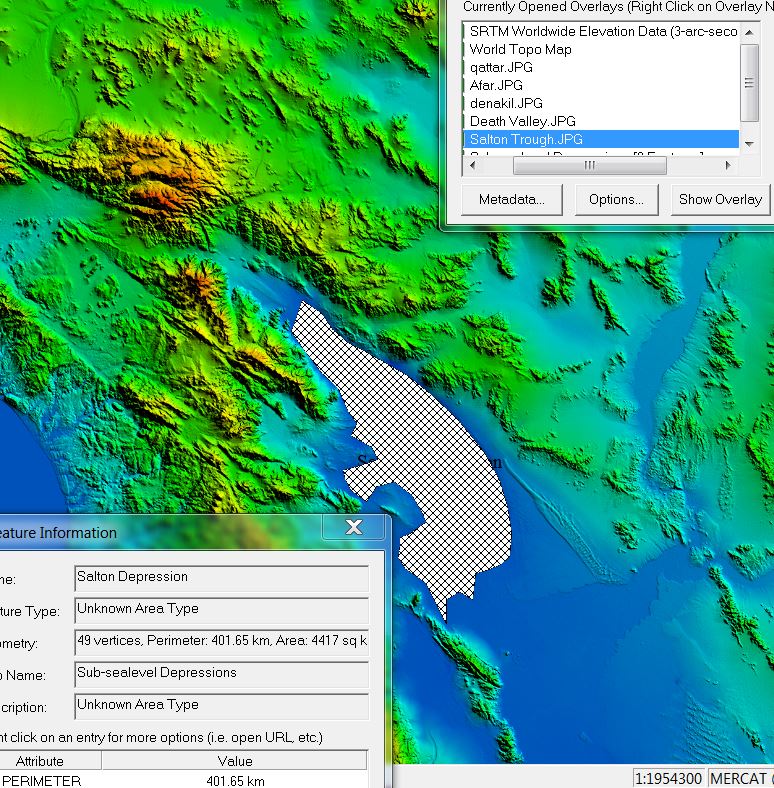
Solving this question is relatively trivial and the answer may surprise you. Using Global Mapper, I loaded a digital elevation overlay, then contoured the outlines of many of the planet’s below-sea-level depressions. There are 49 countries containing land with elevations that are below sea level so there are a number of places to hide future flood waters. Some depressions are small and deep (including Turfan, China and Akdzhakaya, Turkmenistan) while others are broad and shallow. I measured these and the areas of subsea regions such as the Dead Sea and Afar depressions, the gigantic Qattar low elevation desert, Death Valley, Salton Trough, and others. Then I estimated the volume of water these basins could hold.

Areal extent of sub-sea-level Salton Depression, California.

Areal extent of sub-sea-level Salton Depression, California.

The Dead Sea coastline, as you undoubtedly know, is the lowest dry land on the planet – it is about 429 metres below sea level. The “sea” is within a 5,000 square kilometre depression, much of which is shallower than 300 metres. Nevertheless, the Dead Sea Depression, flooded with sea water, could hold 1,500 cubic kilometres of water. Filling the sink, however, would eliminate some rather nice olive groves and would submerge important historical sites – including Jericho, a town of 20,000 and perhaps the oldest community on Earth.

North Africa's Qattar Depression - a vast desert below sea level.

North Africa’s Qattar Depression – a vast desert below sea level.

Other desert depressions are less populated, so (other than some camel operators) who really cares if they get wet? In particular, there’s the vast north Africa Qattar Depression which covers about 25,000 square kilometres. If we include other low Saharan regions in Tunisia, Libya, and Algeria, we may find as much as 50,000 square kilometres of sand sit below sea level. One may argue that this territory is less attractive than the Dead Sea or Death Valley which we have also slated for drowning, but the enormous Sahara tracts are not deep. Much is barely a single meter below sea level. So, despite being vast in area, the volume of water potentially held is less than a fully inundated Dead Sea.

Continuing around the world, we may be able to siphon 7,500 cubic kilometres of water from the ocean, pumping the sea’s brine into the planet’s various depressions. That is a huge quantity of sea water and should take the pressure off the folks in Miami. But, unfortunately, it turns out to be a trivial drop in the proverbial bucket.

The Earth is a big place. The oceans cover 360 million square kilometres. A meter of sea level rise is a volume 50 times greater than all of the depressions that are below sea level  in the world. Climate scientists tell us that the ocean’s waters are presently rising at a rate of about 3 millimetres a year, or 3 centimetres a decade. In just ten years, all of those hypothetical sinks would be full and the waters will still be rising. Because the actual rate of melting is increasing through an amplifying feedback loop, we are told to expect about a meter of sea level increase in the next hundred years or so. It will likely take several centuries for all the world’s ice to melt. By then, the oceans will be 75 metres deeper than they are today.

The bottom line? Flooding Jericho will not save Miami’s Fontainebleau. Nor, if seas rise unabated, will we save Venice, New York, nor the homes of three billion of the planet’s seaside dwellers. Rather than attempting to hide the meltwater, it appears that we need to think of another plan to do something about the impending flood.

Posted in Climate, Engineering, Environment, Oceans | Tagged , , , | 27 Comments

Did humans wipe out the megafauna?

Jan Freedman at the Twilight Beasts blog has a nice, well-balanced essay about the roles humans and climate change may have played in the extinction of really big animals tens of thousands of years ago. Spoiler Alert: Humans might not be innocent. But the jury is still deliberating…

twilightbeasts's avatarTwilightBeasts

The wonderful thing about writing for Twilight Beasts is the chance to bring back some truly incredible creatures. Here we are allowed to be taken back to a time when the largest land lizard ever walked the Earth: Megalania. We can feel the heat of the Australian sun, as we watch this oversized komodo dragon stalk a marsupial the size of a VW Beetle, the wonderful Diprotodon. Or perhaps we enjoy imagining we are sitting on the edge of a rich lagoon, with enormous tank-like Glyptodon taking a drink, unaware of a pride of Smilodon in the bushes. Or for those who like a more chilly time, step back onto the cold Steppes of Eurasia to see herds of Mammoths lolloping across the grassy plains, as a lone woolly rhinoceros munches quietly on the low shrubs.

A quick hop across the globe just a few tens of thousands…

View original post 1,383 more words

Posted in Reblogs | Tagged , | Leave a comment

Newton and the Speed of Sound

Newton's speed of sound experiment at Trinity College, Cambridge

Newton’s speed of sound experiment re-enacted at Trinity College, Cambridge

Would you like to try Newton’s classic speed of sound experiment? Last month, at Trinity College in Cambridge, my 13-year-old stood at the colonnade where Newton measured the speed of sound. Just like Newton, Daniel clapped his hands once and waited for the echo. Unlike Newton, we used electronics to measure the time it took the sound wave to travel down the outdoor corridor and return to our ears. It seemed almost (but not quite) instantaneous. We recorded the sound of the clap and the echo. Later, using a simple sound-editing program, we found the amount of time that it took Daniel’s sound wave to traverse the corridor and return. It was fast. It took just 0.37 seconds.

Hand clap, the major peak, occurred at 0.40 seconds, while the echo is heard at 0.77 seconds. It took about 0.37 seconds for the echo to return from the far wall.

The hand clap, the major peak, occurred at 0.40 seconds, while the echo is heard at 0.77 seconds.
Therefore, it took about 0.37 seconds for the sound to echo and return from the far wall.

We couldn’t measure the length of the colonnade (which is visible in the top picture) because a security guard bloke denied us access for this important part of the experiment. Besides, we had forgotten our measuring tape back in Calgary. However, we found prints of Trinity College’s floor plan. The length of the colonnade turned out to be about 64 metres. So, the round trip for the clap’s sound wave was 128 metres. Knowing distance and time, it’s a simple step to calculate speed:  speed = distance/time = 128m/0.37s = 346 m/s. The accepted nominal speed of sound, at sea level, in dry air, is 343 metres per second. Our observation was within 1% of the accepted value. We did better than Newton, who calculated the speed of sound at 298 m/sec. He was off by 15%, but he didn’t have any easy way to measure a tiny time interval such as a third of a second – though I suppose no one stopped him from measuring the colonnade’s length.

Newton was the first to publish a speed for sound (in 1686) and to show how he made his calculation. He used a small pendulum to measure the amount of time the echo took. This method was much more accurate than any 17th-century clock, but was cumbersome and finicky. It was well known that the back and forth swing of a long pendulum takes a longer period of time than short pendulum. The formula used by Newton relates the constant force of gravity (g) and the pendulum length (L) to the pendulum’s period (T). It’s not a tough calculation (though the derivation of the formula was sheer genius). This is what Newton used:  T = 2 PI SQRT (L/g). Newton changed the pendulum length until it’s swing period was the same as the echo’s return. These match using a 3.5 centimeter length. Plugging numbers into the formula gave Newton the time, which he calculated as about 0.42 seconds. His speed of sound was too slow.

Sir Isaac, about the time he was studying sound at Trinity.

Sir Isaac Newton, about the time he was studying sound at Trinity.

We should also note that Newton had assumed that sound waves are isothermal. Laplace, 1816, suggested that sound waves are not isothermal but adiabatic. The work of Laplace corrects Newton’s measurements and resulting speed of sound calculation.  Other factors (Cambridge’s elevation and the temperature and humidity of the air) would have also changed the speed of sound in Newton’s original experiment and contributed to his discrepancy, though I suspect that much of the difference is due to the difficulty in accurately synchronizing the pendulum and the hand clap and getting the right time interval – we are talking about a few milliseconds. Nevertheless, Newton gets credit for the first analytical determination of the speed of sound and for publishing his experiment and results in 1686,  in Proposition 49 of Book II of the Principia.

Sound reflecting from inside the Earth, ala Newton.

Sound reflecting from inside the Earth, à la Newton.
Credit: XSGEO.com

Because of his measurement of the speed of sound, Newton also should be noted as one of the many grandparents of geophysics. Modern seismic investigation is based on reflected sound waves. Sound, traveling through the Earth, encounters rocks of varying density and bounces back at each new interface. Such interfaces (rock formations) act like buried stone walls, echoing sound waves back to observers. By measuring the amount of time the reflections take, seismologists can infer the depth to layers and formations hidden underground. Not only did Newton perform the first speed of sound calculation, he also began the study of sound wave propagation and variation through different media – a fundamental property of seismic geophysics. As in all of science, the physics of seismology builds on prior work. And as in all science, experiments are verifiable – sometimes even with a 13-year-old’s clapping hands.


Posted in History, How Geophysics Works | Tagged , , , , | 3 Comments

1000 Simple Words

Munroe's Thing Explainer

Munroe’s Thing Explainer

Could you describe your work to someone new if you had to use fewer than 1,000 words? I certainly hope so – that’s two or three typed pages. If you need more than that, maybe you don’t really know your own project as well as you should. But what about this twist – try to use only the 1,000 most common words in the English language. This is the idea behind a new book by XKCD’s Randall Munroe, a cartoonist so creative that he sometimes doesn’t use any words at all.

The thousand most commonly used words (actually, the ‘ten hundred‘ as the word ‘thousand‘ is not among the thousand most commonly used words) include terms like love (but not hate) and mind (but not brain) – according to the reliable reference The Reading Teacher’s Book of Lists, published in 2000. That list tells us that one-third of all printed English material is made up of the 25 most common words (starting with the, of, and, a, to, in, is, you, that . . . and trailing into more obscure words like this, have, and from). And among the thousand most frequently used English language words are gems such as shoulder, industry, planets, and cattle – but not the words gems, carbon, mantle, tectonics, nor even earthquake and volcano.

Saturn VYou can see what this implies. The most common words are simple terms that include an assortment of tripe banalities which glue grander thoughts together and are often combined into quaint aphorisms. But our precious professional technical words are missing from the thousand-word vocabulary list. Randall Munroe demonstrates this in his book Thing Explainer, which will be released in late November. Using only the ten hundred most frequently written words, Munroe describes things like a Saturn V as  the Up Goer Five.

xkcd's take on subduction

xkcd’s take on subduction
(http://xkcd.com/1388/)

Using a thousand-word vocabulary, Randall describes subduction zones as ‘land going away‘ and continental crust as ‘land floor‘.  It doesn’t take long to realize that such a limited stock of words may serve Orwellian New Speak political leaders well enough, but the rest of us would be better off avoiding simple words tied together in cumbersome constructions. We require a more expressive range. It is currently vogue to ask a professional to ‘explain like I’m five’ but the typical five-year-old uses fewer than 2,000 words. It is unlikely anyone can really explain something well by pretending to talk to a child. It takes a stronger vocabulary for science to be understood – even by a five-year-old.

Our rhetoric should use clear and succinct discourse. (Admittedly, my blogs often miss that ideal.)  Clarity doesn’t happen by limiting the size of one’s verbal repertoire. We must let new expressions enter a scientific conversation, quickly define them in rudimentary terms (thus reducing exclusionary technical lingo), then use the new technical words repeatedly until they become as comfortable as old shoes. Those new words then form the backbone of an even more clear and succinct vocabulary.

Rather than the ten hundred common words used by Randall Munroe, we need to saturate the vernacular with our technical terms so that the vocabulary of the scientist becomes as widely understood as the simplest of words. It is unkind and unhelpful to dumb down a scientific message. Although I greatly admire the work of Randall Munroe, his attempt to explain things with the thousand most frequently used words proves it is an impossibly discouraging task.

Ultimately, Munroe’s exercise validates the need to educate non-professionals by using the language of science rather than reducing our concepts to insultingly simplistic terms. By choosing the former route, we find that most adults have little trouble understanding an expression such as “tectonic forces thrust subduction sheets deep below oceanic crust resulting in island arc volcanoes” and actually prefer such an explanation to a simplistic rendering like “big earth-moving power pushes down on away-going-land deep below water-bottom-land making island part-circle fire come out of the top place…” even though the latter is restricted to the thousand most common words.

Don’t be embarrassed to communicate like an educated adult. Rather than “explain like I’m five,” let’s pretend that I am an adult with a brain but I majored in different subjects than you did at university. Now explain your work to me.

Posted in Book Review, Culture, Science Education | Tagged , , | 2 Comments

Respects to the Hobbit Man

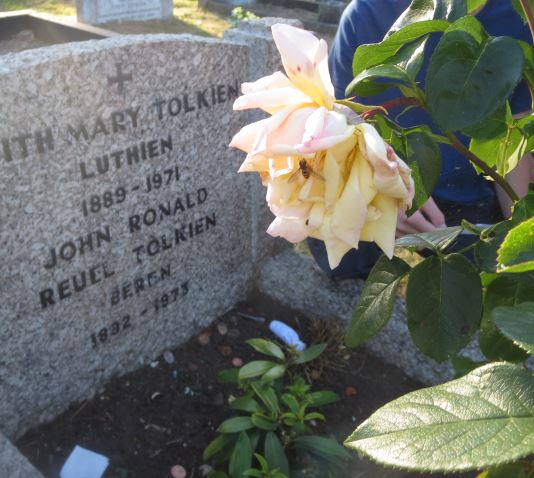
hobbit bookAbout a week ago I was at JRR Tolkien’s grave. It is not my habit to seek cemeteries containing the tombstones of fantasy writers. However, my wife, two young kids, and I were staying at a guesthouse in Oxford. The thoughtful woman in charge of towels told my 13-year-old that we could visit JRR and his wife Edith. They were resting just across the road. So we crossed the road.

Wolvercote Cemetery, set along Banbury Road on the north end of Oxford, is a pleasant spot for pausing for an eternity. Fortunately, we didn’t stay that long. An hour was enough. We found Tolkien amid flowers in the far southwest corner of Wolvercote. His spot is more modest than most of his neighbours’ and there was inconspicuous signage all the way from the road, directing those on a Tolkien pilgrimage. Roses grow from the center of the Tolkien plot. People had left coins on the soil (to pay their respects?). And tucked to his gravestone was a recent note written with some form of Middle Earth runes. It is apparent that not only humans attend Tolkien’s grave.

A message to Tolkien. Instructions, actually.

A message to Tolkien. Instructions, actually.

The touching note of respect, left by an anonymous hobbit (or, less likely, by a human) is reproduced here, above. Even if you are not an expert in Middle Earth languages, you should need less than five minutes to decipher the script. I’ll eventually do that for you, but go ahead and give it a try. Tolkien himself was a languages professor (he studied and taught Anglo-Saxon at Oxford). He even invented languages which he deemed appropriate for the characters who lived in his fantasy worlds. I think he would have appreciated the gesture of a few words written in Hobbit-world runes.   (By the way, after looking at the note, we tucked it back into the same spot we had found it. A sentiment this good deserves to be preserved.)

JRRT beeWe are all story-tellers. Tolkien was simply one of the best. He created entire worlds, populated by strange races which vied for both peace and power. All of his characters were bound by rules of Tolkien’s own creation. These were sometimes outlandish rules which included magic and mysticism, but the rules of Tolkien’s worlds were always self-consistent. Rings could manifest great and dangerous power, but those powers had to be sustained and unwavering, else Tolkien’s worlds would become chaotic and unbelievable. There is a message here for the writers of science.

Like Tolkien, scientists are inventing languages, telling stories, creating worlds. There is no single correct rendering of science. Just over 50 years ago, important geologists insisted that the idea of continents adrift was a ludicrous tale of fantasy. The world of 1960 was one of permanent continents. Details build upon facts. Facts come from observations. Half a century ago, these created a version of the Earth where the distance between Europe and America never changed.  It was wrong, but it was a self-consistent tale – until new observations challenged the story.

An alternate reality crept in. New facts and speculations appeared. The existing story of non-mobile continents was tweaked to accommodate new data. Magnetic anomalies, heat flow from ocean rifts, seismic recordings at deep trenches, the unexpectedly young age of seafloor crust (What happened to the old stuff?), and much more eventually made the earlier story about our planet unsustainable. A new tale had to be written so that all the details made sense and were contained in a new self-consistent story. The ocean floor ripped apart and the continents left their moorings, free to drift across the globe. Plate tectonics is our current story but one day it, too, may be replaced by a new tale, a story more suitable to new evidence. As scientists and science writers we should constantly remind ourselves that our present sense of reality may be no more real than JRR Tolkien’s greatest fantasies.

It serves us well to remember and honour all those who showed great imagination and shaped our views of our planet and its life. In the end, there may be peace in Thorin’s last words to Bilbo Baggins, spoken just before Thorin Oakenshield’s death. As repeated in the cryptic note which my son found on Tolkien’s tombstone, you may eventually “Go back to your books and your armchair; plant your trees and watch them grow.” Although this may be a comforting reward for dead poets, there is little satisfaction in such an existence for most of us among the living. Instead, it seems better to create new worlds and find adventure within them.

I have long been a fan of Tolkien. I appreciate his contributions to our collective imaginations. My youngest brother tells me that I used to entertain him and my younger siblings by recounting Hobbit epics during the long hours we endured in the root cellar on the family farm, chopping seed potatoes into quarters and eighths in preparation for spring planting. It was forty years ago – I scarcely remember the tales I told, but I certainly remember that the potato cellar was a dank and dark low building, dug into the side of a small hill. A single bare one-hundred watt bulb hung from the ceiling. The six of us (I was oldest at about 15, Joe was 7) sat on overturned potato crates, each child’s small hand holding a sharp paring knife, cutting apart the slowly rotting potatoes heaped in front of us.

Joe says the hours passed quickly as I embellished Tolkien’s tales of Bilbo Baggins (still my favourite Hobbit) and the gallant Gandalf. I thank the Oxford linguist for making childhood less dreary for many of us. Tolkien could not know that farm children half a world away were beneficiaries of his creative spirit. And now I was at Wolvercote in Oxford, as close as I will ever get to thanking him in person. As the note atop the dead poet concluded, “Thank you for everything.” Thank you especially for kindling imagination that creates new worlds.

JRRT DRH walking

Posted in Biography, Culture, Philosophy, Science Education | Tagged , , , , | Leave a comment

Busted by Oil

Calgary: The world's cleanest oil city.

Calgary: The world’s cleanest oil city.

The list is long. Spindletop in Texas; Drake’s well in Pennsylvania; Petrolia, Ontario; Baku, Azerbaijan; Boryslav in Galicia. And many more. These are places spoiled by the boom and bust, rust and dust of oil production. I wonder if one day my hometown of Calgary will be listed among the burned out former glorious petroleum towns? Probably not, for reasons I’ll explore in a few moments.

I’ve been reading an interesting blog piece from a site called Europe between East and West – an excellent effort that showcases central European history and culture to westerners. I am a westerner – born in North America – but my grandparents are from ‘over there’ so I read blogs about central Europe with a personal keenness. Last week, in a post called  Black Gold in Galicia, the author gave a detailed story about one of the biggest forgotten oil booms in history.

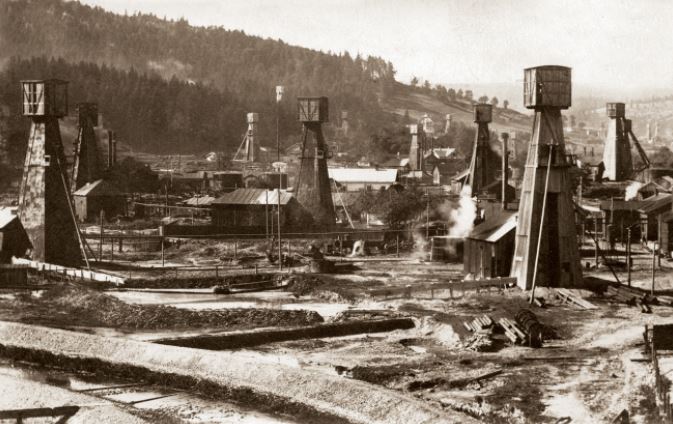
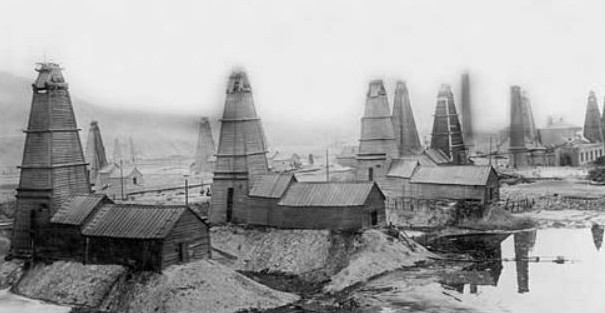
Galicia – a place that had princes and principalities – is now chopped up between Poland, Ukraine, and Slovakia. It was once called Austrian Galicia, though few Austrians cared to live in the provincial hinterlands ruled by Vienna’s Hapsburgs. Galicia seems almost completely lost to history now. So is its messy oil explosion, a boom that shattered the quiet Jewish village of Boryslav over a century ago. With the discovery of oil, the village became a city – its population grew 30 times in ten years. At its peak in 1908, 5% of the world’s oil came from the farmland surrounding Boryslav and the area was the world’s third largest crude producer. Today, a hundred years later, the city has little more than oil-smudged soil as a reminder of once glorious days.

Oil field Boryslav

Boryslav at the peak of its oil days.

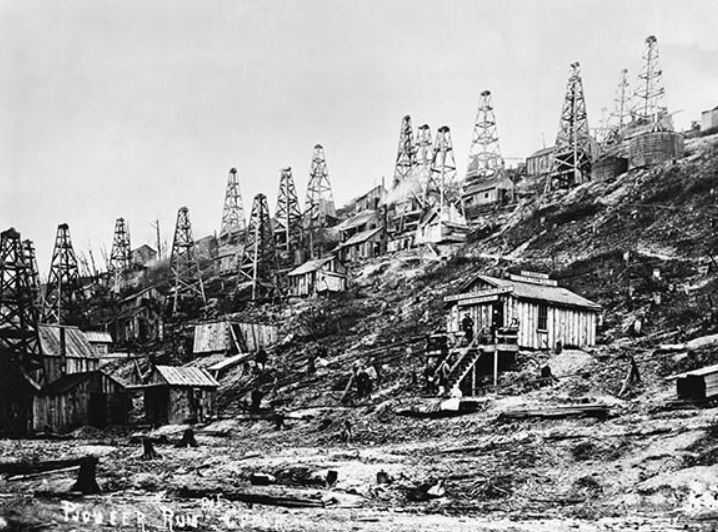
Concurrent to Galicia’s oil boom and bust was the development of western Pennsylvania’s oil fields around Titusville in Crawford County. Europeans once compared the two places favourably. Although the Galician oil wells were drilled first and with better technology, Pennsylvania eventually caught up. The flash of oil from Crawford County built noisy cities along the Appalachian foothills, though the area is again rural and quiet. After 500 million barrels of oil were pumped from the Pennsylvania hills, the wells ran dry, the industry collapsed, and the wildcat drillers moved on.

Titusville Oil Boom, around 1859

Titusville Oil Boom, around 1860

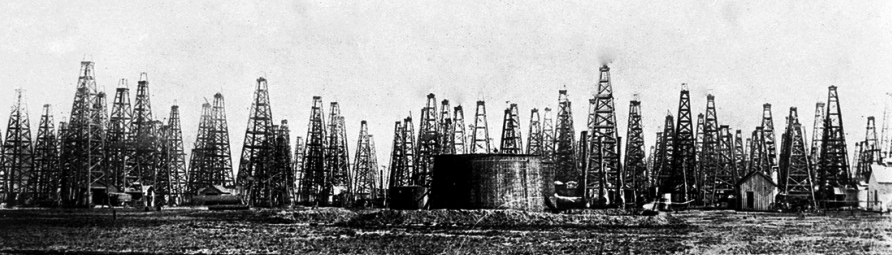
Some oilmen went to Texas where a stubborn engineer named Tony Lucas (Antun Lučić) drilled over a thousand feet to strike the world’s most famous gusher at Spindletop. When Lucas finally pierced the reservoir at the Gulf Coast salt dome, the overpressured petroleum reservoir blasted a million barrels of oil onto the bloated prairie field – deflating the dome and destroying the surrounding fields. Even today, a thousand-foot-wide splotch of grease marks the ground of the famous discovery. The well that helped power America’s amazing industrial boom is commemorated with a kitschy park and simulated boom town, built a couple of kilometres to the north in Beaumont. Tourists may delight in the plastic reconstruction of one of the country’s greatest moments, but for a more authentic glimpse of history, they need only cross the highway and venture to a dead end near Sulphur Drive to see the blackened field where industrialization really began.

Spindletop, October 1902

Spindletop, October 1902

A similar tale can be told of Baku, Azerbaijan. Like Boryslav, there are still minor remnants of the foresaken oil industry in the form of aging Soviet-era refineries and factories. The earth beneath Baku once delivered hundreds of millions of barrels of oil. In 1901, half the world’s oil came from Baku and the shallow Caspian Sea immediately adjacent to the town. The fields were rapidly decompressed. Within twenty or thirty years, the party was largely over, though Azerbaijan continues to produce a million barrels of oil a year from fields in more distant parts of the country.

Baku, Azerbaijan oil field along the Caspian Sea, 1925

Baku:  Azerbaijan oil field along the Caspian Sea, 1908

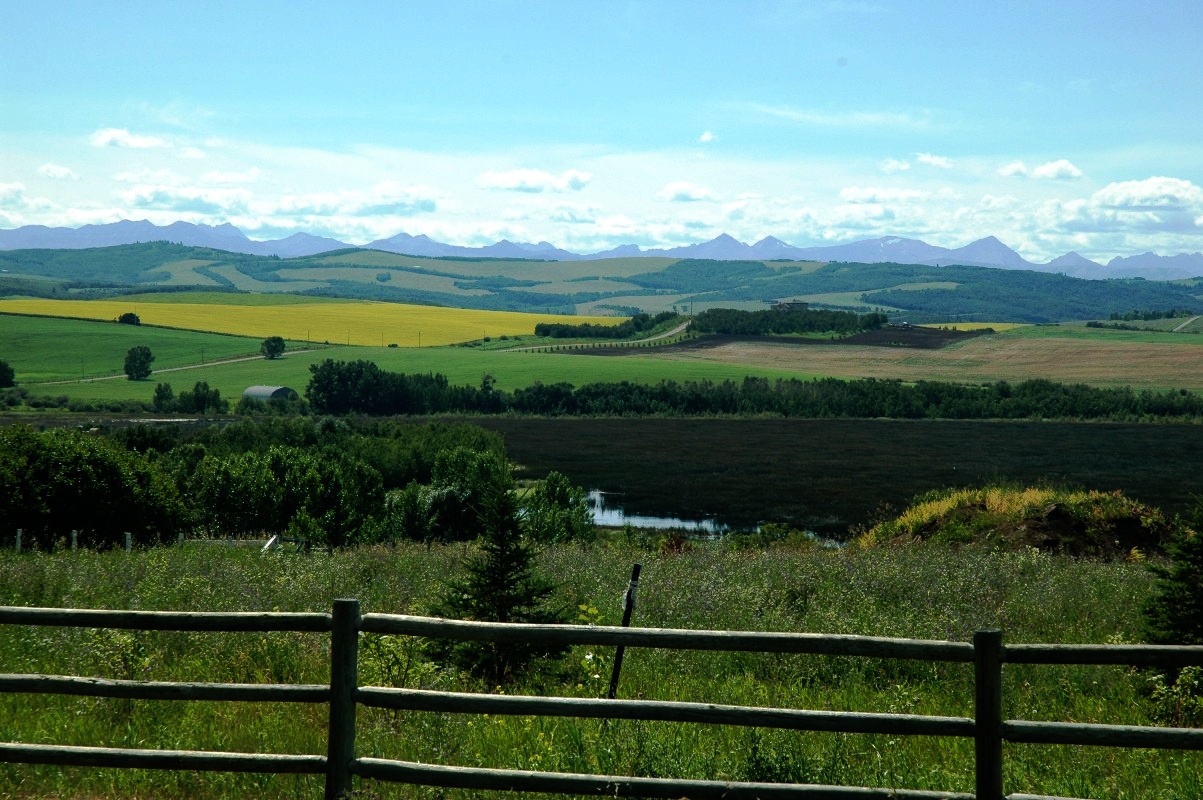
The ugliness and environmental degradation of last century’s depleted oil fields give pause when you live in one of the world’s important oil cities, as I do. For three generations, Calgary has been the home office for several hundred oil and gas companies.  Just a few dozen kilometres south of this city of a million, the western Canadian oil boom began in 1914. The area was called Hell’s Half Acre because of the flaring of natural gas from oil wells. Thousands of hellish wells were drilled within a few years. Geologists, wildcatters, and investors stayed in Calgary, about two hours away by automobile at that time. Calgary stayed clean while 10,000 oil wells were drilled each year during the 50s, 60s, and on up to this decade in reservoirs scattered throughout the province. Even the distant oil sands – the world’s 3rd largest oil deposit – is overseen from Calgary, though the city is 700 kilometres southwest of the digging and pumping.

Calgary is unlikely to suffer the fate of Boryslav or Baku. Calgary regularly scores first in the world for clean air and water – according to the yearly analysis of Mercer Global which studies such things. (By the way, after Calgary in cleanliness are Adelaide (Australia), Honolulu, Minneapolis, and Kobe, Japan). No one foresees Calgary as a wrinkled and rusty collection of pipes and pumps. However, just as all the other oil boom towns of the past saw their fortunes fail as oil fields were depleted, Calgary may also suffer an economic downturn. Remaining provincial reserves are shrinking. Production costs are rising – it becomes progressively more expensive to recover oil when fields start to decline. The oil sands of northern Alberta may last a century or two, but producing oil from tar is expensive. Doing it right – with minimal environmental damage – is costly. So what might the future of the city be? I’m optimistic. It will find its way.

The southwest edge of Calgary, where Canada's big oil boom began.

The southwest edge of Calgary, close to the place Canada’s big oil boom began a hundred years ago.

Posted in Environment, Exploration, History | Tagged , , , , , , | 2 Comments