The Dustbowl Oceanographer’s Birthday

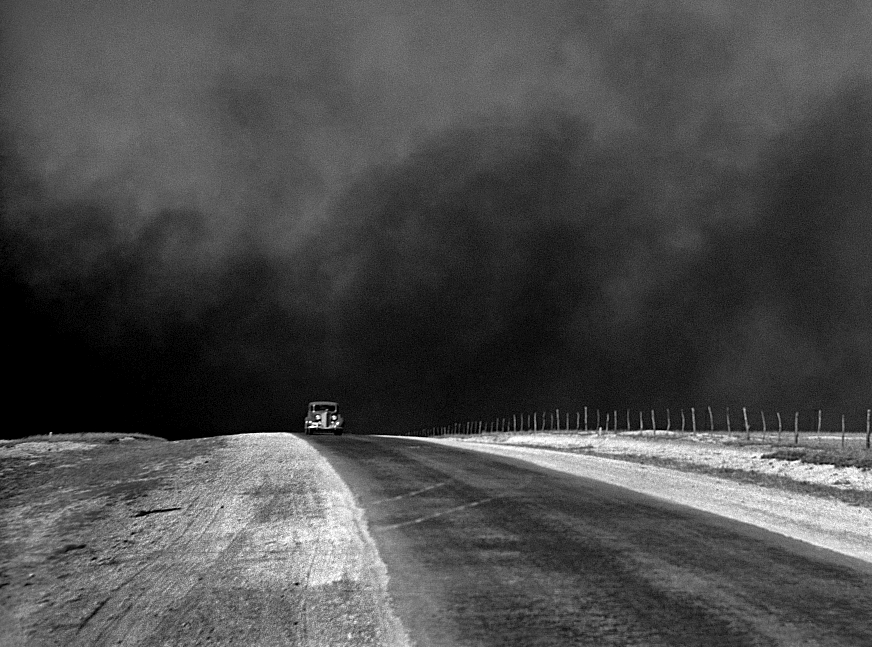
FSA/8b27000/8b272008b27276.tifWilliam Maurice Ewing was a Texas farmboy from the state’s desert panhandle. Somehow he became one of America’s greatest oceanographers. Today we remember his birthday (May 12, 1906) and remember a bit about what he did for the study of the Earth.

It was within his team that Marie Tharp and Bruce Heezen discovered the great mid-ocean rift and the idea of continental drift – redesigned as plate tectonics – began to be taken seriously. Even with their phenomenal 1955 discovery, the new theory took almost 15 years to gain (nearly) universal acceptance.

Ewing was the fourth of ten kids. The first three died – of Continue reading

Posted in Biography, Exploration, Oceans | Tagged , , | 1 Comment

After Wegener

ImageMay 12 is the 83rd anniversary of the discovery of Alfred Wegener’s body.

Wegener, of course, was the meteorologist, physicist, and polar explorer who made the first really reasonable conjecture about moveable continents. There were others before him – as early the 1500s map maker Abraham Ortels (Ortelius) noticed the Americas were “torn away from Europe and Africa by earthquakes and floods. The vestiges of the rupture reveal themselves, if someone brings forward a map of the world and considers carefully the coasts of the three continents.” And many did come forward to consider the rifting. For over 300 years scientists as varied as Ben Franklin and George Darwin (not to mention dozens of lesser-known names) proposed continental mobility as the cause of much of the Earth’s landscape.

But it was Alfred Wegener who elevated the idea to something that was difficult to dismiss. Beginning with some of his private notes in 1910, expanded from lectures to book format in 1912, revised constantly during his life, he stayed true to the idea until his death in 1930. Wegener (about whom this blog will have much more to say) was last seen on his 50th birthday, November 1, 1930. He was director of a Greenland polar research camp. The day following his birthday, he and his colleague Rasmus Villumsen were on a mission that delivered supplies to a small outlying camp when they were overtaken by a blizzard. Wegener’s body was found the following spring, May 12, 1931. He was lying upon a reindeer hide, placed there by Villumsen, who was never found.

Upon Wegener’s death, leadership of the Greenland expedition passed to his friend Fritz Loewe. Loewe had trained as a lawyer in Berlin, but developed a passion for science and exploration, earning a PhD in physics. He became a meteorologist and understudy to Alfred Wegener. Before the expedition, Loewe had earned the Iron Cross as a young soldier in the German army and had already spent time in the arctic.

“During the fatal 1930 expedition, Loewe’s feet froze and a colleague at their Greenland camp clipped off nine of Loewe’s toes with tin-snips and a pocket knife to avoid gangrene. Returning to Germany, Loewe, a Jew, was soon dismissed from his post with the Meteorological Service. He was able to relocate with his wife and two young daughters to England until he found permanent work, in 1937, as a lecturer in Melbourne, Australia, where Loewe co-discovered the southern jet stream. Few students knew the remarkable background of their professor with the awkward gait who clomped the university corridors for 25 years.”   (- excerpt from  The Mountain Mystery.)

Immediately upon Alfred Wegener’s death, the continents quit moving. Few geologists were willing to inherit the orphaned theory. Wegener himself had been ridiculed for his proposal that continents move. There were some intrepid advocates – Arthur Holmes and Alexander du Toit spring to mind. But it would take over thirty years before geologists accepted continental drift – modified as plate tectonics – and the name of Alfred Wegener would inspire courage of convictions, rather than serve as a warning against breaking with scholarly tradition and dogma.

Posted in Biography, Exploration, The Book | Tagged , , , | Leave a comment

Mountains as a mystery

The release of the book, The Mountain Mystery, coincides with the 50th Anniversary of the discovery of how the Earth’s mountains were formed. It’s fascinating to think about – in our parents’ and grandparents’ lifetimes, geologists finally figured out why the planet has mountains.

Getting Smaller.  Before plate tectonics, mountains were indeed a mystery. For a long while – a few hundred years, actually, the prevailing notion was the mountains are the scabby remnants of a shrinking, contracting world. Sometimes called the Apple-Earth Theory, advocates championed the idea that the planet is cooling, ridges are forming (“Just like a dry old apple,” they said) and mountains were the result. Not as silly as it sounds – almost everything shrinks as it cools, the Earth is undoubtedly cooling – and has been for billions of years. It would take only a millimeter or two each thousand years. In four billion years, you’ve got mountains.

Getting Bigger.  Then there were the geologists who figured that the planet wasn’t shrinking – it was expanding. Growing a few millimeters each several hundred years. Ripping itself apart at the seams. Advocates described elaborate (and perhaps accurate) schemes in which various inner earth materials crystallized in ways that expanded our old ball of iron and stone. By the way, the fruit for these scientists was the orange – theirs is the Orange-Peel Theory.

Bouncing.  Still others figured mountains rose along the edges of seas where continental erosion filled enormously deep geosynclines which became pressurized and hot. Eventually, a great rebound occurred and the mountains rose as if they were on a trampoline. Alas, this theory has no known fruits.

Just 50 years ago, scientists supporting the improbable idea of mobile continents were in a minority – a rejected, ridiculed minority. They held a counter-intuitive solution: big cumbersome landmasses sailing the oceans. Put that way, it does sound a bit ridiculous. But a newly constructed model – plate tectonics – was being developed to supplant continental drift. The older image of continents plowing through the open seas was being refined. Over the next few months, this blog will look at how that revolution developed and will look at some of the new ideas – and still unresolved issues – that are part of this solution to the mountain mystery.

Posted in The Book | Tagged , , , | Leave a comment