The Greatest Science Quotes

Do you mentally collect and muse over science quotes? Some reasonably good web sites have already done this, but so far none of those sites has my all-time favourite. It’s obscure. It was spoken by a geophysicist fifty years ago and it is mostly lost to the annals of history. But it is worth resurrecting.

I will dash through a few of my runners-up before I get to the best of the best quotes (as defined by me, though my thoughts are open to revision). The following small group of also-rans have been adjudicated as superior only through my own myopic lenses, but you have likely seen them before. And some have the fun attribute of being fake.

Fake? The greatest quotations are attributed to people who may have never voiced the words. Carl Sagan’s reference to our planet as a pale blue dot is stirring and poignant – and because we have this video, we know for certain that he actually said it. But I like this one, too, which is also attributed to Sagan: “Somewhere, something incredible is waiting to be known.” This pithy statement reflects Sagan’s life – motivated by curiosity, seeking the unknown. It should be a guiding aphorism for all of us. It would be my favourite Sagan apothegm, but it was likely penned by journalists who wrote a Newsweek cover story about Carl Sagan. He probably never said it.

Similarly, Einstein is credited with “Everything must be made as simple as possible. But not simpler.” For those of us who aspire to write about science, culture, and history, these words serve as a fundamental maxim. Scientists do well by following this simple philosophy – but not any philosophy that might be simpler. It sums up Occam’s Razor – the preferred theory amongst any two is the simpler theory. Einstein certainly would have agreed with the simple statement, but there is no record that he said it. Ironically, the closest he comes is this very wordy version from a 1933 Oxford speech: “It can scarcely be denied that the supreme goal of all theory is to make the irreducible basic elements as simple and as few as possible without having to surrender the adequate representation of a single datum of experience.” A fine thought, but he could have expressed it more simply.

In a letter to his arch-rival Robert Hooke, Sir Isaac Newton gave us another of our great science quotes: “If I have seen further it is by standing on the sholders [sic] of Giants.” We credit this to Newton. But Sir Isaac was repeating an old and well-worn adage, attributed to the 12th century Jewish philosopher Isaiah di Trani: “Who sees further, a dwarf or a giant? …if the dwarf is placed on the shoulders of the giant who sees further? … So too we are dwarfs astride the shoulders of giants. We master their wisdom and move beyond it.” And there were others who said it, even earlier. Here, however, is perhaps a more original Newtonian quotation, one of my favourites: “I don’t know what I may seem to the world, but, as to myself, I seem to have been only like a boy playing on the sea shore, and diverting myself in now and then finding a smoother pebble or a prettier shell than ordinary, whilst the great ocean of truth lay undiscovered before me.”  The Cambridge library, in a recent Newton exhibit, says that Sir Isaac “is supposed to have remarked” this on his deathbed. Said or unsaid, Sir Isaac Newton lived the quote and it is a great one.

From these dubious yet credible quotations attributed to Sagan, Einstein, and Newton, I’ll add this unsourced succinct witness to scientific progress: “Science progresses one funeral at a time.” This one is attributed to anonymous, though it was undoubtedly muttered by some young assistant professor, growing weary while waiting for the department chair to die. It, of course, underlies the deeper sentiment that progress comes only when the defenders of old untenable beliefs finally exit the stage. This, you will find, is one of the main themes in my book, The Mountain Mystery.

As long as I am indulging in unsourced, unproven, and misappropriated science quotes, here are two of my favourite literary science selections. First, from Michael Crichton’s Jurassic Park, mathematician Ian Malcolm tells the scientists who think they have  sterilized their dinosaurs that “Life finds a way.”  Best heard in Jeff Goldblum’s voice, it is a reminder that we can’t control nature, nor can we predict all the variables in our experiments. My other prized literary quote is from Jules Verne. In Journey to the Center of the Earth, 1864, Verne’s protagonist (Professor Otto Lidenbrock) says:  “Science, my boy, is made up of mistakes, but they are useful mistakes, because they lead little by little to the truth.”  Little truths such as “life finds a way,” perhaps.

So, we have Sagan reminding us to be curious, Einstein admonishing simplicity, Newton celebrating childish wonder, Anonymous encouraging patience, Crichton warning caution, and Verne tolerating mistakes. The last one, from Jules Verne, (science progresses through useful mistakes) leads us finally to my favourite scientific quote.

In the mid-1960s, plate tectonics was slowly gaining acceptance as the best idea to explain how geology works. Before tectonics, large-scale geological phenomena (such as mountain ranges) were considered the work of an expanding Earth, or a contracting Earth, or perhaps a complicated system of rebounding geosynclines. At the time, moveable plates of crust were given less credibility than wild ape-men at carnivals. But a small and persistent group of geophysicists resolved the mechanics of plates in motion and guided geologists to accept the inevitable. Among the leaders was a soft-spoken southerner, Jason Morgan.

Morgan’s work was the final bit of research that completed the drift revolution and led to almost universal acceptance of plate tectonics. His was the last dab of polish on the theory.  Jason Morgan became world-renowned for his mathematical description of plate motion. A colleague asked Morgan what he could possibly do about plate tectonics to make an even greater name for himself. “I don’t know. Prove it wrong, I guess.” To me, Morgan sums up the beauty of science in his reply – there is no humiliation in making a mistake; there is honour in proving oneself wrong.

Good scientists expect and accept that their ideas will one day be rewritten or rejected. Science is not dead, not fixed in absolutes, not inscribed in an unerring tome of ideals. One of the most noble things any scientist can aspire to is to take deeply-held truths – especially their own truths – and examine the most fundamental of them closely, even if the result is to “Prove it wrong.”
Posted in History, How Geophysics Works, Philosophy, Plate Tectonics | Tagged , , , | 1 Comment

How the Earth’s Mystery Mineral Got Its Name

We seldom get to see a sample of the Earth’s most common mineral. It resides within the mantle at extreme heat and pressure not found on the surface. We think that the mineral resides within the mantle – we are not sure, but it is a good hypothesis. However, the mineral stays hidden far below the crust, so we can’t be sure until someone goes down there and fetches a piece.

Fifty years ago, a hypothesis was made that much of our planet is composed of a mineral designated MgSiO3-perovskite. Geologists estimate that 70% of the Earth’s lower mantle (670 to 2900 kilometers below us) is made of this one mineral. If true, it means 38% of the Earth’s volume is MgSiO3-perovskite. For 50 years, this probable existence of magnesium silicate perovskite was debated and generally accepted, but since no one had actually held a piece of it in their hands, the International Mineralogical Association could not approve a more catchy name for this most common of all minerals.

According to the Mineralogical Association, a mineral cannot be given a name until there is physical proof of its natural existence. Tests must be performed on an actual physical sample, not an expected theoretical mineral. This, I suppose, is a policy that prevents amateur chemists from concocting imaginary minerals (“some of this, some of that, a little of this, and Presto! – let’s call it Canadaite.”) For 50 years, no one had analyzed hand-held samples of MgSiO3-perovskite. Now there is an identified sample – and the mineral has finally been given a real name.

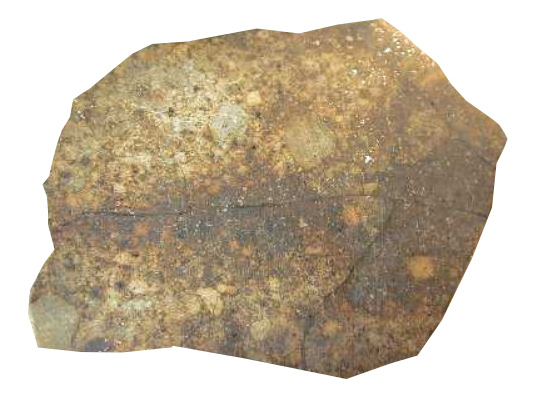
Australian Tenham chondrite meteorite - black blobs may contain the mystery mineral.

An Australian Tenham L6 chondrite meteorite  – black blobs may contain the mystery mineral that is common in the Earth’s deep lower mantle.

No one picked up the sample on a trip through the center of the Earth. Instead, it dropped out of the sky. Meteors, when they pass through the atmosphere and slam into our planet, are exposed to high pressure and temperature similar to those in the mantle. Scientists examined one of a group of meteorites called the Tenham L6 chondrites which hit near Tenham Station, Queensland, Australia, in 1879. Over 160 kilograms (350 pounds) of this broken-up meteor were recovered. The examined piece shows evidence that the impact pressure was about 240,000 times sea level (24 gigapascal) and the temperature was about 2100 degrees Celsius. These values are remarkably similar to what scientists expect the lower mantle’s environment to be.

Last month, researchers Oliver Tschauner of the University of Nevada and Chi Ma at Caltech reported in the journal Science that their work on the meteorite “concludes a half century of efforts to find, identify, and characterize a natural specimen of this important mineral.” The pair themselves had spent 5 years searching for MgSiO3-perovskite. The two conclusively identified tiny (30-micrometre) blobs of the mineral as the rumored magnesium silicate perovskite. With this positive identification, the material could be given a proper moniker. No, not Canadaite. Nor was it to be called Americium (that name was already taken and applied to element number 95).  Instead, this most common – but most secluded – mineral has been named bridgmanite. “Who?” you ask.

Percy Bridgman with his high-pressure experimental apparatus, around 1915.

Percy Bridgman with his high-pressure experimental apparatus, around 1915.

You might expect that the Earth’s most common mineral would be named for someone who did some amazing science. You would be right. Percy Bridgman is one of those great scientists of whom most of us have never heard. His expertise was the physics of enormous pressures. In 1905, when his machinery broke at his Harvard lab after pressing some material all the way to 3,000 times the Earth’s atmospheric pressure, he redesigned the apparatus and achieved 100,000 times atmospheric pressure. From thousands of experiments on tensile strength, viscosity, compressibility, electric and thermal conductivity of highly squeezed materials, he derived a set of basic equations which others have named the Bridgman Thermodynamics Equations. For this, Percy Bridgman was awarded the 1946 Nobel Prize in Physics.

Bridgman, right, in his Harvard office.

Bridgman, right, in his Harvard office.

Some of the applications of Bridgman’s work worried him. As head of the physics department, he had to sign off on the transfer of Harvard’s cyclotron to the US Army for the Manhattan Project in 1943. The American nuclear bomb project was top secret, so the military told Bridgman that they were taking his machine to St Louis where it would be used to treat wounded soldiers. Bridgman was no dummy. He told the military, “If you want it for what you say you want it for, you can’t have it.  If you want it for what I think you want it for, of course you can have it.” His cyclotron went to Los Alamos (not St Louis) and was used to develop the atomic bomb, not medicinal isotopes, and he knew it. But after the war, Percy Bridgman saw the escalation of Soviet and American warheads as an impending disaster. Along with Joseph Rotblat, Linus Pauling, Max Born, Bertrand Russel, and Albert Einstein, he was one of the 11 signatories of the famous Russel-Einstein Manifesto, signed in Pugwash, Nova Scotia, in 1955. The manifesto called on world leaders to seek peaceful resolutions to international conflict and to find ways to disarm. The original meeting turned into the on-going Pugwash Conferences on Science and World Affairs.

Bridgman was passionate about the philosophy of science and about the way science affects society. In 1927, he wrote The Logic of Modern Physics which had a major and surprising influence through the 1930s and 1940s on the social sciences. Bridgman’s main subject looked at how we know what we think we know. Particularly, he wrote about the methodology of physics. His intended audience included physical scientists. But through Bridgman’s introduction of operationalism, his book had a huge impact on the field of psychology. Operationalism is a variation of positivism, and positivism is the very basic idea that knowledge can only enter the human mind (and science) through observation and sensory experience – there is no role for intuition, introspection, or divine inspiration.

BridgmanPositivism is not a new idea, but Percy Bridgman’s contribution was to move beyond its requirement for direct sensory validation. He included things that can not be directly measured but instead can be described by related elements which are readily observed. A common, everyday example of operationalism is measurement of the fuzzy idea of “health” in terms of empirical things like biomass, heart rate, and the number of trips to the hospital – things that can be counted and measured. From these, one gets a second-hand, but accurate, measurement of “health”.

Similarly, the second-hand, measured side- effects of quantum mechanics and subatomic particles can define quantums and subparticles. This is important because it means that even if something can not be seen and directly measured, it can still be real – it is not the product of intuition, introspection, or inspiration.  And this idea loops back to bridgmanite and geophysics.

Geophysics (like astrophysics) is at an enormous disadvantage compared to chemistry, botany, newtonian physics, and most other sciences. The latter can be subjected to testable, experimental hypotheses. You might speculate that an upside-down seed will still send roots downward, so you experiment – you turn a seed upside-down and observe and measure the root’s growth. You test your guess by designing an experiment and measuring the results. You can’t do this in astrophysics – you can not crash two supernovae together in a controlled experiment. You might simulate your experiment with a computer model, but you can’t possibly include all the parameters you need to get the right answer.

With the Earth, presumptions about the deep interior (including the existence of bridgmanite) have been indirectly confirmed. Ever since Sir William Gilbert deduced that the core is iron and is generating magnetism, up to modern observations that the crust is apparently burnt in places by fixed hot spots, discovering our planet’s inner workings has all been a series of indirect observations, followed by untestable hypotheses about what will never be seen. If a new observation negates an old hypothesis, the old hypothesis is revised or rejected. But there are no direct experiments and very few first-hand facts.

You can see how all this ties Bridgman to the Earth’s most common and most secretive mineral, bridgmanite. Percy Bridgman gave us the tools to experiment with high pressure, creating environments similar to the lower mantle; but he also gave us the intellectual tools to trust the existence of things which we can only know second-hand. Ironically, the International Mineralogical Association says you can not name a mineral until you can prove its existence and hold it in your hands (positivism),  yet MgSiO3-perovskite has been named bridgmanite to honour the man who said that measurable second-hand effects (operationalism) are good enough to prove that something exists – seen or unseen.

Posted in Biography, Geology, People, Philosophy | Tagged , , , , , , , , , , | Leave a comment

Banana Peel Tectonics

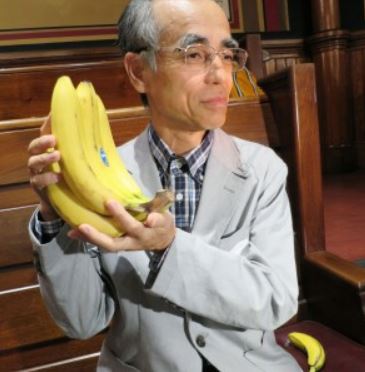
Ig Nobel Laureate Kiyoshi

Ig Nobel laureate Kiyoshi Mabuchi and some bananas

The 24th annual Harvard Ig Nobel Prizes were awarded to courageous trail-blazing scientists who pushed the limits of curiosity and credulity during the past year. Among the winners of the 2014 prestigious momento were a Canadian who won the Neuroscience Prize “for trying to understand what happens in the brains of people who see the face of Jesus in a piece of toast” while the Psychology Prize went to an Australian “for amassing evidence that people who habitually stay up late are, on average, more self-admiring, more manipulative, and more psychopathic than people who habitually arise early in the morning.” In their good company was a group of four Japanese researchers headed by Kiyoshi Mabuchi. That team’s winning Physics paper was Frictional Coefficient under Banana Skin. In other words, they studied the effect of slipping on a banana peel. Equipment included a shoe, a banana, and a linoleum floor. Apparently “polysaccharide follicular gel played the dominant role in the lubricating effect of banana skin after the crush and the change to homogeneous sol.” The elusive coefficient of friction was measured at 0.07. Ah, but didn’t the MythBusters already do that? Perhaps, but Mabuchi et.al. used more math.

The TV guys busted the myth – they found that it is hard to slip on a banana peel. They discovered that the slick underside of a fresh banana skin has some slippery properties, but things don’t get comedic until a pile of over-ripe banana skins are enlisted. To get a laugh, you need old rotten skins stacked like pancakes. Those old peels need to decompose into a soft slimy slippery texture.

If banana peels aren’t inherently slippery, how did they earn their sidekick reputation? And why did Mario’s Kart expel them as infinite point-stealing weapons? The story goes back to 1866 when Carl Frank started importing bananas from Panama into New York City. They were a novelty and sold at the 1876 Philadelphia Expo as if they were corn dogs. Soon people everywhere indulged – and discarded the peels on the street. In those days, big cities were filthy – the whiff of sanitation was not yet in the air. Thirty years later,  civic leaders were admonishing residents that their dirty throw-away habits were leading to broken arms and legs. And very lame vaudeville skits. Litter laws were enacted and trash removal was started, resulting in less hazardous streets. But the slippery-peel comedians thrived anyway.

Although Mabushi et.al. worked out the friction coefficient for soles skidding on peelings, it was actually the MythBusters who gave us a good experimental, qualitative approach. Alas, there are no Nobels (Ig- or non-Ig-) for television stuntmen, regardless their lofty talents and achievements. Nevertheless, experimental and qualitative investigation is closer to the heart of the average geologist trying to understand how rock layers slide atop one another. And that’s where this blog is heading.

Decollement cartoonIn the 50 years since mountain building was recognized as the result of colliding tectonic plates, thrust sheets have been understood in their true context.  As crustal rocks crash together, some wedges slide up and over others. They tend to do this along a décollement, which is a (relatively) slippery zone between different rock types that allows detachment for rock layers that decouple and move independently. You can see how that works in this cartoon. When compressional pressure squeezes this structural model, the slippery-as-a-banana layer slides along the décollement, the weakest link in the system. Layers get stacked, leading to crustal shortening. This phenomenon was first noticed in the Swiss Jura Mountains in 1907. Geologists there speculated that if all the Swiss stacks could be decompressed and returned to their pre-thrusted positions, Switzerland would be the largest (and flattest) country in Europe.

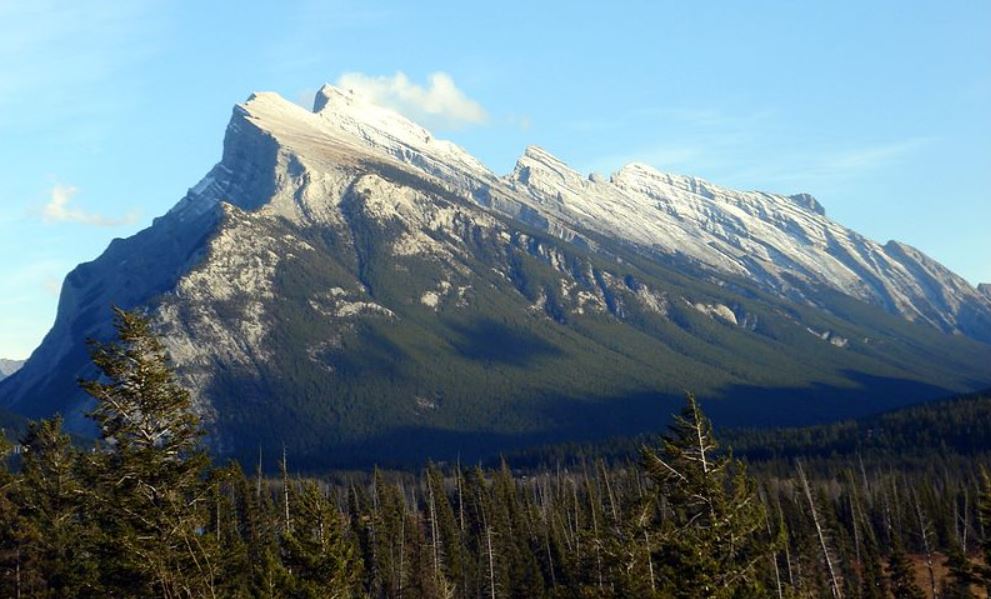
Meanwhile, closer to my Canadian home in Calgary, I can spy a few similarly stacked peaks from my living room window. These mountains were build as the Kula Plate rammed into the North American Plate and rocks folded, detached, and thrust above the plains. But these rocks didn’t break loose and slide without spending a bit of time resisting the urge to move. Just like the shoe on the banana peel, there is a coefficient of friction involved. Turcotte and Schubert, in their book Geodynamics (pp 352-353), do the math for us. In lab tests, the coefficient is about 0.85. But surprisingly, they discover that the addition of water in porous deeply buried rock layers reduces the frictional force to a coefficient of just 0.o6 – almost exactly the same as Mabuchi’s shoe on the fresh banana peel. Granted, the weights and forces get bigger when it involves mountains rather than fruits, but the skidding principle is the same.

A classic thrust sheet - Alberta Canada's Mount Rundle

A classic thrust sheet – Alberta Canada’s Mount Rundle (Wiki CC image)

Posted in Culture, How Geophysics Works, Plate Tectonics | Tagged , , , , , , | 2 Comments

Okotoks, The Big Rock

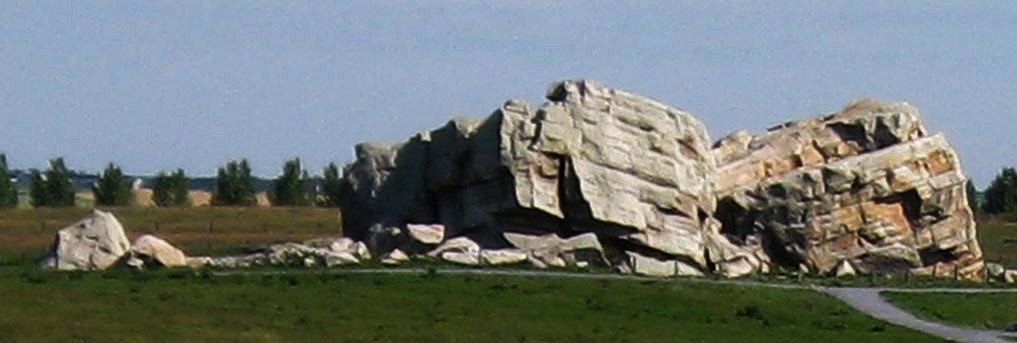
Okotoks - aka Big Rock

Okotoks – aka Big Rock

A shattered rock as large as a 3-storey house sits in an alfalfa field on the flat Alberta prairie. It is about 30 minutes from my home in Calgary and the rock is more than a little startling, resting out in a big flat open field. The native Blackfoot people considered the out-of-place rock sacred. They called it Okotoks, which means Big Rock. They had a legend that the Creator Napi had offered his robe to the rock but Napi took it back when the weather turned cold and the Creator had a chill. The rock chased Him. Finally (and this part may be just a myth), a bird farted on the rock, knocking it from the sky, allowing Napi to escape. The rock shattered, but remains quite impressive.

Modern geologists tend to doubt the story, but they agree that Big Rock did travel a long way to get to where it is. About 500 kilometres, in fact. The huge boulder rode into southern Alberta, Canada, atop a kilometre-high glacier from Jasper National Park. It was dropped when the glacier melted at the end of the last ice age, about 12,000 years ago. Although the erratic was originally called Okotoks, I’ll call it Big Rock here, to distinguish it from a small city ten kilometres away also called Okotoks, which is named for the rock. Besides, Big Rock is what the travel guides call it.

oko-fractures filled with quartz

Grey, pink, and white fractured quartzite.

Big Rock is a  massive, highly fractured grey, pink, and white quartzite rock with minor dark brown, dark red, and black banding and some minor veins of crystalline quartz.  The monolith is a glacial erratic – a rock carried by glaciers along a glacial train, then deposited upon the prairie when the transporting glacier melted. Big Rock is an apt moniker because it is believed to be the largest glacially deposited erratic in the world.

The local underlying geology is quite different from the extremely large erratic (16,500 tonnes; 9 metres height and 40 metres length) which sits forlorn upon the Paleogene Porcupine Hills Formation (approximately 40 mya), a nonmarine mudstone interbedded with fine- to coarse-grained cross-stratified sandstone and siltstone.  Twenty kilometres to the west, rugged thrust sheets of the Rocky Mountain foothills dominate. Big Rock rests on the flat high prairie at 1144 metres elevation; fifty kilometres west, the Rocky Mountains top 3,000 metres. The nearness of the foothills and the mountain range are significant to an understanding of the location of the rock.

Big Rock’s metamorphic quartzite contrasts significantly with the underlying Paleogene sedimentary formation. Even the first European explorers knew it was out of place. John Hector, the first geologist to study the rock (1863) suspected it had been transported as part of a thrust sheet from the nearby mountains. He was wrong. The nearest Rocky Mountain exposures are limestone and shale, not quartzite. Quartzite rocks similar to Big Rock are found far to the northwest, in Jasper National Park. These were discovered by Eric Mountjoy in 1958. Mountjoy showed that the Big Rock erratic originated in the Cambrian Gog Group (600-520 mya), a metamorphic formation exposed on peaks that Mountjoy examined high above the Tonquin Valley in the national park. The Gog began as sands deposited in a shallow Cambrian sea. The quartz minerals were buried deeply, subjected to heat and pressure, and became quartzite. During the formation of the Rockies, the old Gog Group was lifted and exposed to erosion.

A modern glacial train, photo by Guilhem Vellut cc-by-sa-2.0

A modern glacial train, photo by Guilhem Vellut cc-by-sa-2.0

Eric Mountjoy surmised that a landslide, likely due to destructive ice sheets approximately 15,000 years ago, deposited the exposed quartzite on top of the glacier. That glacier acted like a conveyor belt, transporting the huge quartzite rock 500 kilometres from Jasper’s Tonquin Valley to its present location, near Calgary. Geologists have referred to this glacial activity as the Foothills Glacial Train because it was narrowly confined between the Rocky Mountains to the west and a larger, rigid continental ice sheet to the east. The glacial erratic train melted, leaving a sparse string of similar, but smaller, erratics along a trail from west central Alberta into Montana.

It took about 3,000 years to deliver the rock via the glacial express train and subsequently deposit it on the flatlands. For the next 12,000 years, the Okotoks Big Rock was exposed to harsh prairie climate conditions. Summer heat at times exceeds 40° C while winter temperatures typically fall below -30° C. Rainfall is not excessive, but sufficient to lodge in cracks and widen them through freezing and thawing cycles in spring and autumn. This contributes to the fractures seen on the rock today.

In summary, Big Rock was subjected to a series of geological misadventures which resulted in its present location and condition. The events spanned since the rock’s deposit as sedimentary sandstone in the Gog Formation approximately 600 million years ago, subsequent burial and metamorphosis into quartzite, uplift in a Rocky Mountain thrust sheet about 70 million years ago, and then the landslide which placed it on the glacial train, 15,000 years ago, which flowed southward at a rate of about 100 – 150 metres per year, (typical for an advancing glacier). When the climate exited the ice age cycle, the glacier melted, leaving Big Rock on the open prairie where weathering has led to massive fracturing.

oko-withfieldsThis is almost the end of the (many-million-years-old) story. About 40 years ago a local construction team decided to take a few sticks of dynamite to the rock, intending to use the material on a road. The dynamite was never lit – folks in the nearby town of Okotoks stopped the destruction of their Big Rock. Since then it has become a minor tourist draw. (As in, “What do you wanna do this weekend? I dunno, why don’t we drive down to Okotoks for ice cream and then go out to see the Big Rock.) A nearby parking area was recently built, a trail paved across the field, and a fence placed around the rock. The last time I was there it was a hot Sunday August afternoon and about 15 people were walking around the rock. A few furtive rock climbers were on top, contrary to the posted rules. But it was all good.

Posted in Culture, Religion | Tagged , , , , , | 6 Comments

The Colour Blind Geologist

According to Wikipedia, these are green tomatoes. (CC-Wiki via User:Ks.mini)

According to Wikipedia, these are green tomatoes. (CC-Wiki via User:Ks.mini)

I grew up on a truck-garden farm where children were paid to pick strawberries and tomatoes. I couldn’t tell red from green; I was forever poor. My siblings – especially my younger sisters – would pick three baskets for each of mine. And I was penalized for the green ones. It must have cost the family a lot of money – the green berries had to be thrown out. No one suspected I might be colour blind. They thought that I was slow and that I wasn’t paying attention. That may have also been true, but that’s an entirely different issue.

Colour blindness is an inherited defect. I don’t know who among my ancestors was similarly afflicted, but it might have been my maternal grandfather who often wore mismatched socks (though that may also have been an entirely different issue). Six percent of the world’s males have the red-green mix-up (but only about 0.5 percent of females), so it is sex-linked – that is, the genetic deficiency is stowed on a mutated X-chromosome. Girls get two X’s (as in XX); boys have an XY set. Girls, then, have a fallback X chromosome which is almost always healthy. I undoubtedly got my bad gene from my mother, though of 6 male heirs to the family throne, I am the only mutant.

Cama Cat (CCO via Pixabay)

Cama Cat (CCO via Pixabay)

Where did this defect originate and how has it lasted – and spread – throughout most of the world’s population? One theory suggests that red-green colour blindness has an evolutionary advantage. Apparently people such as I can see through camouflage better than ordinary people. According to Nature, we can discern 15 shades of khaki. This might have helped us alert the tribe to nearby lions or kittens, though in today’s world it only helps us spot the odd paparazzi in the bushes. I have a different evolutionary theory, though I hasten to add that I’ve never seen it presented elsewhere, so it is probably wrong. People such as I (and 1/16th of the other males) have proven ourselves useless at fruit picking. We are better stalking game and tossing spears. This could reinforce and promote the division of labour which appears to be nearly universal in every tribe on Earth. Send the useless man out to hunt lions. Maybe he won’t come back. But if he does, he has been assisted by that mutated colour insensitivity. Meanwhile the keener-eyed lady cavefolk harvested the non-poisonous red mountain ash berries.

Seismic wiggles

Seismic wiggles

I never stalked lions. Instead, I am a geophysicist who works with maps and charts. Colour blindness presents problems in this field, too. Fortunately, geophysical work- stations can be tuned to display seismic amplitudes in variations of red and blue, or yellow and black, or some other exotic combination that does not range from dark red to dark green. Depth or time maps can be generated in a similar way that also does not discriminate against the colour-impaired.

However, there are a lot of old geological maps using shades of red and green. I’ve encountered many. I get into trouble whenever dark red bleeds into lighter shades which blur to light green and then dark green. I can’t tell them apart. Here is how Steve Dutch of the University of Wisconsin (Greenbay) describes a set of USGS maps:

“Within periods, colors mostly grade from dark at the bottom to light at the top. The middle color is used generically for undivided periods. For sedimentary units, coloring is as uniform as possible across the map, with a few ad-hoc variations for areas where extra subdivisions are required. The principal exception is that I insist granite is pink on a geologic map and other igneous rocks should be red or orange. Igneous and metamorphic rocks are colored using shades that contrast with other rock units, and vary in usage in the Appalachians (Paleozoic), Midcontinent (Precambrian) and far West (mostly Mesozoic and Cenozoic). Each map has its own color legend.”

I have no idea what this is.

I have no idea what this map is telling us.

Did you see what he wrote? “Within [geological] periods, colors mostly grade from dark…to light.” And, “I insist granite is pink…other igneous rocks should be red or orange.” You might as well have the legend printed in Klingon while you’re at it. I am not accusing or blaming Professor Dutch, of course. He is saying exactly what I heard in Geology 101. These are the standard colours of geology, but such colours are impossible for some us. (My worst university mark was a bare pass in my Mineralogy 212 Lab. There was no way that I could cross the polarized light streams through a thin section of plagioclase without killing a Stay-Puff Marshmallow Man.) But it’s not just me and I am not complaining about this First World Problem simply because I am easily irritated. I am writing this for the estimated 6,000 red-green colour blind geologists and geophysicists in the world. I have only mentioned geology/geophysics issues that one finds in a classroom or office – going into the Precambrian bush as a colour blind field geologist opens a whole other can of DEET.

What to do?

  • There are advocacy and self-help groups for the colour-impaired. I found this website, We Are Color Blind,  and undoubtedly there are others. Unfairly, colour blind folks are not trusted with fighter jets, yet we aren’t compensated for the heartbreak of not being allowed to fly fighter jets. But that’s OK. (In Romania, colour-blind people are not allowed driver’s licences – and that is not OK.) However, we are invariably better looking than average and sometimes that’s compensation enough.
  • There are corrective lenses. They even look cool. I may consider the glasses – but they are still rather expensive, although the price came down a lot in the past year. At about $350, maybe I could just rent them one autumn. I could be led around the woodlands so I can share in the ooohs and aaahs that I’ve heard about all my life, but have never experienced. It would also be nice to see the difference at traffic lights, too, instead of just remembering to stop when the light on top is brightest (or is it when the light on the bottom is brightest?).
Cool colour-correcting glasses, from EnChoma.

Cool colour-correcting glasses, from EnChroma.

I once worked in an office with several colour-disabled colleagues. Two were geologists, another was a fellow geophysicist. (He often wore tinted sunglasses at his workstation – now I know why.) I had been at that office for about two years. I had learned small tricks that kept my deficiency from introducing glaring errs of judgement. I remembered which rock horizons were red and green on the maps and I spoke about them knowingly. I kept my disability well-hidden. But the team eventually figured out my problem. Not from my maps, but from my mismatched socks.

Posted in Culture | Tagged , , , | 8 Comments

Tuzo

“Tuzo’s dead.” That was the first time I’d ever heard of Tuzo. It was April 1993 and I wondered who – or what – Tuzo was. Now he was dead. I had already completed my University of Saskatchewan geophysics degree but I couldn’t recall hearing about Canada’s greatest geophysicist. My ignorance was my own fault.

I had been focused on the theory of geophysics – signal processing, solid Earth dynamics, potential fields, anisotropic conditions, and the like. The professors at Saskatoon’s remarkable university imbued the ingredients that assured my success in science. There was a lot to absorb. At the end of each course, I squeezed my sponge-brain dry and moved on to the next semester. There was no time to indulge in a study of the context and environment of the subjects. Nor had it really occurred to me that some humans somewhere had invented all the geophysical things I had memorized.

To try to fill the gap – and fulfill graduation requirements – I took humanities electives. One was the History of Science, taught by an able young philosopher who introduced me to Kuhn and Cohen and Popper. I wrote a thesis on society’s acceptance of Einstein’s Special Relativity. Had I known about Tuzo Wilson, he would have been my subject.

Tuzo Wilson, 1908-1991

John Tuzo Wilson, 1908-1993

John Tuzo Wilson – called Tuzo by nearly everyone – indubitably revolutionized the way we understand the Earth. He had three great ideas that reinforced the nascent theory of plate tectonics. I will mention each briefly. But first I want to consider the versatile life of an established scientist who was able to change his mind about something important well into his middle age.

What follows is not a comprehensive biography of the great man, but rather a collection of some of his milestones. (In my book, The Mountain Mystery, I give Tuzo a broader treatment.) Tuzo’s mother carried the French Huguenot name Tuzo. From her, Tuzo inherited more than his middle name. Henrietta Tuzo was a fearless mountain climber. (In 1907, she and Christian Kaufman were first to climb Alberta’s Mount Tuzo, a peak so lovely it graced the Canadian 20 dollar bill for a long while.) Tuzo Wilson’s own love of mountains included his ascension of the Bear Tooth’s Mount Hague, conquered first  by Tuzo while he was doing his PhD field research.

From his father, Tuzo Wilson absorbed engineering and science. His father, a Scottish immigrant, designed the Montreal and Toronto airports. With his father’s sense of project design and craftsmanship, Tuzo took to the air and photographed Canada’s Arctic. He developed the idea of remote sensing, figuring out how to collate aerial photographs with geologists’ field notes.

Tuzo had a precocious appetite for geology. At 15, he worked summers for the Geological Survey of Canada. He loved geology and he excelled in math and physics. It is not surprising that he earned the first geophysics degree awarded to a Canadian. After Trinity College in Toronto, he received a Massey Fellowship to St John’s at Cambridge, then finished his PhD at Princeton, in 1936. After Princeton, Wilson returned to the GSC and mapped much of Canada’s enormous Northwest Territories. With the start of war in 1939, Tuzo Wilson enlisted in the Canadian Army, finishing his service with the rank of colonel. After the war, he led Exercise Musk Ox, a 5,000-kilometre excursion through the Arctic – it remains the longest arctic vehicular trip ever undertaken. Upon discharge, Colonel Wilson became Professor Wilson at the University of Toronto. He stayed there for almost thirty years.

If it involved geology, Wilson had probably studied it. His interests were so wide-ranging that colleagues called him the cyclone scientist. He was internationally regarded for his work on glaciers, which led him to draft the first glacial map of Canada. As part of that study, he searched for ice patches on the arctic islands and became the second Canadian to fly over the North Pole. His experience in flight, mapping, and the Arctic merged into pioneering work in aerial photography. His photos were a key element in creating Canada’s geological maps. A view from above was an essential step in that tedious project.

Tuzo UnglazedTuzo headed the department at U of T, ran the the Ontario Science Centre, and led Canada’s participation in the International Geophysical Year (1957-1958). After an IGY meeting in Moscow, at the height of the Cold War, Tuzo hopped a trans-Siberian rail and headed to Beijing. He was the first western scientist to visit Mao’s China. His book, Unglazed China, is one of the few glimpses the west had of Chinese science and culture immediately after the Communists consolidated their autocratic power. Tuzo Wilson returned in 1971, just before Nixon’s famous table-tennis expedition, and wrote a second book, highlighting the changes that transpired since the International Geophysical Year – changes which included the devastating Great Proletarian Cultural Revolution.

For years, if Wilson had any opinion about continental drift, it was a guarded one. Those who knew him said he didn’t find much value in the idea until about 1960.  But after he contemplated the new evidence, Wilson decided the idea of moving continents fit the data and he became an unwavering advocate. His colleagues were much more reticent. As Tuzo Wilson himself said in this 1975 TV interview, “a lot of people weren’t happy about it, because they weren’t brought up with it – it’s like asking a middle-aged man to change his religion, and they don’t really like it. They would have been delighted to see something happen that would  destroy it all, and go back to fixed continents!”

Tuzo Wilson was in his mid-50s, an age at which most scientists find change and innovation difficult. Tuzo, however, delighted in the challenge. It was then that he made his greatest contributions to science. He resolved three of the most vexing issues that threatened to derail plate tectonics theory: (1) As presented in 1962, the idea of continents in motion implied Hawaii and Yellowstone shouldn’t exist – they are remote from the energy sources of spreading ocean rifts and  colliding continents. (2) Geologists made no sense of swarms of awkwardly positioned faults near rift zones – they weren’t within the style of typical faults. And (3) there was evidence that some mountain-building had inexplicably occurred at a time predating the supercontinent, Pangaea.

These three issues suggested flaws in drift theory. Wilson solved each without complicated mathematics. He used something he described as visual imagery – sharp pictures that formed in his creative mind. For example, in the case of Hawaii, he visualized the eerie scene of a girl lying on her back at the bottom of a stream. As bubbles surfaced from her mouth, they were swept away by the moving current. This is how he saw Hawaii – hot volcanic material rose to the crustal surface, building mountains that were ‘swept away’ by the moving seafloor. His ideas at first seemed outlandish, but geologists listened to Tuzo. He had a long-established reputation for getting things right.

He solved (1) Hawaii  by introducing plumes – an idea that seemed so peculiar he couldn’t get it published at first. (2) The odd faults at rift zones were resolved when he invented transform faults. And (3), the apparent existence of mountains that predated Pangaea was explained by cycles of continental amalgamation and disintegration – others named these Wilson Cycles in his honour.

Tuzo's Planet of Man series

Tuzo’s Planet of Man series

Tuzo Wilson, Canada’s Renaissance man, enjoyed educating and performing. In the 1970s, he created and hosted a 12-episode television series – The Planet of Man – in which he explained plate tectonics, fault systems, and mountain growth. These shows opened with Tuzo cruising lakes in northern Canada on his Chinese junk, a 12-metre craft that he said was well-suited for approaching isolated outcrops. Another venue for public education came late in life – he spent the eleven years up to his 76th birthday as director of the Ontario Science Centre. Because he had made such outstanding contributions to support plate tectonics, the Ontario Science Centre later built a three-metre-high memorial to commemorate Tuzo Wilson. The sculpture includes a spike jabbed into the ground. It indicates the distance the science centre has drifted away from Europe since Wilson’s birth. A remarkable monument that celebrates a man who spent most of his life skeptical of continental drift theory, but perhaps did more than anyone else to advance it.

Posted in Biography, History, How Geophysics Works, Plate Tectonics, Science Education | Tagged , , , , , | 4 Comments

Canada’s Deceptive Arm

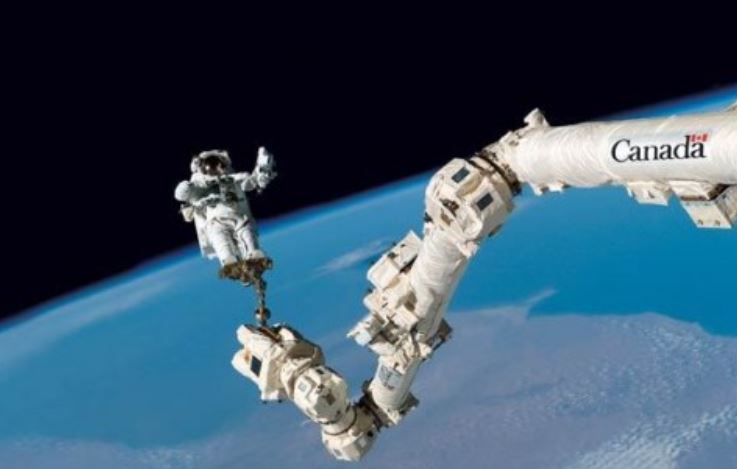
Canada Arm, as seen on Government of Canada websites.

The Canadarm, as imagined  by the government of Canada

Well, this is embarrassing. A friend in the States sent me a link to a Washington Post story. Along with the link, he sent a short note: “So much for your Canada Arm.” You see, I had bragged about Canada’s amazing engineering feat – a robotic arm that can pop the top off an ice-cold Molson while orbiting 400 kilometres above the Earth. Yes, Canadians designed and built that dexterous appendage of utilitarian mechanics.

“Not so quick,” said my friend. I had to swallow hard when I saw the Washington Post photographs myself. The Post had copied a picture from Discover Canada: The Rights and Responsibilities of Citizenship, a page on the Canadian government’s immigration site. That picture is reproduced above, but it has since been pulled from the several government sites that hosted it. For good reason. This is not what the astronauts saw. They saw the scene below. See if you can spot the difference.

The original NASA photo was doctored into something apparently more suited to a Canadian government web page about the “rights and responsibilities of citizenship.” I guess honesty and integrity aren’t essential responsibilities of citizenship.

The story in the respected Washington Post is troubling. The headline “How Canada Faked its Place in Space” is followed by an article that shows how like-minded governments in China and North Korea similarly Photoshop their image. So, we get to share a news piece with North Korea. Not the thing you see every day – thankfully.  The Economist – an even more venerated newspaper – also featured the story, along with a reference to the Democratic People’s Republic of Korea. Under the banner “Airbrushing in Space: Canada’s Astronomical Boasting,” here’s what the Economist ran:

“CANADIANS are known for humility. But leave the Earth’s surface and you’ll find the country’s ego somewhere up in the thermosphere. Canada’s government websites use doctored photographs of its contribution to the International Space Station to call special attention to itself.

“Of course, countries have long fiddled with photographs to present an image of grandeur. But the tactic of fairly ham-fisted airbrushing used here seems more reminiscent of North Korean propaganda posters than of Western democracies’ typical PR efforts.”

This is quite a dismal drop in our prestige. Canada had been riding high on the achievements of our singing astronaut, Chris Hadfield. Of all the space station chiefs, none was as capable as Hadfield. He was the first Canadian space walker. (I can only imagine the guts, skill, and confidence that would take.) Hadfield popularized space exploration just as it was becoming a humdrum affair. (My youngsters were as awed as I.) After Commander Hadfield’s brilliant work and the tireless efforts of hundreds of other Canadian space scientists and engineers, we are now seen on the world stage as imposters. This scandal is a disservice to Canada’s space legacy, but the scandal is not entirely unexpected. Our recent history has been one of sour and strained relations between Canada’s scientists and Canada’s government. It is symptomatic of a deeper problem.

Last year, the Professional Institute of Public Service Canada (PIPSC) commissioned a survey “to gauge the scale and impact of ‘muzzling’ and political interference among federal scientists.” Over 4,000 of the country’s 60,000 public servants (including 20,000 scientists) in federal departments and agencies were polled. “Hundreds of federal scientists said that they had been asked to exclude or alter technical information in government documents for non-scientific reasons, and thousands said they had been prevented from responding to the media or the public,” according to the survey results. Gary Corbett, president of PIPSC, said that the scientists “say themselves, ‘We live in a climate of fear.'” What do they fear? Taboo topics include environmental science, studies of ozone depletion, statistics on aboriginal health, status reports from fisheries, waterways, and occupational hazards. Breaches are reported by government “minders” who have the Orwellian task of accompanying federal scientists to conferences and reporting home on any scientists who become unleashed or unmuzzled. It would be better if there were more support for science and scientists, and less emphasis on glossy policy salesmanship.

Because of the website blunder, there are people all around the world who have read the Economist, Washington Post, and dozens of other papers’ stories. They now doubt Canada’s contribution entirely. However, the fact remains that there really is a Canadian arm in space, developed by Canadian robotics and space scientists. It is a shame their reputations have been sullied – but they best not complain lest the minders report their thoughts. We would have preferred to see the Photoshopping money spent on unfettered science, research, and exploration – not on a computer graphic rendering of science, research, and exploration. Unlike a doctored space photograph, the damage done by the past half dozen years of muzzled scientists and stripped research budgets can not be undone by a simple cut and paste.

Posted in Culture, Exploration, Space | Tagged , , , , | Leave a comment

The Theory of Everything

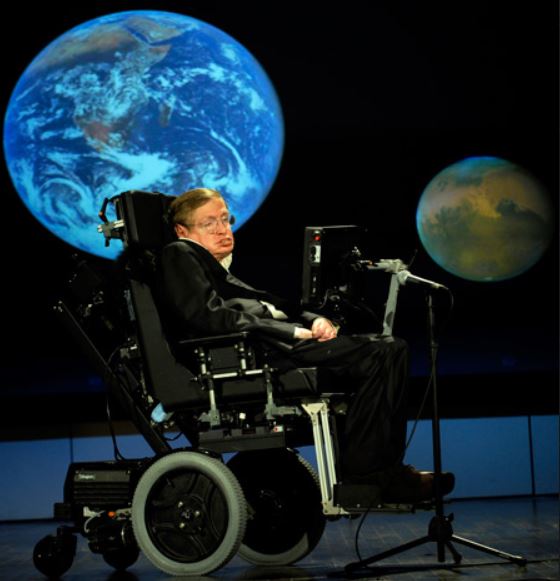
Stephen Hawking, addressing NASA, 2008. Photo credit NASA

Stephen Hawking, addressing NASA, 2008.  (Photo credit NASA)

The marriage of Stephen Hawking and Jane Wilde – as told through the ex-wife’s memoir – has become the stuff of a Hollywood tragic-romance. I have not read her memoir but have read excerpts and reviews of it. The Jane Wilde Hawking Jones book, Travelling to Infinity – My Life with Stephen, was written a few years after their divorce (the Hawkings had been together for nearly 30 years). The Theory of Everything, the Hollywood adaptation, is a very loose interpretation of her story of their time together. The film makes  a compelling and fascinating account, but it is an extraordinarily unfaithful rendering. The screenplay adapters knew what they were doing in their rewrite – they were presenting a story that should fill theatre seats. It is intended as entertainment, of course.

As entertainment, the movie works well. The viewer is quickly engaged in the awkward charm and cerebral wit of young Stephen Hawking (Eddie Redmayne) and the quiet poise and dignity of his wife Jane (Felicity Jones). The film begins with Hawking’s arrival at Cambridge, the first signs of his progressive motor neuron disease, his PhD defence, and his meeting of Jane. (They were introduced through Jane’s sister, but the movie has us believe that Hawking spied her at a party and pursued her through some quirky schemes.) The movie trails through Jane’s incredible efforts to build a semblance of a family life for their children while simultaneously dealing with her husband’s unimaginably challenging progressive paralysis, her own infidelity, and Hawking’s growing fame. The film shows their parting and a final reconciliation. Although they were married nearly 30 years and their children became adults, the ending scenes present the children as grammar-school kids, for obvious emotional effect.

The movie does a good job documenting the progression of Hawking’s motor neuron disease, which has been described as a variant of ALS. (It is a variant only because it has been slowly progressive – all of his symptoms fall well within this broad-spectrum disorder.) Hawking was diagnosed at age 21 and the disease has slowly paralyzed him – albeit at a rate one-tenth the “normal” progression of the illness. It took 20 years for his disability to mimic the presentation found within 2 years in a typical ALS patient. The movie does an exceptionally stirring job of showing the difficulties family, friends, and spouses endure as they try to maintain normal lives while caring for profoundly ill loved ones.

But the movie should not be taken as a serious factual representation of the life of the Hawkings. For example, as Jane is unzipping her boyfriend’s tent, Stephen is far away, having his trachea neatly incised by a surgeon. Although the juxtaposed symbolism is startling and brilliant as it equates young Jane’s affair with the slitting of her husband’s throat, things didn’t happen quite that way. For pursuers of fact, I would point you towards Stephen Hawking: A Brief History of Mine. This more accurate account shows us that Jane is not so young –  it  is a mature 42-year-old Jane Hawking who made the life-saving decision for her husband’s continued ventilation. The tracheotomy came months later. And, according to Jane’s memoir, she stayed faithful to Stephen –  the camping scene is entirely contrived theatre.

A few more overt fabrications in the movie:

Sex. A friend asks Stephen about his sex life. Hawking’s actor smirks and responds. The scene is shear invention – Hawking, according to Jane’s memoir, never spoke openly about sex, “which for him was as taboo a subject as his illness.”

Dating. The movie shows Hawking’s friends breaking the news about the diagnosis to Jane. In the film, the Hawkings were depicted as a couple – in reality, she heard about his ALS by chance and they were not even dating yet.

Croquet. A game of croquet figures large in the movie – it symbolizes Hawking’s frustration with his illness and Jane’s loyalty. The game never happened.

Tracheotomy. In the movie, Hawking coughs and chokes at a formal concert and is whisked away in an ambulance – reality was not as dramatic. During a stop in Geneva, his friends were concerned about his persistent cough. They called a doctor. He was admitted to a hospital. The tracheotomy came after Hawking had recovered and had been on a ventilator for months.

The family friend. The movie leads the viewer to believe that Jane’s friend, Johnathan Jones, was the family’s sole helper for years. This is not true. A series of Hawking’s grad students lived with the family and helped with his care – one even travelled to California and lived with the family there for a year. The family friend did not. Further, the movie shows Hawking suffering the indignity of his wife’s boyfriend lifting Stephen from the toilet, implying this was how life worked in the Hawking household. It didn’t work that way, but it creates great theatre.

Brian. To simplify things, many of Hawking’s colleagues are merged into a single person. This was most artfully executed in “Brian,” portrayed as Hawking’s close friend and confidant, the gentleman who tries to rescue Stephen Hawking from despair. In real life, no such person existed.

The voice. In the movie, Jane remarks that Hawking’s new voice is “American” – this drew laughter from the audience, but in reality, she never said it. Instead, Jane thought the voice sounded like a cyborg from the British television series, Doctor Who.

I think that Physics actually receives a reasonable treatment from this Hollywood flick, although the New York Times reviewer calls it vastly over-simplified. Of course it is – this is a mass-consumption movie, not a Feynman lecture. At one point, Jane spews one of Hawking’s theories at a dinner table. This theatrical device describes the science in layman’s terms and helps the audience grasp an outline of the scientist’s work. But this movie is not a science movie, and its makers do not portend as much. For the real physics, Errol Morris’s documentary A Brief History of Time will not disappoint you.

In the film, I felt that Stephen Hawking’s religious beliefs are intentionally muddled. In what I assume is an attempt to appease a largely religious American audience, Hawking’s well-known and frequently stated atheism is toned down and his wife’s religiosity (which is genuine) was amplified. Hawking was shown making allowances for God in the universe and, near the movie’s end, Hawking is asked directly about the role of a deity (and his own beliefs) –  the film’s answer is a very indirect and highly qualified retreat from Stephen Hawking’s often stated principles. But perhaps vague innuendo about religion is the best way to satisfy those who may attend this show. To be direct, the producers could have used this quote from Hawking: “There is no god. No one created the universe and no one directs our fate.” You can see Hawking make this statement and its context at this link. It is not presented as a muddled triviality.

Although this Mountain Mystery blog is usually about Earth Science topics, I have written at length about this new movie for two reasons.  First, I saw the film last night at a first-screening event here in Calgary. My tickets were provided through the distributor, E-One Entertainment and were sent to me by the Canadian Science Writers Association, of which I am a member. So, with gratitude for the E-One advance screening tickets (the movies opens here on Friday) and with thanks to the CSWA, I felt I would blog this bit about the film. But there is a second reason for blogging about The Theory of Everything. And it is personal.

me

Some friends and I.

Like Stephen Hawking, I have a variant of motor neuron disease. I sensed something was amiss for most of my life. But I was nearly 40 when I finally began to tumble and fall. (The first time resulted in a broken arm; a series of lesser mishaps soon followed.) It took a year of clumsy movement, slow walking, and weakness before I approached a physician. Another year passed before a neurologist reluctantly told me that I probably had ALS. We would monitor the disease monthly and see how it progressed. All of the tests (mostly electrified wires that made me jump like a dead frog) pointed to motor neuron disease, but progression has been incredibly slow.  What I have is certainly not typical ALS, nor is Hawking’s disease typical ALS. It is best described as a motor neuron disorder (of which there are many flavours). It took years, but I recently surrendered my outdoor ambulations to a wheelchair, curtailed my travels, reduced my work. Fatigue is chronic. Everything I do takes more energy and frustration than you can imagine. Both of my feet have pronounced foot-drop which requires me to lift my legs high when I try to walk, lest I trip on my toes and plant my face into our wooden floor. My left hand hangs limp and its fingers no longer coordinate their movements very well. My right arm does not rise above my head.  But like Stephen Hawking in his younger days, I also have a dedicated wife who spends her free time doing things I should be able to do and who tirelessly works to make my life easier and more comfortable.

Unlike Stephen Hawking, I am not profoundly disabled. Nor am I profoundly brilliant. We are all different people, aren’t we? Most of us have some debilitation – often unseen emotional or mental challenges, sometimes unseen medical problems, sometimes severe disabilities that startle others unexpectedly. We all travel the same road, all bound to the same destination. With that in mind, the movie – The Theory of Everything – is less remarkable than it might seem. It is a movie about all of us. It is worth watching, not as a documentary about a scientist and his wife, but as a glimpse into the reality of life and the suffering that every one of us endures.

Posted in Biography, Culture, History, People, Religion | Tagged , , , , , | 5 Comments

The Audacity of Exploration

A thoughtful – even poetic – telling of humanity’s drive to explore.

From the blog Write Science.

Shane L. Larson's avatarWrite Science

by Shane L. Larson

We are perhaps the most audacious species to ever inhabit the Earth. Our audacity is not defined by our weird physical features (as perhaps defines our cousin the duck-billed platypus), nor defined by our strange physical geometry (as perhaps defines our cousins the octopuses), nor defined by abbreviated or extenuated oddities in our life cycles (as perhaps defines our cousins the mayflies or cicadas respectively).

Humans have been on Earth a long time. Doing what humans do. Humans have been on Earth a long time. Doing what humans do.

The existence of modern humans as a distinct biological species on planet Earth goes back around 200,000 years. At the time modern humans appear in the fossil record, we were just as smart and as strong as we are now, but we hadn’t become a society yet. The oldest known artifacts of human manufacture are roughly 100,000 years old (shell jewelry), and the oldest bit of recorded history goes…

View original post 1,232 more words

Posted in Culture, Engineering, Exploration, Reblogs | Tagged , | Leave a comment

We Love Comets… but it wasn’t always that way

So, today we kissed a comet. Many of us shared the excitement of the European Space Agency’s successful landing. Something built on the Earth is now sitting on a comet, traveling at 135,000 kilometres an hour, heading towards an even faster spin around the sun. The sheer scope of the engineering is astounding – the spacecraft traveled over 6 billion kilometres pursuing its target and the rendezvous took place 500 million kilometres from the mission’s control room in Germany. Rosetta’s speed had to exactly match the speed of Comet 67P/Churyumov-Gerasimenko when its lander, Philae, was sent to touchdown. The lander lit on the comet as one might settle on a park bench after a long casual walk. Almost softly and gently taking its seat, with just a slight rebound.

19 September 2014 at 28.6 km from the centre of comet 67P/Churyumov-Gerasimenko - photo mosaic by permission of "ESA/Rosetta/NAVCAM, CC BY-SA IGO 3.0"

September 19 2014 at 28.6 km from the centre of comet 67P/Churyumov-Gerasimenko – photo mosaic by permission of  ESA/Rosetta/NAVCAM, CC BY-SA IGO 3.0

I hate to be the one to say it, but Comet 67P/C-G doesn’t look much like a comet. In fact, it is rather ugly. And, if reports are correct, it is rather smelly, too. A comet only a mother could love. And, I suspect, a few hundred Europena space flight engineers. 67P is mottled, grey, warty. It is irregularly twisted. With some imagination, the image released by the European Space Agency might represent a two-headed chimera. I see an Elsa the lion on the left end, a Scottish terrier on the right. At just 4 kilometres in length, this flying creature will not it light up the night sky. Visually, it will neither delight nor terrorize anyone on its dash around the sun.

Hale-Bopp March 29 1997 photo by Philipp Salzgeber released the pictures under CC-BY-SA-2.0-AT

Hale-Bopp March 29 1997 photo by Philipp Salzgeber released under CC-BY-SA-2.0-AT

In the past, comets were almost universally an omen that terrorized onlookers. That’s hard to believe today. I remember watching Hale-Bopp in April 1997. My best view was quite accidental – I was standing at a bus stop just before sunrise. I pointed out the comet to others waiting. I especially remember the man who wouldn’t look. He somehow thought it was a prank – make the unwary gentleman search the sky for the elusive comet, lots of laughs. But it was no hoax and when the fellow finally dared to look, he dropped his pack and muttered profane words of astonishment. A good view of a superior comet can have that effect on anyone. Hale-Bopp’s 1997 appearance at the Calgary bus stop did not send shudders of fear down the spines of its witnesses. Had it appeared a thousand years earlier, it certainly would have. Mayans, Aztecs, Chinese, and Europeans all thought comets bade only misfortune. Comets brought unexpected deaths, famines, revolts against the king. I guess you would not want to be the royal astronomer who first spotted a new comet in the sky.

For nearly 2,000 years,  people believed Aristotle’s tripe about comets – comets, he said, lived in the realm between Earth and Moon. They were part of our atmosphere and understandably, they could influence life on Earth. It wasn’t until Tycho Brahe (1600) proved that comets occupy space much, much further away from the Earth that people quit fearing comets. Only if one should colllide with the Earth should there be much cause for dread. And in that case, the dread would be short-lived. Newton and Halley put a final end to superstitious musings about comets. Newton proved the elliptical shape of their paths and Halley made predictions of comets’ returns.

Halley and his sketch of the Earth's inner layers and core.

Edmond Halley with his sketch of the Earth’s inner layers and core.

Edmond Halley was interested in everything. He explained the newly discovered problem of magnetic drift which made compasses slowly less accurate. Halley suggested that extreme internal pressure gives the Earth a solid iron core. The crust we stand upon is also obviously solid. But Halley brilliantly surmised that some type of fluid separates the two solids.  He believed the fluid region of the inner Earth produces the magnetic field, but due to sluggish rotation of that liquid, the magnetic pole is drifting. Halley was partially correct; he was certainly right when he identified distinct inner-earth layers. He was one of the first to understand the differentiation.

Halley had a knack for clear reasoning in other areas of science, too. He said solar heat was the cause of wind. He discovered the relationship between barometric pressure and elevation. Halley edited his friend Newton’s great study of physics, Principia, then printed it when the Royal Society failed to find the cash. And, of course, Halley predicted the return of the comet which others named in his honour. Halley was England’s Royal Astronomer but he didn’t receive the job he really wanted – Oxford Professor of Astronomy. The Archbishop of Canterbury vetoed the appointment due to Halley’s well-known atheism.

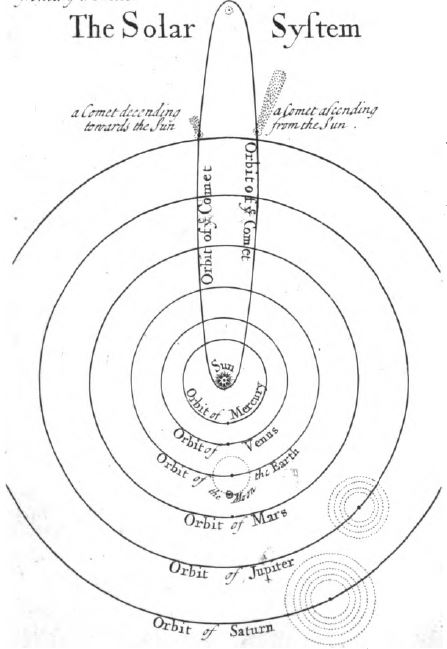
Whiston's 1696 drawing of the solar system - almost good enough to use today.

Whiston’s 1696 drawing of the solar system – good enough for some of today’s high school text books.

Comets were becoming a thing of nature rather than a messenger of gods.  A Brit named William Whiston wrote a very popular book, A New Theory of the Earth (1696), that tried to reconcile stories from Genesis with Renaissance discoveries from science. Comets played a big role.  Whiston was one of the smartest men of his era. He followed Newton as Chair of Mathematics at Cambridge and he produced an extraordinarily popular translation of Josephus’s History of the Jews – after the Bible, Whiston’s version of Josephus was the most widely-owned book in England. For Noah’s Flood, Whiston had the necessary water delivered on the tail of a comet. Whiston correctly identified that comets contain water and his 1696 drawing of a comet’s orbit is among the earliest printed diagrams showing the Earth revolving around the Sun. Except for perfect circles, rather than ellipses for the planets’ paths, his sketch of the solar system could almost sneak into a modern Kansas high school textbook.

Whiston also maintained that the Earth itself originated from the atmosphere of a comet and most changes in Earth’s geological history could be attributed to the action of comets. God created the Earth out of the atmosphere of a comet, and then engulfed it in a Great Flood with the tail of another. His book, with its nod to a world designed by God, then set in motion and allowed to run on fixed laws, was well received by Isaac Newton, John Locke, and other notable contemporaries.  Comets enamoured Whiston. He caused a bit of a panic in London when he predicted that one of those comets would collide with the Earth on October 16, 1736, and bring an end to life on the planet. It didn’t.

Into our own times, one of the most bizarre cases of pseudoscience involved a psychiatrist named Immanuel Velikovsky. Velikovsky gained fame for his best-selling Worlds in Collision which offered an alternative view of the evolution of the solar system. His book claims Venus was once a comet ejected from Jupiter and the new comet Venus swept near the Earth in 50-year intervals, disrupting the planet’s spin and orbit, leading to some of the dramatic events portrayed in the Bible – including the plagues of Egypt and the parting of the Red Sea.  At one point Venus stalled near the Earth, giving Joshua the extra hours of sunlight the Bible said he needed to slaughter the Amorites of Gibeon, following God’s orders to kill every Canaanite on Earth.

According to Velikovsky, Comet Venus helped Joshua in his battle, and the planet carried pestilences of flies that originated on Jupiter. Those flies and other Jovian creatures were the source of Earth’s current petroleum deposits. Decaying organic bodies of creatures from Jupiter, said Velikovsky, were carried to Earth on the comet tail of Venus. He also argued persuasively that Saturn had once gone through a nova state, ejecting a huge quantity of water into space, which found its way to Earth on a comet and caused Noah’s flood. Velikovsky also proved (at least to his readers) that the planet Mercury was involved in the collapse of the Tower Of Babel, and Jupiter in the destruction of Sodom and Gomorrah. I don’t make these things up. Velikovsky wrote sincerely and stretched science to fit his stories. And he made millions from book sales.

Worlds in Collision was enormously popular in the 1960s and 1970s. It (and Velikovsky’s sequels) sold tens of millions of copies. Study groups formed in high schools and colleges across the USA. Velikovsky’s pseudoscience appealed to many who wanted to believe the literal word of the Bible, yet also needed to support their belief with some type of science. Although Velikovsky had no training in physics or astronomy, he persuasively explained Old Testament miracles with an imaginative flair that seduced millions of followers. Geologists dismissed Velikovsky’s charming hypotheses, inadvertently strengthening his standing among those who recognized the dismissive tones as a conspiracy among mainstream scientists to hide the true nature of the solar system. Velikovsky offered a non-mathematical solace with his entertaining religious-scientific synthesis. It did not take much depth of thought to be swept away by his tales – in fact, that was perhaps a prerequisite. Readers came to the defence of the doctor whom they saw as a persecuted scientific martyr attacked by the establishment. Geologists objected and Velikovsky’s books sold better.

But that was then and this is now. Today, Philae is apparently perched on a small comet dashing around the solar system. Don’t expect plagues or deluges or harbingers of death and destruction. Instead, celebrate with the European engineers who pulled off a marvelous achievement.

Posted in Culture, Engineering, Exploration, History, Religion, Science Education, Space | Tagged , , , , , , , , , | 3 Comments