Interesting piece by Steve Drury on the attempts to define Earth’s Year Zero. Accuracy of a new model narrows the date to a rather narrow window. Reblogged on The Mountain Mystery site.
That the Moon formed and Earth’s geochemistry was reset by our planet’s collision with another, now vanished world, has become pretty much part of the geoscientific canon. It was but one of some unimaginably catastrophic events that possibly characterised the early Solar System and those around other stars. Since the mantle geochemistry of the Earth’s precursor was fundamentally transformed to that which underpinned all later geological events, notwithstanding the formation of the protoEarth about 4.57 Ga ago, I now think of the Moon-forming event as our homeworld’s ‘Year Zero’. It was the ‘beginning’ of which James Hutton reckoned there was ‘no vestige’. Any modern geochemist might comment, ‘Well, there must be some kind of signature!’, but what that might be and when it happened are elusive, to say the least. One way of looking for answers is, as with so many thorny issues these days, to make a
Two flavours of oil in Alberta, Canada: Canola and Devonian
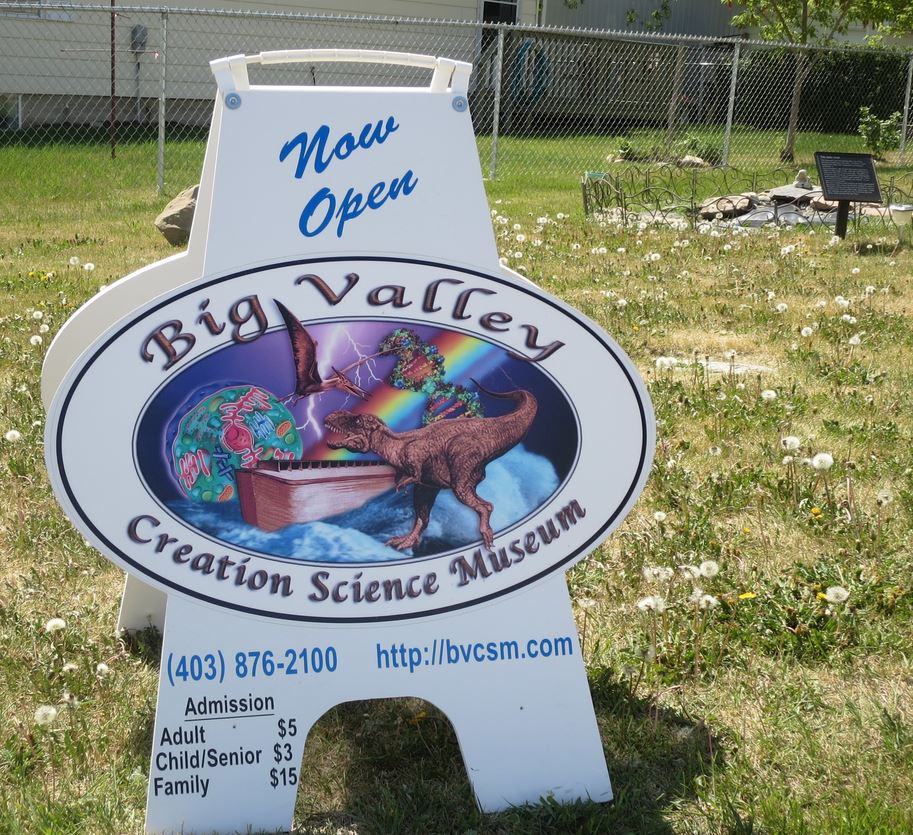
A few days ago, I lamented that the lovely town of Big Valley is blessed with a Creation Science Museum. The museum is a single-room curio shop with a fossilized Teddy Bear and not much more. It’s a disappointing destination for anyone seeking answers from either Genesis or science. And it’s a sad addition to Big Valley’s community.
“Archeological” ruins in Big Valley, Alberta: Train repair shop from 1920.
Aerial of abandoned roundhouse
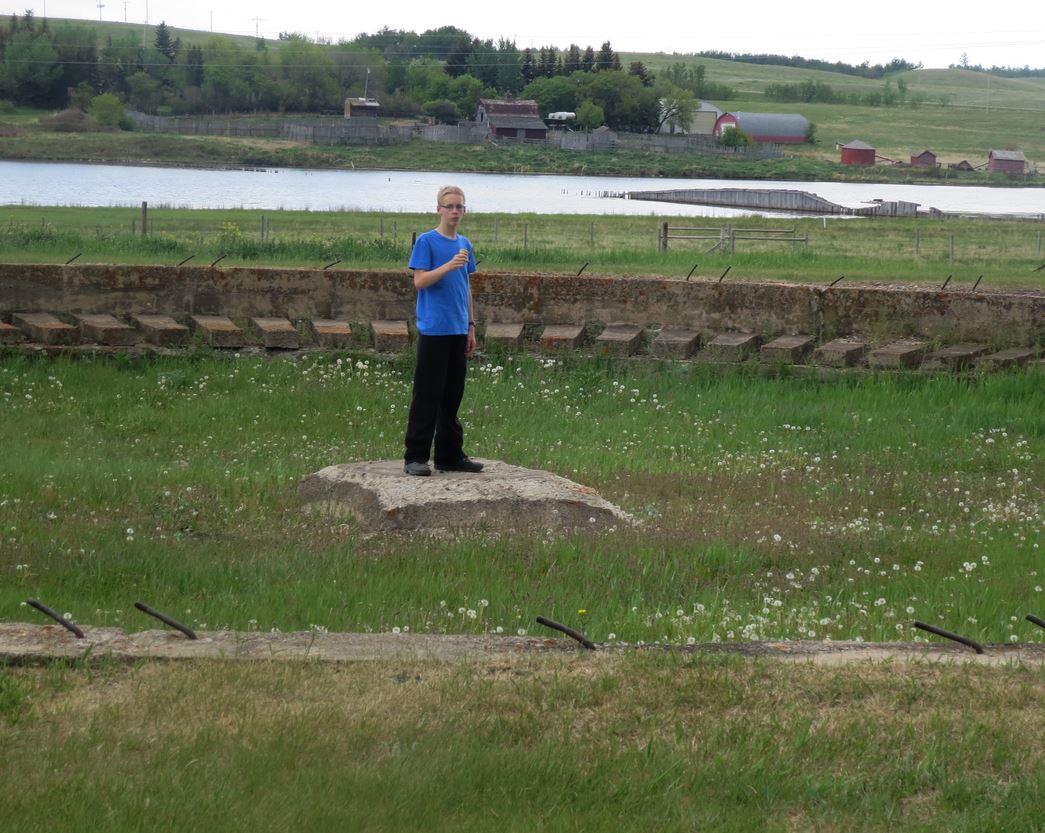
I don’t want to paint the town with the same brush I used on my Creation Science essay. Rural Alberta is more than funky anti-science museums. For example, long before there was the museum, there was the train. The town of Big Valley is a terminal for a steam engine and its passenger cars. They will take you across prairie hills and vales and return you a few hours later. I didn’t ride the train, but instead I hobbled around an archeological ruins of sorts. Big Valley once housed a large commercial train hub with roundhouse and repair shops for grain, coal, and passenger trains. The remains – acres of concrete slabs and the walls of warehouses – are a delight to see. My sons and I spent more time among the roundhouse ruins that inside the Creation Science Museum, and we’re not even rail buffs.
Big Valley Roundhouse
There’s a boardwalk along Big Valley’s main drag. It’s got gift shops which we didn’t try out and a fine ice creamery, which we did sample from. Most people likely miss the fact that the Jimmie Jock Boardwalk was built in memory of the owner of the town’s Chinese restaurant. Like many (if not most) small towns on Canada’s western prairies, Big Valley was home to a Chinese family that ran the town’s main diner for a few generations. These places – and their Asian restaurateur – have mostly disappeared now, but I remember enjoying Chinese food and hospitality during the 1970s and 1980s when I was young and Canada’s small towns were new to me.
The other major cultural site in Big Valley, Alberta, is the blue church on the hill. The Anglican church was built in 1916 with a gift of $500 from Caroline Leffler who raised the funds by making selling children’s clothing. Ms Leffler probably never saw the church. She lived in England but sent her gift to Calgary, which was then on the Empire’s frontier. She suggested that the local diocese select any needy town to build a church. Big Valley wasn’t especially needy – it had prosperous ranches and a huge coal and rail business, but it was booming, lacked an Anglican church, and was perhaps more seedy than needy.
Big Valley was cattle, then farming, then coal, then oil and gas. Coal fueled the rails and energized Canada’s west. By the time the easy coal had been dug and depleted, oil was discovered. In 1949, seismic records suggested a nice anomaly 6 kilometres south of Big Valley. In September 1950, Big Valley No. 7 discovery well was completed. It produced 350,000 barrels of oil and led to a field that produced 321 million more – plus 85 billion cubic feet of gas. Now, 65 years later, the oil is waning and most of the pump jacks are idle. The area has returned to its agrarian roots.
However, oil is having an unexpected renaissance in the Big Valley area. An oilseed plant called canola (bred from rapus, or rapeseed) covers the region like a yellow carpet. Canola grows on 20 million acres of western Canadian cropland and yields three barrels of oil from each acre. That’s 60 million barrels of farmed oil each year. Meanwhile, conventional oil production in western Canada has fallen to around 250 million barrels. Most canola is used for cooking, but it’s also an ingredient in biofuel production. In the future, the volume of oil grown on farms will exceed the oil lifted by nodding donkey heads from under the farms around Big Valley.
Oh, I almost forgot. Those rocks that made all the oil in the last century? They are buried 1660 metres (about one mile) inside the Western Canadian Sedimentary Basin. The shale that generated the hydrocarbons was deposited over several million years in a warm tropical sea when plate tectonics positioned Big Valley close to the equator. Later, with millions more years of heat and pressure, the oils migrated into reservoir rocks – porous limestone created during millions of years of reef growth in equatorial sea water. All of this happened during the late Devonian, about 400 million years ago. But for a simpler explanation, drop by the Creation Science Museum for their take on the formation of oil deposits.
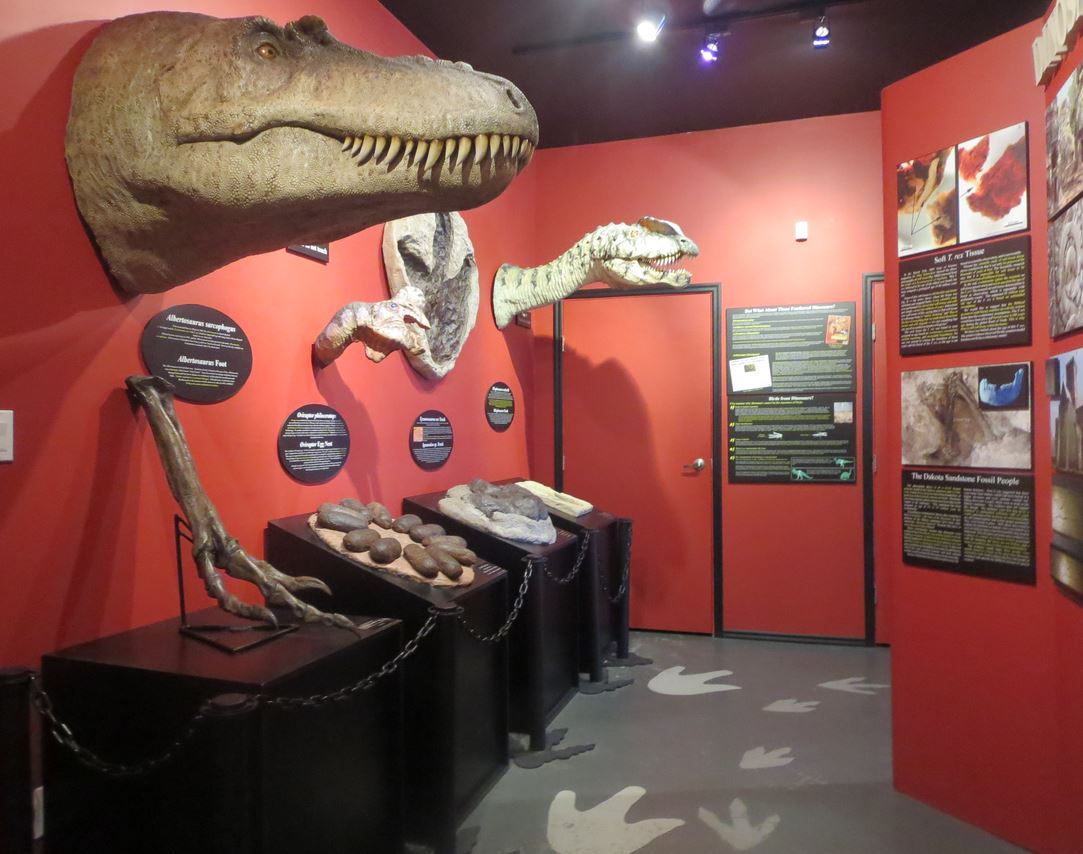
If you ever wanted to visit a museum unencumbered by crowds and undistracted by children’s laughter, come to the Canadian Creation Science Museum in Big Valley, Alberta, Canada. It’s as quiet as a tomb. I thoroughly enjoyed the solitude and highly recommend the museum as a place where you can take your time, take lots of pictures (I asked permission and was told, “Of course!”), and you may appreciate the gallant efforts that twist pseudo-scientific curios into biblical proofs.
The town of Big Valley is lovely. I liked it a lot. In a day or two, I’ll write about this small rural Canadian community with its steam passenger train and archeological ruins. But today, I’m focusing on the town’s unfortunate Creation Science Museum. Unfortunate for the town, that is.
When my two sons and I entered, we paid $13 to look around. I didn’t ask for the Family Discount, which the museum’s website says is for “A Father, Mother, and children” and obviously not for miscreant family arrangements. We gave our money to the nice lady at the cash register by the door.
Obviously bored, the nice lady was quick to run to us whenever we had questions. My first question regarded the first thing I saw as we entered. It was a genealogy chart that stretched from the ceiling almost to the floor.
“What on Earth does that have to do with Creationism?” The nice lady wasn’t sure. The chart mapped the direct descendants of Adam (Eve, too, I guess – though she wasn’t mentioned). Did you know that about 1,500 years after Adam, Noah was born? Did you know that Noah is the direct linear ancestor of all the English kings and Prince Charles? Well, that should surprise none of the Anglo-Saxon fans of the museum, but the guide in the museum was shocked when I told her that Osama bin Laden would also be a direct linear descendant of Noah. I suggested that she think about it for a moment. Then she remembered the story of how all the people except Noah and his kids were killed by the angry god in the flood. In her world, British kings have to be Noah’s spawn, as is everyone – they have no other choice.
According to the Flood narrative, in the past 4,350 years, 7 billion of us descended from Noah and his wife Gertrude (or whatever). “But you have English ancestry, don’t you?” she asked me. “No, I do not,” I said. Somehow race and English ancestry are tangled up in this Creation Science Museum. Then I saw the book with Hitler on the cover. (To be fair, Hitler was just selling a book that equated Darwin to Nazis. They weren’t openly selling Mein Kampf.)
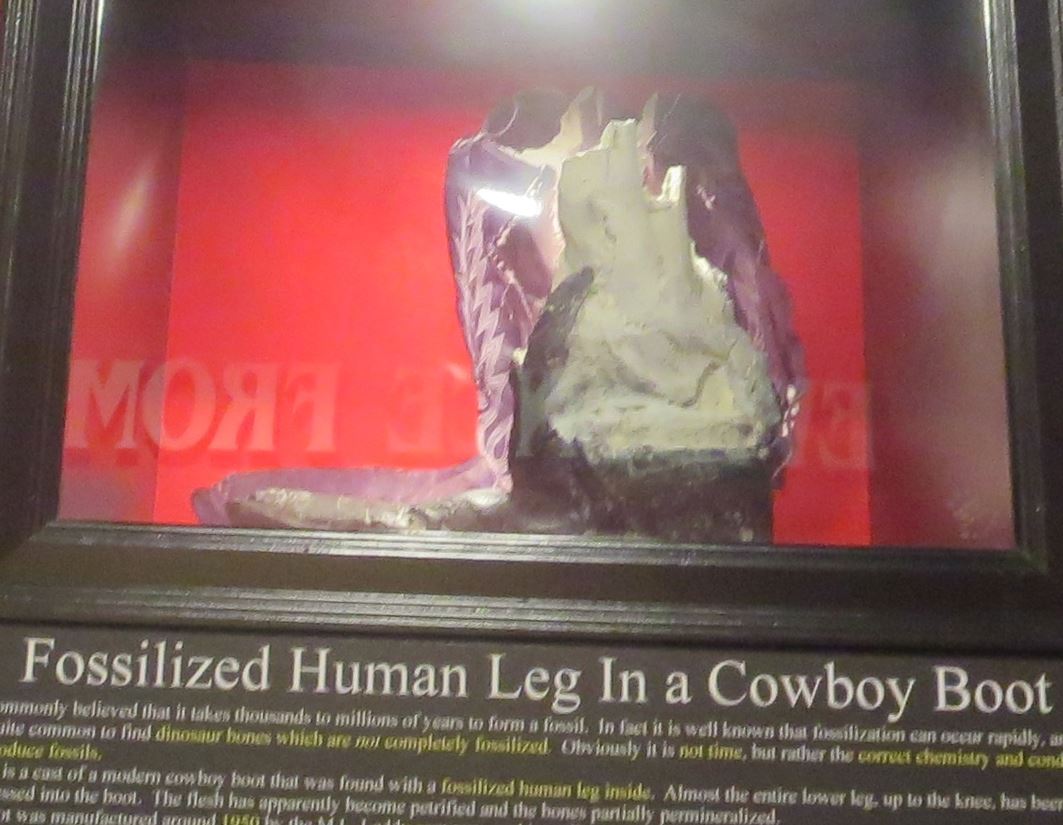
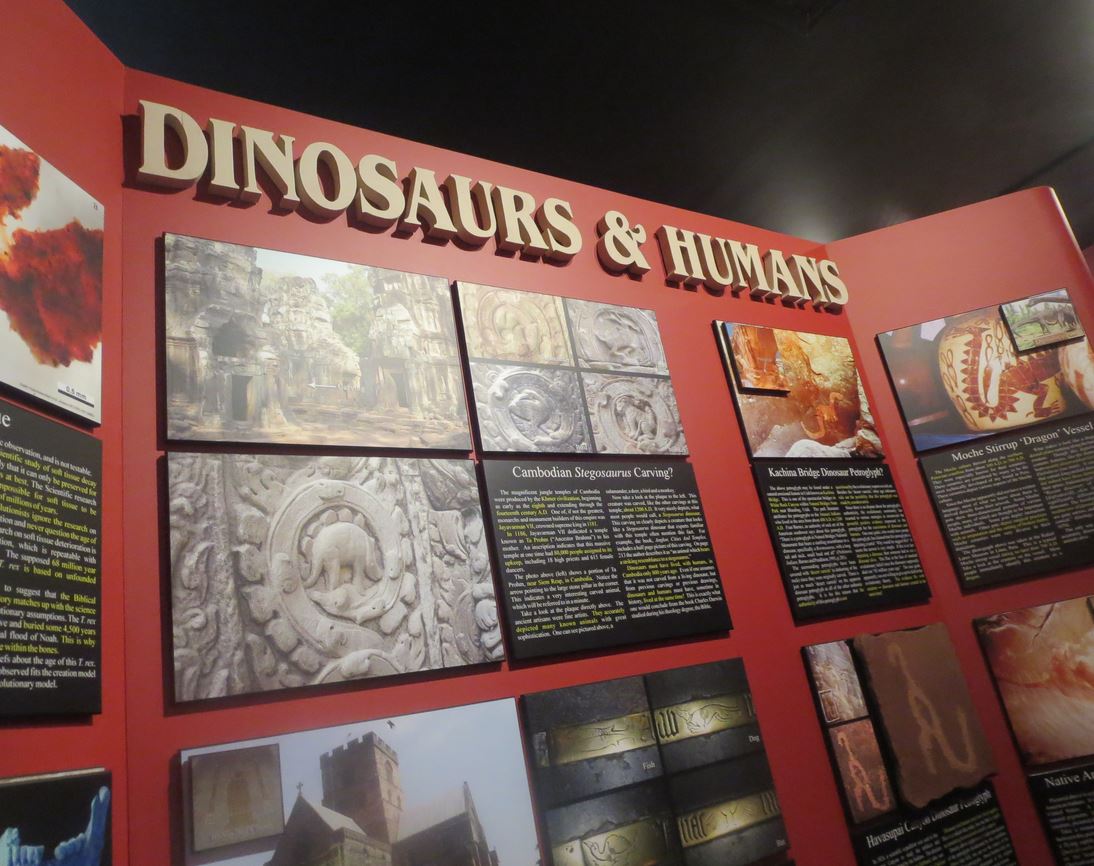
I should have left, but I’d already spent $13. And there were another 15 minutes of displays to take in. There was evidence of creationism everywhere. Signs proclaimed Evidence from Fossils; Evidence from Geology; Evidence from Plants; DNA by Design; and, there were lovely photographs of Dinosaurs and Humans being cozy pals. We saw the Fossilized Teddy Bear, the Iron Pot Found in Coal, and, of course, the human leg fossilized in a cowboy boot. By the time we’d reached the proof that horses didn’t grow in size and “peppered moths” didn’t change colour, we had traveled about 30 metres in a loop that brought us back to the cash register.
Was that too fast for you? Then let us go back about 10 metres and take another look at the fossilized leg in the cowboy boot. It’s just an old boot with a rock stuck in it, but here’s how it’s described:
“It is commonly believed that it takes thousands to millions of years to form a fossil. In fact it is well known that fossilization can occur rapidly. [Wait a minute: one fact is “commonly believed” while its opposite is well known? How’s that work?] Above [behind the glass] is a cast of a modern cowboy boot that was found with a fossilized human leg inside… The flesh has apparently become petrified and the bones partially permineralized. The boot was manufactured around 1950 … and found in 1980. The leg was fossilized in less than 30 years!”
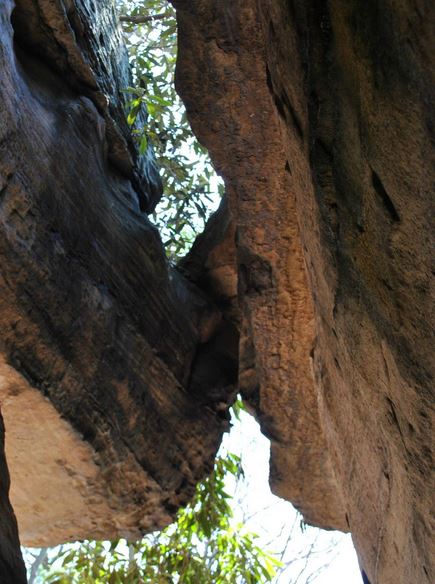
It’s just a rock in an old boot. There are two rocks at West Virginia’s Cooper’s Rock State Park which look like gigantic stone people kissing. Other rocks look like Bugs Bunny or fossilized legs in cowboy boots. Trust me, I’m a geophysicist. Rocks can take a lot of fascinating shapes.
The boot, manufactured by the M.L. Leddy Company, was found in Iraan, Texas, which abounds in light-coloured rocks. Mud may have leeched into the boot and hardened. Or maybe someone stuck the stone in the boot and sold it to the Creation Science Museum. We may never know.
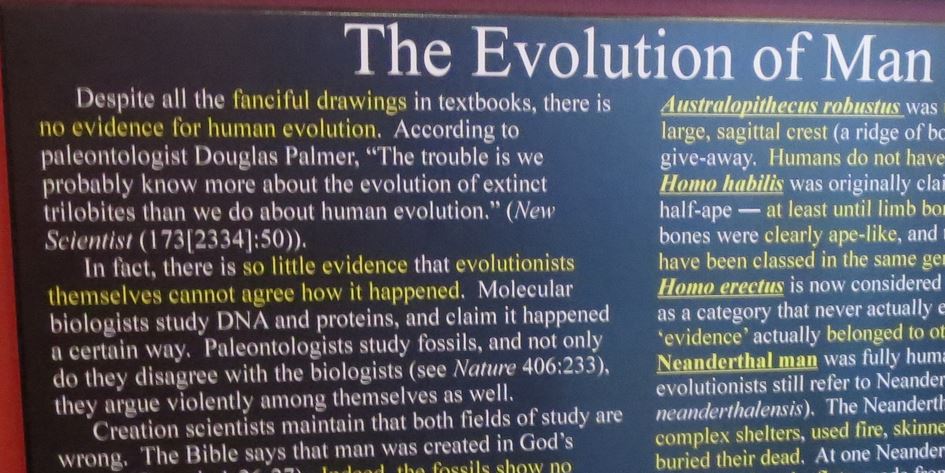
On one poster near the exit, we are told that in matters of science, biologists and paleontologists “argue violently among themselves.” Violently? Really? – in the fashion of Irish Catholics and Protestants or perhaps Malaysian Buddhists and Muslims? Or maybe the biologists find heretical paleontologists guilty of witchery and burn them? I’ll be charitable and assume that the poster meant to say that scientists argue vigorously, not violently, and the poster was mistaken about this and nearly everything else printed on it.
Another recurring anti-science theme printed on the museum displays is the statement that scientists are constantly changing their minds about things, and that’s considered a bad thing by the Creation Science Museum curators. They imply that since science is dynamic, whatever we think today must be wrong. On the other hand, the Bible is set in King James’ English, unchanging, and therefore obviously true. Science is dismissed as faulty because it hasn’t come to final answers about everything. This lies at the troubled heart of many Creationists. Rather than thinking, reasoning, and evaluating, it’s much easier to believe that 3,000-year-old pronouncements made by a nomadic desert tribe are true. And then populate a one-room museum with dubious or fraudulent supporting curios.
Noah’s Ark on Mount Ararat, by Simon de Myle, 1570
Ken Ham’s latest monument to his beliefs has opened in Kentucky. The Ark Encounter is about an hour from his Creation Museum. Both are operated by Answers in Genesis, which is operated by the Australian immigrant. They both seek to cash in on a small subgroup’s faith in the early 17th-century translation of a 1,700-year-old collection of tales inscribed from 3,000-year-old legends recited for generations by a nomadic desert tribe. These tales explain cosmology and the origin of the universe. Got a modern scientific query? Look for the Answers in Genesis. Is King James too ponderous to read? Come see the Creation Museum where dinosaurs and humans frolic in dioramas – or take a thrill ride beside the freshly painted 510-foot Ark of Noah at the Ark Encounter.
Or come to the Canadian Creation Science Museum in Big Valley, Alberta, Canada (as I did!). There you can wonder about and wander among the assorted relics that prove evolution never happened. Marvel at the huge genealogy tree that shows all 6,000 years of human history – from Adam’s creation to his direct descendants – King James and Prince Charles! Gaze at the fossilized leg in a cowboy boot and the iron pot discovered in coal. See books with Hitler on the cover. Marvel at DNA models. It’s all there – and not much more – at the Creation Science Museum.
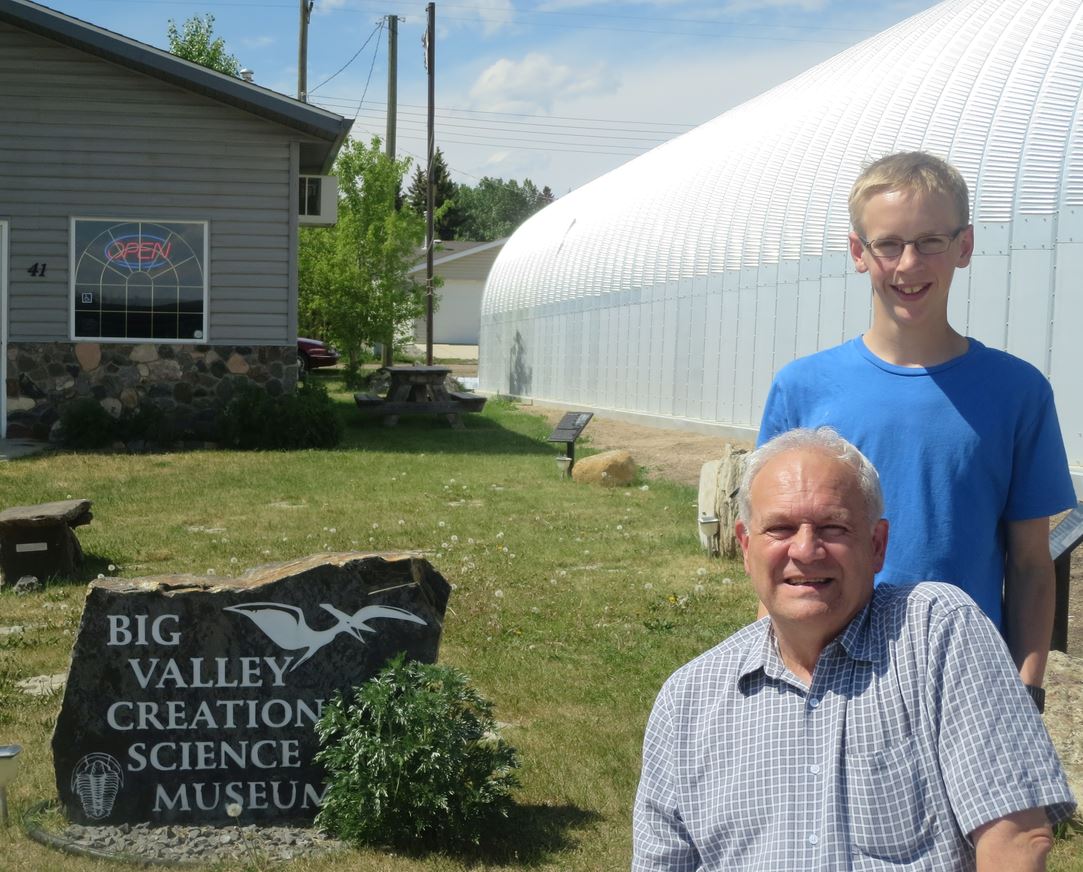
Big Valley Creation Science Museum Entrance (photo: Miksha) The museum is in the little house to the left, not the quonset behind us.
Admission is just $5. (I think Ham charges more.) Only $3 per kid. And there’s a special family discount – available to families that the museum’s website describe as “A Father, Mother and children”. No pesky gay couples with kids shall be given the family discount at Big Valley’s wonder-filled Creation Science Museum. The discrimination isn’t legal, but it certainly reflects the above-the-law sentiments of these faith-driven sorts.
Before you head off to the Creation Science Museum, you may want to take a look at Trip Advisor. Only 7 reviews, but they are dandy. Two reviewers gave the place top marks – they write in glowing terms about the depth of science presented. The other five reviewers graded the place as “Terrible”, the lowest mark possible. There are no in-between scores. If you aren’t visiting the tiny museum seeking validation for the stories you heard as a child, if your common sense and critical evaluation skills have matured, then you’ll see the museum as a one-room curio shop of dubious merit designed to shimmy up a crumbling shanty of religiosity. Here are some of Trip Advisor’s warnings:
This is basically a small room full of nonsense… “behold, these dinosaur track fossils all go in the same direction so they MUST have been running away from a global flood, right?”
Unfortunately, this is a curio shop of archaic biblical nonsense. Visit only if you are interested in seeing how those who refuse to educate themselves on true science operate.
It’s basically a shack full of crazy proofs for creationism.
I am sorry they put this [museum] here – does not reflect how good the rest of the town is. What a bunch of nonsense.
Creation Museum’s competition
The Canadian province of Alberta is rich in fossils. We have 45 major dinosaur groups (including Ankylosaurus, Stegoceras, Triceratops, Ichthyosaurus, and various close relatives of the T-rex), mostly unearthed in Mesozoic-age rocks exposed in Alberta’s badlands. A world-class research station at Dinosaur Provincial Park and a major showcase museum at Drumheller draw millions of visitors. Undoubtedly, the people who built the Creation Science Museum in nearby Big Valley expected thousands of truth-seeking guests, folks looking for the non-mainstream-science explanation for dinosaur fossils. I’ll bet that they thought their tiny one-room museum would soon occupy a quonset or two to hold the capacity crowds. The day I showed up with my two sons, we were the only customers for the day.
It was a pathetic little museum. I imagine that there were high hopes at the planning stage. Western Canada has ten million souls. If just one-percent would visit every year, the place would quickly expand. The instigators likely believed that people visiting the Royal Tyrrell Museum of Palaeontology, just a few dozen kilometres down the road, would feel compelled to get the facts about evolution right. If one in a hundred cars headed north from the devil’s museum to the one built upon the Bible, this would be a success. But alas, the lonely woman taking our money at the door had hosted only us – just three people the entire Saturday that we visited. When we left, she put our $13 in the till and locked the door. Her day was over.
Meanwhile in Kentucky, Ken Ham’s new $100 milion Noah adventure opened with just 8,000 visitors. That will probably be their best day of the year. The Creation Museum had 450,000 guests the first year but is down to half the number now. Their daily take is about $25,000 – but they have a big property to maintain and 300 employees to pay. Part of Kentucky Ham’s problem relates to the quality of the museum and the fact that Creationists unfortunately correlate with poor education which correlates with poverty. Not many believers can afford over $100 (plus fuel, lodging, food) to visit the museum. It would go bankrupt and close, but Answers in Genesis is adapt at sucking taxpayers money out of the Kentucky government coffers. Fortunately for Canadians, the Alberta Creation Science Museum isn’t likely to receive tax breaks and subsidies. But its overhead is nearly zero, so it will limp along, like a cowpoke with a single fossilized leg in a boot.
Tomorrow I’ll write more about the museum and that fossilized cowboy boot. And we’ll enter the one-room curio cabinet and look around.
Come back tomorrow and see what else is on display!
I write a beekeeping and society blog called “Bad Beekeeping” and I posted this piece there a few weeks ago. I thought readers of Mountain Mystery might find it interesting.
Bees sense the environment differently than humans. For example, bees can see ultra-violet colour and distinguish it from violet and white, yet they see red as if it were black. They sense the orientation of polarized light. Their massive compound eyes give them an image made of hexagonal images, similar (but not quite) to the picture I made below, to the right. The honey bee’s eyes are good at sensing thin structures (like flowers on stems) and motion but, for a bee, a person pressed flat against a wall has disappeared from sight.
Bees see mosaic hexagons, similar (but not quite the same) to what’s shown here.
Bees taste with the tips of their antennae, sampling sweet, bitter, sour, and salt. They can taste salts better than humans can, but are less sensitive to the bitter flavour of coffee. Their antennae also give them a sense of touch which monitors bee…
The Earth’s plates move at the same blazing speed as fingernails grow. On average, 2 centimetres in a year. Blink and you won’t miss much. The ox may be slow, but the Earth is patient. In 650 million years, the Earth’s crust moved 13,000 kilometres. Planet-scale wrinkles, rifts, twists, collisions, and mountain ranges are possible with the vastness of time. But the only signs we might witness are some volcanoes and the occasional earthquake. We really can’t appreciate North America’s westward drift – the continent barely budges a meter or two in a lifetime.
To help us grasp the ungraspable, various analogies and visual tricks help us appreciate that plate tectonics happens. One of my favourites is an ever-widening space between some stakes in the ground at the Ontario Science Centre, where one of the leaders of tectonics theory (Tuzo Wilson) worked. One marker shows the continent’s location in 1908, when Wilson was born, the other – displaced a couple metres – shows us how much the marker has moved since then.
Without travelling to Toronto, here is another way to experience the reality of plate tectonics. This video gives us 3,300 million years of motion in 260 seconds. If we assume the rate of motion has always averaged 2 cm/year (not a likely assumption), then the various plates have meandered 66,000 kilometres. We’ll see that happen in about four minutes, with the crust racing around at almost a million kilometres an hour. So hang on:
Benalmadena, Costa del Sol, Spain, some 20 miles West of Malaga, and perhaps readers can enlighten me about what I’m seeing:
Rocks within rocks within rocks; red sandstone matrix (no stratification or bedding apparent), containing fragments of varied origin and degree of processing; some examples include fragments of chert-veined basalt. Note at far left, and also beneath scaling coin, pebbles of chert-containing cnglomerate.
How did any of this happen and in what kind of environment? The diversity of the pebbles in composition and processing suggests rapid river transport, but what process would leave so much sand between them? I haven’t seen an outcrop of this kind of rock, but there are chunks of it all along the coastline, and some examples (e.g. those to left and right in this picture) are far poorer in pebbles.
Rocks within rocks: chert vein within a very strange looking rock indeed; dark, micaceous, bands…
Many months ago, Ron Miksha was kind enough to send a copy of his book, The Mountain Mystery, to GG (Ron writes a blog under the book’s name). Although the book was mostly read long ago, other things kept getting in the way of condensing GG’s scattered thoughts. The quickest summary of this book might be to compare it to visiting caverns. While most visits are on nice paths that lead you in a very direct way to the highlights, often avoiding the original historical paths into the caves, Miksha’s book is more like a discovery tour, poking into every side chamber and crevice, sometimes revealing rarely visited gems and sometimes just getting all dirty for little payoff.
Most histories of plate tectonics tend to start with Wegener or even later, but The Mountain Mystery starts far earlier, invoking the ghosts of such lesser known men as Anaximander…
Geophysicist Tuzo Wilson had a creepy daydream. He imagined himself lying at the bottom of a creek, looking up at water flowing overhead. He blew bubbles. They rose, were caught by the current, and drifted away. He came back from his mini-nightmare with an idea about the way the Hawaiian islands formed. Bubbles of magma rose from deep within the Earth, broke through the crust, and drifted along because of plate tectonics.
The original Hawaiian settlers had a similar idea. They knew that the weathered northwest islands were much older than the new big island they called Hawaii. They believed that the fiery goddess Pele had successively emerged from the underworld, creating a series of volcanic islands over the ages.
Wilson was 55 at the time that his imagination discovered a way to explain the Hawaii island chain. His first attempt to publish “A Possible Origin of the Hawaiian Islands” failed when the scientists reviewing it at a leading American geophysical journal found the idea too radical. They rejected it. Tuzo scrambled to the Canadian Journal of Physics, which published his paper in 1963 – probably because they didn’t realize it was such a controversial subject, Tuzo figured.
Tuzo Wilson’s paper explained that the Hawaiian islands formed in a string because the Pacific tectonic plate slowly slid across a fixed hotspot while a plume of magma rose directly from deep below. This was an important idea because plate tectonics – new at the time – was struggling to explain anomalous volcanic activity occurring in places like Hawaii, thousands of kilometres from the rubbing and colliding spots where crustal plates met.
Some geophysicists don’t believe in plumes. They suggested that the material creating island paradises is sourced just below the lithosphere. The jury is out; however, most who have studied it for the past fifty years have cautiously agreed with Wilson’s original thesis. Similar streams of hot mantle rising in hot ribbons of rock possibly cause thermal events in Réunion, Yellowstone, Iceland, Galápagos, Tahiti and at least forty other places scattered about the globe. With his near-mystic vision, Tuzo Wilson invented a whole new way to understand what’s causing some of the Earth’s volcanic activity.
But not so fast. Ten years after Wilson, in 1972, the father and son geology team of Howard and Arthur Meyerhoff took an awkward stand against all forms of plate tectonics and against Tuzo Wilson’s plume theory. They generated vigorous pleas alerting fellow earth scientists to the pitfalls of those new ideas.
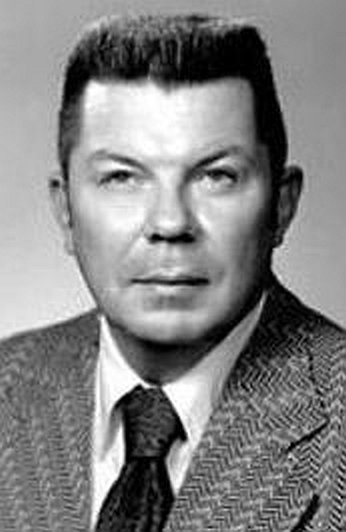
Arthur Meyerhoff (1928-1994)
The Meyerhoffs assembled obscure facts that disputed tectonic motion. They released reasonable commentaries voicing their opposition to the nascent theory. They were usually correct in pointing out weak and contradictory aspects of plate tectonics. They asserted their opposition was based on “geological fact, which nothing can change.” Almost invariably, however, a scientist who clutches facts that “nothing can change,” is proven wrong. The ‘facts’ often change due to new data, investigation, and confirmation. The Meyerhoffs protested mobile continents, but didn’t provide an alternative that explained earth history as convincingly as plumes and plate tectonics.
In time, the younger Meyerhoff, Arthur, realized that the role of naysayer wasn’t enough. He needed to add something positive to the discussion. In 1988, he proposed a creative alternative earth-model: an interconnected near-surface world-wide plumbing system that conveyed melted igneous rocks. This relatively shallow plumbing system, he suggested, was being misinterpreted as plate tectonics. He carefully explained it in his posthumously published 1996 book, Surge Tectonics, which became popular among followers of his surge theory. And, in fact, there has been some evidence to support the notion that sub-crustal flows supply the Hawaiian island chain. In 2011, Qin Cao and her team at M.I.T. seemed to have found a hot pool of magma in the shallow mantle that could be sourcing the growth of the Hawaiian islands – possibly in a non-plume-like manner.
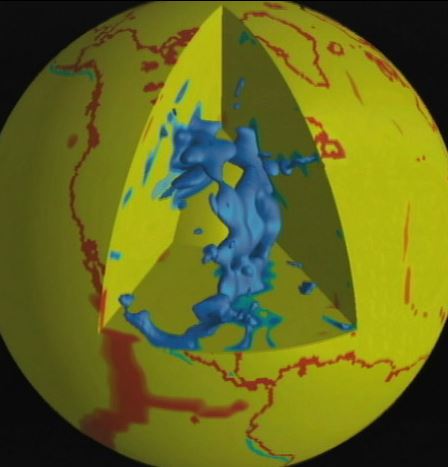
But plumes still has advocates. And more data has changed the idea yet again. Seismic tomography has helped by monitoring earthquake energy waves as they vibrate through the mantle. Receivers record arrivals of the earthquake signals at thousands of surface locations. Variations in those arrivals indicate waves have been influenced by variations in composition, phase, density, pressure, or temperature of mantle rock. Seismic waves travel more slowly through hotter rock. If those changes could be accurately mapped, shallow pipes and plumes might be spotted – if they exist.
Example of seismic tomography (Source: NASA)
Using seismic tomography, it should have been straight-forward to map pipes or channels or deep plumes surging with hot streams of mantle. But for over 50 years, we didn’t have an unequivocally clear rendering of a narrow, ribbon-like plume. The idea that hot spots exist became, to some scientists, a kind of belief system. Belief in an invisible God-like force that explained some otherwise inexplicable phenomenon of nature.
A newer technique – telescopic seismic tomography, a focused sort of tomography – recently emerged and has been enlisted in the search for plumes. Arrays of surface receivers collect billions of bits of earthquake data, collate them, and then invert the waves, mapping their probable travel paths. Yet this technique is painfully tedious and can be error-prone. The energy waves arrive steeply dipping; the Earth’s innards are far from uniform; and, a delayed arrival may be due to any combination of composition, density, pressure, phase and/or temperature differences along the seismic wave’s travel path. This underlies a fundamental problem with geophysics: almost any observation can be due to a variety of causes. Nearly every geophysics problem has multiple non-unique solutions.
Thus, for over fifty years, plumes eluded researchers. Until now, perhaps. With repeated studies and massive data-crunching, wide plumes of low velocity mantle material have finally been discerned. Last fall an important paper was released. It makes the strong and well-supported claim that plumes are real, putting plume atheists on the spot.
Barbara Romanowicz and Scott French published their findings in Nature in September. Broad Plumes Rooted At The Base Of The Earth’s Mantle Beneath Major Hotspots resulted from analysis of whole-mantle earthquake tomographic seismic data. Romanowicz’s group used full-waveform seismic computation in a process that analyzed energy waves from 273 large earthquakes and took 3 million hours of computation on a supercomputer. The data indicate that plumes are real, but are much wider than the innocent trail of creek bubbles envisioned long ago by Tuzo Wilson. From the Naturepaper’s abstract:
“We describe the use of a whole-mantle seismic imaging technique— combining accurate wavefield computations with information contained in whole seismic waveforms—that reveals the presence of broad (not thin), quasi-vertical conduits beneath many prominent hotspots. These conduits extend from the core–mantle boundary to about 1,000 kilometres below Earth’s surface, where some are deflected horizontally, as though entrained into more vigorous upper-mantle circulation. At the base of the mantle, these conduits are rooted in patches of greatly reduced shear velocity that, in the case of Hawaii, Iceland and Samoa, correspond to the locations of known large ultralow-velocity zones. This correspondence clearly establishes a continuous connection between such zones and mantle plumes. We also show that the imaged conduits are robustly broader than classical thermal plume tails, suggesting that they are long-lived, and may have a thermochemical origin.”
Are we done? Probably not. This was the state of the art in September, 2015. The conclusion is that plumes are real, are much broader than hypothesized earlier, they originate at the mantle-core boundary, rise almost vertically, and (closer to surface) get distorted by the same horizontal convection currents that drive plate tectonics. It’s our best description of plumes to date, arriving at the surface 50 years after Tuzo Wilson’s first puff of air from his eerie creek bottom.
Not long ago, a reader of this blog commented on my story about Alfred Wegener and continental drift. Wegener’s theory, you know, kicked around for about 50 years before enough evidence accumulated to prove its sister theory, plate tectonics. The reader asked if I am “no fan of the Neal Adams’ Expanding Earth videos, then?” No, I’m not a fan of the great cartoonist’s geofantasies. But Adams’ videos are popular. One has over two million views on YouTube. Not a bad take for a purely bonkers pseudo-science video called “Neal Adams – Science: 01 – Conspiracy: Earth is Growing!”
Neal Adams is a notable creative force in comics. He modernized the art and inspired a generation of cartoonists. He championed the creators of Superman (Jerry Siegel and Joe Shuster) and helped them received awards, recognition, and pensions. Neal Adams is a fine cartoonist. He changed the look and style of Batman, Superman, and Green Arrow. He has been called “the greatest comic book artist alive” – a statement that Adams himself unabashedly repeats on his own website. He is epic with pen and pad, but he is wrong about geology.
Adams’ video, Science: 01 – Conspiracy, begins with Richard Strauss’s Also Sprach Zarathustra which adds melodrama to his pseudo-science film. But instead of authenticity, the pretentious soundtrack made me laugh. Whenever you hear Strauss, you know that something of great importance is about to unfold. It’s like the alert siren used on public service announcements. In this case, it’s a call to don your tin hat and prepare to hear about yet another science conspiracy – this time, it’s geophysicists hiding the truth about the evolution of the Earth.
Well, it looks like the world’s greatest comic book illustrator has unmasked us geoscientists. For years, we’ve been gathering in dark parkades, exchanging stuffed envelopes of incriminating geophysical formulae. Our goal: to promote the idea of plate tectonics, thereby gaining mastery of the universe. A minute into his video, Adams tells us “There is a kind of conspiracy of science among certain scientists. They know, but are not telling you, that…” Well, you can watch the video for yourself to see what we know but are not telling you.
Mr Adams would like us to believe that the Earth is rapidly expanding. If you imagine a small balloon with (Hey, look!) a squirrel drawn on it, the eyes of the squirrel drift apart as you add more air. The Expanding Earth Theorists believe the same is happening to our planet, except eyeballs become continents and mystery substances replace air. Our planet Earth fattens because . . . darn, I didn’t give Mr Adams $5 for his PDF, so I don’t know how to finish this sentence. (But you may go to his website and buy the $5 answer for yourself.)
Drop into Neal Adam’s alternate reality website, nealadams.com, and you’ll be treated to the opportunity to buy his PDF as well as a couple dozen videos explaining his version of the Expanding Earth Theory. Before you do, though, you might want to become familiar with past iterations of the theory. You see, the idea of an expanding Earth has been around since the time of Sir Francis Bacon who (over 400 years ago) wrote that the Earth looks like an expanding flower blossom, as evidenced by the way the African and South American continents have apparently parted.
Heezen and Tharp’s Rift Map, 1957.
In 1909, professional musician Roberto Mantovani wrote a popular science piece about the Earth expanding. More recently, a series of scientists put their voices to the idea. In the 1950s, Bruce Heezen (who inadvertently helped prove plate tectonics), co-discovered the great mid-ocean rift. He felt that the rift proved that the Earth was breaking and cracking as it expanded. His partner in science, Marie Tharp, believed they had found the source of continental motion and the cradle of oceanic crust. New crust formed at oceanic rifts, pushed the continents apart, then merged into the mantle at subduction zones. She was right; Heezen was wrong.
Another bright geologist/geophysicist who promoted expansion theory was the Australian Warren Carey. Carey adopted the hypothesis of planetary inflation early in his career and advocated it with congenial vigour. Well liked, correct about many things, but rejecting plate tectonics, he clung to expansion as the explanation for the odd way that fossils and rock formations are distributed around the world. Late in his life, he continued to attend conferences and held court with a dwindling number of like-minded expansionists. Warren Carey, like Neal Adams, fell into the trap of promoting expansion while rejecting plate tectonics. It is not necessarily an either/or situation. Perhaps both drift and expansion are true.
Is our planet expanding? Maybe. A Hungarian geophysicist, László Egyed, calculated that due to internal chemistry, the Earth’s radius increases by a millimetre, or less, each year. That’s imperceptible within the lifetime of a human, who may live on a planet that grows only a single hand’s width in a hundred years.
Model of layered Earth: cooling may result in boundary phase changes.
The cause of expansion, said Egyed, is a change in the materials at the hot boundaries between the inner core, the outer core, and the mantle. Expansion, by his theory, occurs along those adjacent zones. At each phase change, the Earth’s inner stuff becomes less dense. It expands. Egyed seems correct about those phase changes. They may really be happening, with inner core morphing into outer core, and outer core into mantle. If so, the planet might expand a millimetre a year.
If Egyed is right, our planet’s rotation must slow so that angular momentum is conserved. The Hungarian geophysicist proposed a geomagnetic test, but the results are not yet clear. So far, geophysicists aren’t sure that our planet has expanded as Egyed suggested, but there is no conspiracy rejecting the idea. Instead, it’s examined and studied – as are any credible scientific theories.
But expansion without plate tectonics can’t explain what we see on the Earth’s surface. For example, only plate tectonics accounts for the fact that the oldest seafloor is 180 million years old. Older ocean crust has subducted into the mantle. To account for the young age of ocean crust, expansionists say expansion just started 180 million years ago. Most expansionists think the planet has doubled in size within this brief window. Neal Adams rejects subduction, but he’s wrong. There is no doubt that heavy ocean crust is pulled under lighter continental crust at subduction zones. Geophysical data from three lines of evidence (gravity, GPS, and seismic) overwhelmingly prove subduction.
What about Neal Adams’ idea that scientists conspire against him? It is hard to seriously study Adams (or anyone else) when part of their argument is that a group of us is quietly withholding secret knowledge about the way the world really works. Real science is quite the opposite. Scientists relish the idea of discovering that a theory is wrong. During the 1960s 70s, and 80s, hundreds tried to disprove plate tectonics. There is no better way to make one’s name than to revolutionize a field. But you’d better have the data to prove your idea.
Neal Adams, in an interview that you can hear at this link, says continents have not twisted and turned, Pangaea never existed (“Everything about the Pangea theory is wrong scientifically. Everything is wrong.”), the Earth has more than doubled in size, mountains didn’t exist until 80 million years ago, subduction is physically impossible, and plate tectonics is wrong. On all of this, Mr Adams is mistaken. Sadly, in the interview, you will hear him give the wrong ages of oceans and mountains, incorrectly explain the evolution of fish, and show a total lack of knowledge about sea salinity and salt domes. Neal Adams’ breadth of misinformation is impressive. So is the fact that over two million people have watched his science video.
We have empirical data – facts, not speculation – confirming continental mobility. These data come from real-time GPS measurements of the crust. Discrete plates twist and turn along paths that confirm plate tectonics and reject the simplified expansion model used by Adams. That does not mean that some expansion is impossible.
But the overwhelming data says that Neal Adam’s theory is incorrigibly false. As Batman and Robin said, “Boom! Bash! Bang!” – continents collide tectonically, crust subducts, and the cartoonist is wrong.









 Bees see mosaic hexagons, similar (but not quite the same) to what’s shown here.





 The Mountain Mystery